
Nearly 85 percent of american consumers own devices that support wireless charging today, marking a fast shift away from traditional power cords. This rising adoption reflects a growing demand for more convenient and flexible charging experiences across homes, workplaces, and even vehicles. Understanding the technologies behind wireless power is key for anyone who wants to keep up with the latest innovations and make informed choices in a market that keeps evolving.
Table of Contents
- Defining Wireless Charging Technologies
- Major Types of Wireless Charging Systems
- How Wireless Charging Actually Works
- Emerging Trends And Innovations Ahead
- Challenges, Safety, And Regulatory Issues
- Comparing Wireless And Wired Charging Solutions
Key Takeaways
| Point | Details |
|---|---|
| Wireless Charging Technologies | Wireless charging offers innovative energy transfer methods, including inductive, resonant, and capacitive charging, enhancing convenience across various industries. |
| Emerging Innovations | Future developments are focused on improving efficiency, reducing energy loss, and facilitating power delivery through integrated charging networks and adaptive systems. |
| Challenges and Safety Concerns | Key challenges include power transfer efficiency and coil alignment, alongside regulatory considerations to ensure safety and consumer protection. |
| Comparison with Wired Charging | While wired charging tends to be more efficient, wireless charging excels in user convenience, and both technologies are evolving towards better efficiency and performance. |
Defining Wireless Charging Technologies
Wireless charging technologies represent a transformative approach to power transmission that eliminates traditional wired connections. Wireless charging enables electrical energy transfer between a power source and a receiving device through electromagnetic fields, creating seamless and convenient power solutions across multiple industries.
According to research from arxiv.org, wireless power transfer encompasses several sophisticated methodologies, including:
- Inductive coupling: Uses magnetic fields to transmit energy between closely positioned devices
- Resonant inductive coupling: Allows power transfer across slightly greater distances with improved efficiency
- Radio frequency techniques: Enables power transmission using electromagnetic radio waves
The drpress.org research highlights that inductive wireless charging represents a particularly promising technology, especially in electric vehicle applications. This method involves two primary components: a transmitter coil that generates an oscillating magnetic field and a receiver coil that captures and converts this energy into electrical power.
Key technological innovations have dramatically expanded wireless charging capabilities. Modern systems now support faster charging speeds, greater transmission distances, and compatibility across multiple device types. From smartphones and wearables to industrial equipment and electric vehicles, wireless charging technologies continue to evolve, promising increasingly sophisticated and seamless power delivery solutions for consumers and businesses alike.

Major Types of Wireless Charging Systems
Wireless charging systems represent a diverse technological landscape with multiple sophisticated approaches to power transmission. These systems are fundamentally distinguished by their unique energy transfer mechanisms, each offering distinct advantages and operational characteristics across various applications.
According to research from deanfrancispress.com, wireless charging can be categorized into three primary methodological approaches:
- Inductive Charging: Transfers energy through closely positioned electromagnetic fields
- Resonant Charging: Enables power transmission across slightly extended distances
- Capacitive Charging: Utilizes electrical field interactions for energy transfer
The drpress.org research provides deeper insights into electromagnetic induction and magnetic resonance technologies. These systems differ significantly in their operational principles, with electromagnetic induction requiring extremely close proximity between transmitter and receiver, while magnetic resonance allows for more flexible positioning and greater transmission distances.
Each wireless charging system presents unique performance characteristics. Inductive systems excel in short-range, high-efficiency scenarios like smartphone charging, while resonant technologies prove more adaptable for electric vehicle charging and larger-scale power transfer applications. As technology advances, these systems continue to evolve, promising increasingly sophisticated and efficient wireless power delivery solutions across consumer, industrial, and automotive sectors.
How Wireless Charging Actually Works
Wireless charging represents a sophisticated process of transferring electrical energy without physical contact between power source and device. Electromagnetic induction serves as the fundamental mechanism enabling this groundbreaking technology, allowing power transmission through seemingly empty space.
According to research from arxiv.org, wireless charging fundamentally operates through two critical components:
- Transmitter coil: Generates an alternating electromagnetic field
- Receiver coil: Captures and converts electromagnetic energy into electrical current
The drpress.org research provides deeper insights into the intricate process of inductive wireless charging. When an electrical current passes through the transmitter coil, it creates a magnetic field. The receiver coil, positioned within this magnetic field, experiences electromagnetic induction that generates a corresponding electrical current, effectively transferring power without direct physical connection.
The efficiency of wireless charging depends on several critical factors, including coil design, proximity between transmitter and receiver, and alignment of magnetic fields. Advanced systems now incorporate sophisticated resonance techniques that extend transmission distances and improve power transfer efficiency. As technology continues to evolve, wireless charging promises increasingly seamless and convenient power delivery across various electronic devices and industries.
Emerging Trends and Innovations Ahead
Wireless charging technology is rapidly evolving, promising transformative solutions that extend far beyond current capabilities. The future of power transmission is poised to revolutionize how we think about energy delivery across multiple industries and technological platforms.
According to research from arxiv.org, emerging wireless power transfer technologies are exploring groundbreaking approaches in communication networks and energy delivery:
- Long-distance microwave power transmission: Enables energy transfer across significantly greater distances
- Integrated communication and charging networks: Combines data transmission with simultaneous power delivery
- Smart adaptive charging systems: Dynamically optimize power transfer based on device requirements
The next generation of wireless charging technologies will likely focus on several key innovation areas. Researchers are developing techniques that dramatically increase transmission efficiency, reduce energy loss, and create more versatile charging environments. These advancements include multi-device charging platforms, environmental adaptive charging systems, and technologies that can seamlessly transfer power through multiple surfaces and materials.
Potential applications are expanding rapidly across automotive, medical, industrial, and consumer electronics sectors. Imagine electric vehicles charging while in motion, medical implants powered wirelessly, smart home environments with integrated power transmission, and entire urban infrastructures designed around wireless energy networks. As technological barriers continue to fall, wireless charging is transitioning from a convenient feature to a fundamental infrastructure technology that will reshape our understanding of power distribution and device connectivity.
Challenges, Safety, and Regulatory Issues
Wireless charging technologies face significant hurdles that demand comprehensive research and strategic solutions. Technological complexity and multifaceted safety concerns represent critical challenges preventing widespread adoption across various industries and consumer applications.
According to research from journals.iium.edu.my, dynamic wireless charging systems encounter several fundamental challenges:
- Power transfer efficiency: Maintaining consistent energy transmission across varying distances
- Coil misalignment: Managing performance disruptions when charging components are not precisely positioned
- Thermal management: Preventing excessive heat generation during power transfer
The arxiv.org research highlights critical regulatory and safety considerations that must be addressed. Electromagnetic radiation exposure, potential interference with medical devices, and establishing universal technical standards represent key obstacles. Regulatory bodies are increasingly focused on developing comprehensive guidelines to ensure consumer protection and technological standardization.
Safety protocols are evolving to address potential risks associated with wireless charging. Advanced systems now incorporate sophisticated mechanisms like foreign object detection, automatic power cutoff, and precise temperature monitoring. As the technology matures, interdisciplinary collaboration between engineers, medical professionals, and regulatory experts will be crucial in developing robust safety frameworks that protect users while enabling continued technological innovation.
Comparing Wireless and Wired Charging Solutions
Charging technologies represent a critical intersection of convenience, efficiency, and technological innovation. The ongoing debate between wireless and wired charging solutions continues to shape how we power our increasingly mobile and interconnected devices.
According to research from ijrpr.com, key comparative factors between wireless and wired charging include:
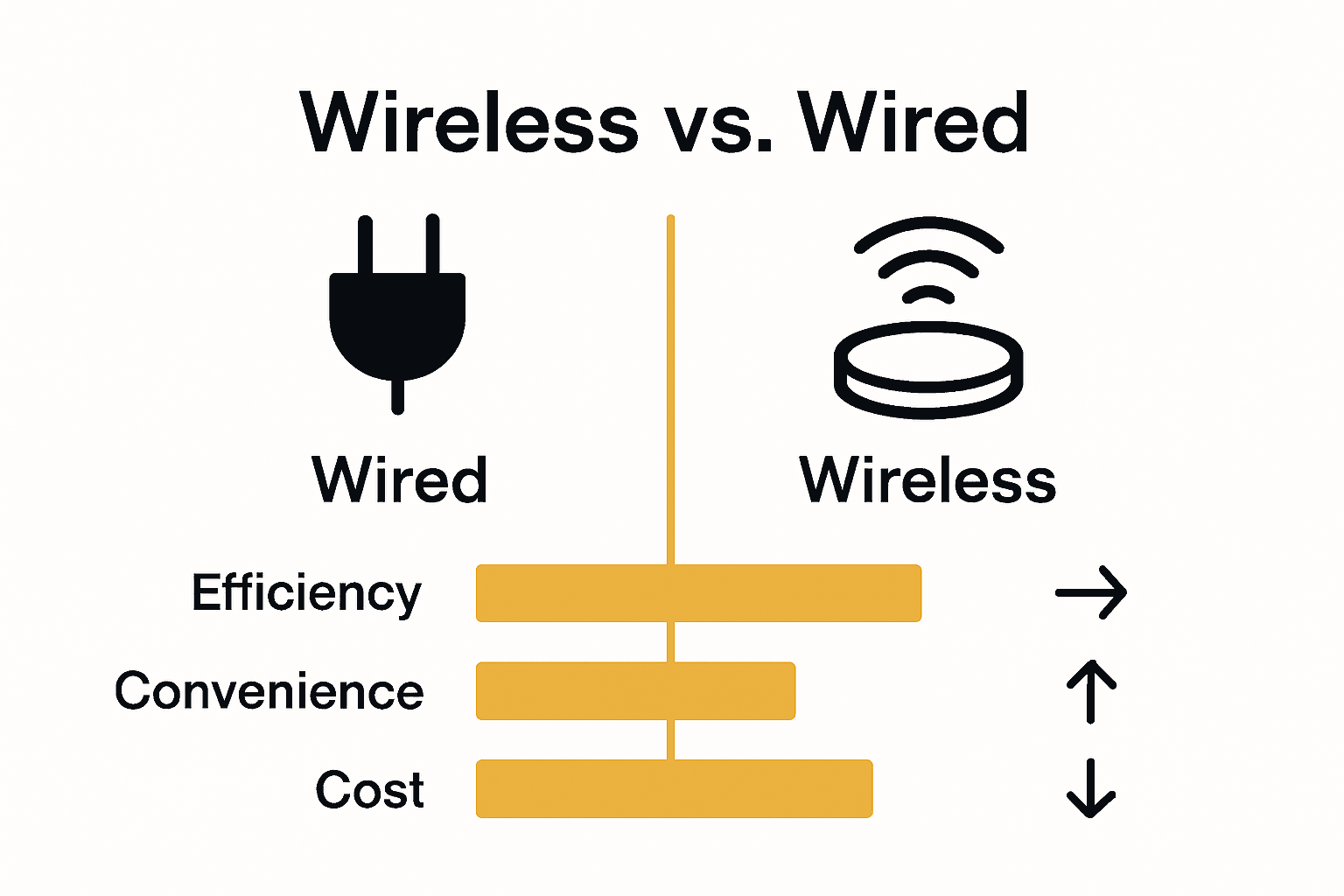
- Energy efficiency: Wired charging typically demonstrates higher power transfer rates
- Convenience: Wireless charging offers superior ease of use and device flexibility
- Infrastructure requirements: Wired systems demand more structured physical connections
- Cost considerations: Wireless technologies currently involve higher initial implementation expenses
The deanfrancispress.com research provides deeper insights into performance metrics across these technologies. Wired charging maintains advantages in direct power transmission and minimal energy loss, while wireless charging excels in user convenience and potential for integrated, seamless charging environments.
As technology evolves, the gap between wireless and wired charging continues to narrow. Future developments are likely to address current limitations, with emerging wireless technologies promising improved efficiency, faster charging speeds, and more robust power transfer mechanisms. The ultimate goal remains creating charging solutions that are simultaneously convenient, efficient, and universally adaptable across diverse technological platforms.
Experience Wireless Charging Innovation with Cutting-Edge Display Solutions
The future of wireless charging promises unmatched convenience and efficiency but also faces challenges like power transfer efficiency and device compatibility. As highlighted in the article, overcoming these issues requires intelligent technology and seamless integration. At ProjectorDisplay.com, we bring you the latest projectors equipped with wireless connectivity and smart features that align perfectly with these emerging trends. Whether you need a high-lumen laser projector or a portable smart projector, our products are designed to support your evolving tech needs without tangled cords or limited mobility.

Explore our extensive range of projectors and accessories to enjoy effortless wireless power and connectivity today. Don't wait as technology moves fast and so do the benefits of wireless power. Visit ProjectorDisplay.com to discover your perfect wireless-ready display solution and take a major step forward in both convenience and performance.
Frequently Asked Questions
What are the main types of wireless charging technologies?
Wireless charging technologies can be categorized into three primary types: inductive charging, resonant charging, and capacitive charging. Inductive charging uses closely positioned electromagnetic fields, resonant charging allows for power transfer across slightly greater distances, and capacitive charging utilizes electrical field interactions for energy transfer.
How does wireless charging work?
Wireless charging works by transferring electrical energy through electromagnetic induction. It involves two main components: a transmitter coil that generates an alternating electromagnetic field and a receiver coil that captures and converts that energy into electrical power. This allows devices to charge without a physical connection.
What are the advantages of wireless charging compared to wired charging?
Wireless charging offers superior convenience and flexibility, allowing users to charge devices without the need for physical connectors. However, wired charging typically demonstrates higher energy efficiency and faster charging speeds. The ongoing advancements in wireless technology aim to bridge this efficiency gap.
What challenges does wireless charging face?
Wireless charging technologies encounter several challenges including maintaining power transfer efficiency across varying distances, managing coil misalignment that can disrupt performance, and addressing thermal management to prevent excessive heat generation during power transfer. Additionally, there are regulatory and safety concerns regarding electromagnetic radiation exposure and interference with medical devices.
Recommended
- Wireless Screen Mirroring in Malaysia: 2025 Guide for Entertainment, Education, and Business – Projector Display
- Mirror Phone to Projector: Easy Ways for Malaysians 2025 – Projector Display
- Best Wireless Screen Mirroring Projector Guide 2025 – Projector Display
- Apa Itu Wireless Projektor? Panduan Lengkap 2025 untuk Pengguna Malaysia – Projector Display