
TL;DR:
- The projection screen material type is the key factor in achieving a crisp, vibrant, and contrast-rich image from your projector. Different materials such as matte white, gray, ALR, vinyl coatings, rear projection fabric, and acoustically transparent fabrics suit various room lighting and seating arrangements. Selecting the appropriate material based on room conditions and projector specifications ensures optimal image quality and viewing experience.
Projection screen material type is the single biggest variable determining whether your projector delivers a crisp, vibrant image or a washed-out disappointment. The right projector screen material governs brightness distribution, contrast ratio, viewing angle, and how well the screen handles ambient light. Whether you are setting up a home theater in Kuala Lumpur, equipping a classroom in Penang, or configuring a corporate AV room in Johor Bahru, understanding screen material properties is the foundation of every good projection decision.
1. Projection screen material types: the core categories
The projection screen industry recognizes six primary material categories, each engineered for a distinct optical purpose. Screen material choice drastically changes the same projector's image appearance because optical surface properties govern brightness distribution, color accuracy, and ambient light interaction. Knowing these categories upfront saves you from buying the wrong screen for your room.
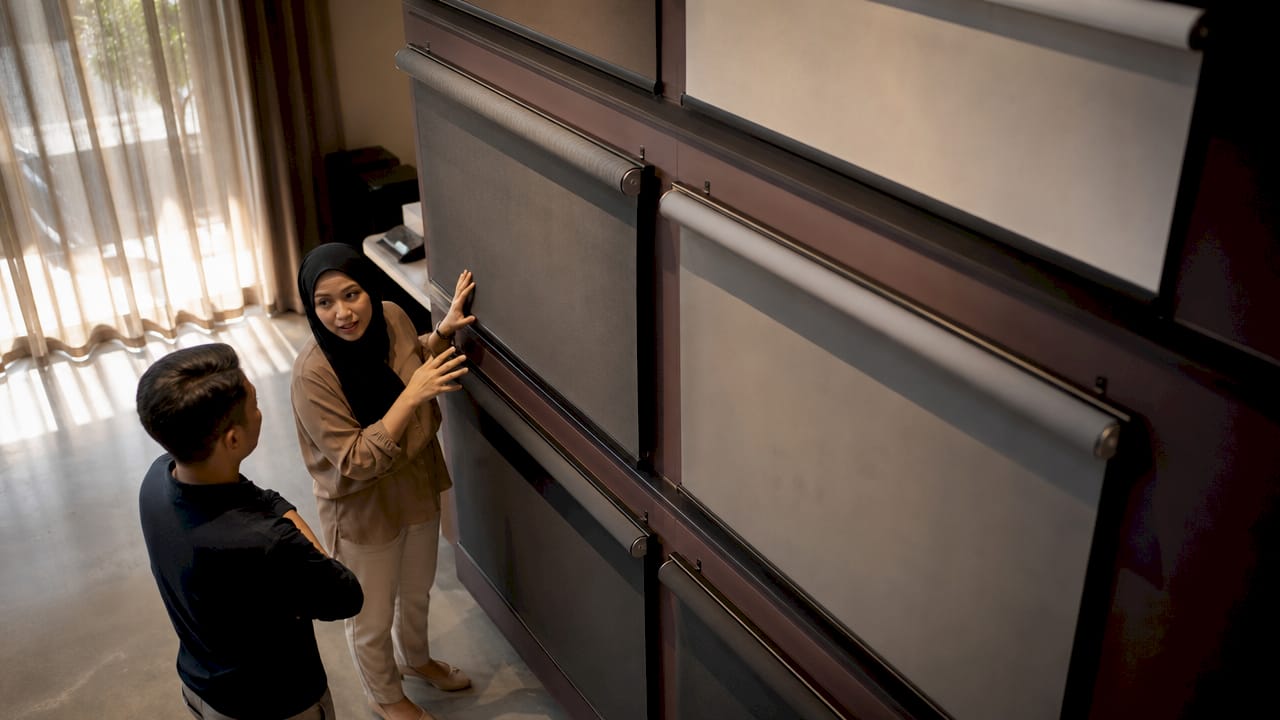
The six core types are matte white, gray screen fabric, ambient light rejecting (ALR) material, vinyl-based coated textile, rear projection fabric, and acoustically transparent fabric. Each type suits a different combination of room brightness, seating layout, projector brightness, and audio integration needs.
2. Matte white fabric
Matte white is the baseline standard for projection screen materials. It carries a gain of exactly 1.0, meaning it reflects light evenly without amplifying or reducing brightness relative to a reference white surface. This neutral behavior produces accurate color reproduction and a wide viewing angle, typically 160 degrees or more, making it the default choice for dark or light-controlled rooms.
Malaysian home theater setups with blackout curtains and Epson projector Malaysia units in the 3,000 to 4,000 lumen range pair naturally with matte white screens. The material forgives minor projector alignment errors and works with virtually every projector brand available from Projectordisplay, including BenQ projector Malaysia, Optoma projector Malaysia, and Viewsonic projector Malaysia models.
Pro Tip: Matte white screens show dust and fingerprints easily. In high-traffic Malaysian classrooms, choose a matte white material with an anti-static coating to reduce maintenance frequency.
3. Gray screen fabric
Gray screen fabric absorbs more ambient light than matte white, which raises perceived contrast without requiring a darker room. The trade-off is a slight reduction in peak brightness, but in rooms with moderate ambient light, such as Malaysian conference rooms with partially open blinds, the contrast gain outweighs the brightness loss.
Gray materials typically carry a gain between 0.8 and 1.1. The darker the gray, the better the black levels, but the more lumens your projector needs to compensate. Pairing a gray screen with an Epson LCD projector rated above 4,000 lumens produces noticeably richer images in semi-lit boardrooms than matte white would under the same conditions.
4. Ambient light rejecting (ALR) material
ALR materials are the most technically advanced projection screen options available today. ALR materials use surface coatings or layered micro-structures to redirect or absorb ambient light, especially in bright rooms. The result is a high-contrast image even when ceiling lights are on, which is a critical advantage in Malaysian open-plan offices and modern classrooms that cannot achieve full blackout.
There are two main ALR subtypes worth understanding. Fresnel ALR screens use concentric ridges that focus projected light back toward viewers while rejecting off-axis ambient light. Fresnel screens deliver gain greater than 1.0 even with strong ambient light rejection, but they are sensitive to installation tolerances and work best with ultra-short-throw projectors. CLR (ceiling light rejecting) screens are more forgiving of installation variance and offer a wider viewing angle, making them better suited for rooms with multiple seating rows.
For a deeper breakdown of ALR options, Projectordisplay's ALR screen guide covers local installation scenarios in detail.
5. Vinyl-based coated textile
Vinyl-based coated textiles are the dominant material in modern projection screen manufacturing because they balance durability with consistent optical diffusion. The vinyl substrate provides dimensional stability, meaning the screen stays flat under Malaysia's humidity and temperature fluctuations, which is a genuine concern for outdoor events and non-climate-controlled venues.
Most fixed-frame and motorized screens sold by projector sellers in Malaysia use vinyl as the base material, then apply optical coatings on top to achieve matte white, gray, or ALR performance. This layered construction means the "material type" label on a screen refers to its optical coating, while vinyl is almost always the structural foundation underneath.
6. Rear projection fabric
Rear projection fabric is a translucent material that scatters projected light forward toward the audience while the projector sits behind the screen. Rear projection installations require significant space behind the screen and brighter projectors due to brightness loss from back reflection. This makes rear projection less common in Malaysian homes but relevant for broadcast studios, retail display walls, and trade show booths where hiding the projector improves aesthetics.
The brightness penalty for rear projection is real. A projector that delivers 5,000 lumens in a front projection setup may feel equivalent to a 3,000-lumen unit when used with rear projection fabric. If you are considering this setup, Projectordisplay's front vs rear projection guide explains the brightness math and installation requirements clearly.
7. Acoustically transparent fabric
Acoustically transparent screens allow sound from speakers placed directly behind the screen to pass through without significant audio degradation. Micro-perforations or woven fabrics enable sound transmission, and the selection of the right material depends on acoustic engineering beyond mere fabric perforation. This material type is the standard choice for dedicated home cinemas and professional AV theaters where speaker placement behind the screen is non-negotiable for audio imaging accuracy.
Acoustic transparency in perforated projection screens depends not just on hole size but on the overall panel system, including backing, air cavity, and material density. This means you cannot simply buy any perforated screen and expect audiophile-grade sound. Professional AV integrators in Malaysia typically specify acoustically transparent screens alongside speaker placement plans, not as an afterthought. Exhibition and display specialists like A3M also produce perforated and woven screen materials with verified sound transmission ratings for professional installations.
8. How screen gain affects your material choice
Screen gain is the brightness enhancement factor relative to a standard white reference surface. Gain 1.0 is neutral brightness; gain above 1.0 means a brighter center image but a narrower viewing angle and hotspot risk; gain below 1.0 means softer brightness but a wider viewing angle. This single number has more practical impact on multi-viewer rooms than almost any other spec.
High gain screens concentrate brightness at the center, causing off-axis viewers to see dimmer images. In a Malaysian university lecture hall or corporate training room with 30 seats spread across a wide arc, a gain of 1.0 to 1.2 keeps brightness consistent for everyone. A gain of 2.0 or higher would look spectacular from the center seat and noticeably dim from the sides.
Pro Tip: Match your projector's lumen output to your screen gain before purchase. A wireless projector Malaysia unit rated at 3,500 lumens on a 1.0 gain screen will outperform a 5,000-lumen projector on a 0.6 gain screen in most real-world rooms.
The table below summarizes gain ranges and their practical applications for Malaysian buyers.
| Gain range | Best use case | Viewing angle |
|---|---|---|
| Below 1.0 (0.6 to 0.9) | Wide seating, dark rooms, color-critical work | Very wide, 160+ degrees |
| Neutral 1.0 | Classrooms, conference rooms, general use | Wide, 160 degrees |
| Moderate 1.1 to 1.5 | Semi-lit rooms, moderate seating spread | Medium, 100 to 140 degrees |
| High 1.6 to 2.5 | Narrow rooms, single-axis seating, bright projectors | Narrow, 60 to 90 degrees |
For educational or corporate multi-viewer rooms in Malaysia, moderate gain screens near 1.0 optimize consistent brightness across wide seating far better than high-gain alternatives.
9. Front vs rear projection: a direct comparison
The choice between front and rear projection screen materials shapes the entire room layout, not just the image quality. Front projection materials reflect light toward viewers and are generally brighter and more efficient. Rear projection materials scatter light rearward, requiring more projector power and dedicated space behind the screen.
| Factor | Front projection | Rear projection |
|---|---|---|
| Projector placement | In front of audience | Behind the screen |
| Brightness efficiency | High | Lower, needs brighter projector |
| Room space required | Standard | Extra depth behind screen |
| Ambient light handling | Depends on material type | Moderate, self-contained |
| Best for | Home, classroom, office | Studio, retail, trade shows |
Front projection with ALR or matte white materials covers the majority of Malaysian home, classroom, and office needs. Rear projection earns its place in specialized commercial installations where projector concealment and a seamless visual display are worth the added cost and space.
Key takeaways
Choosing the right projection screen material requires matching optical properties to your specific room conditions, seating layout, and projector specifications.
| Point | Details |
|---|---|
| Material type drives image quality | Screen material determines brightness, contrast, and viewing angle more than projector brand alone. |
| Gain near 1.0 suits multi-viewer rooms | Malaysian classrooms and conference rooms benefit most from neutral to moderate gain screens. |
| ALR materials solve bright room problems | Fresnel and CLR ALR screens maintain contrast in lit environments where matte white fails. |
| Rear projection needs extra planning | Rear projection setups require brighter projectors and dedicated space behind the screen. |
| Acoustic screens need system-level design | Acoustically transparent materials require professional input on perforation, backing, and speaker placement. |
What I've learned from matching screens to Malaysian rooms
The most common mistake I see Malaysian buyers make is selecting a screen material based on maximum brightness spec rather than room conditions. A high-gain screen in a wide lecture hall creates a two-tier experience: front-center viewers get a brilliant image while side-row viewers get a noticeably dimmer one. That is not a projector problem. It is a screen material mismatch.
My practical recommendation for most Malaysian buyers in 2026 is to start with room audit before screen selection. Measure your ambient light level at the screen surface during typical use. If you can achieve near-blackout, matte white with a 1.0 gain is the most forgiving and cost-effective choice. If your room has ceiling lights you cannot dim, an ALR material is worth the premium. The image quality difference in a bright room between matte white and a quality CLR ALR screen is not subtle. It is the difference between a usable image and a genuinely impressive one.
For Epson projector Malaysia and BenQ projector Malaysia units in the 3,000 to 5,000 lumen range, which represent the majority of what Malaysian schools and offices buy, a neutral gain screen between 0.9 and 1.2 will extract the best balanced performance across the widest range of room conditions. Resist the temptation to buy a high-gain screen to compensate for a lower-lumen projector. The viewing angle penalty in a real room with real people seated at real angles will cost you more than the brightness gain delivers.
— Projector
Find the right projection screen at Projectordisplay
Projectordisplay is Malaysia's trusted projector seller with one of the widest selections of projection screens and projectors for home, classroom, and professional AV use. Whether you need a matte white fixed-frame screen for a home theater, an ALR screen for a bright office, or a motorized screen for a university lecture hall, the Projectordisplay catalog covers every projection screen option with fast shipping across Peninsular Malaysia. Browse the full projector screen Malaysia collection to compare materials, sizes, and gain ratings side by side. For buyers still deciding between screen types, the projection screen types guide breaks down every format available locally. Contact Projectordisplay via WhatsApp for personalized recommendations matched to your projector model and room layout.
FAQ
What is the best screen material for a bright room?
ALR (ambient light rejecting) material is the best projection screen option for bright rooms. CLR and Fresnel ALR screens use optical micro-structures to reject ceiling and side light while preserving projected image contrast.
What does screen gain mean for projector screen materials?
Screen gain measures brightness relative to a standard white surface. A gain of 1.0 is neutral; higher gain amplifies center brightness but narrows the viewing angle, which matters significantly in wide seating arrangements.
Are gray screens better than matte white screens?
Gray screens outperform matte white in rooms with moderate ambient light by improving perceived contrast. In fully dark rooms, matte white delivers more accurate color and a wider viewing angle.
What is an acoustically transparent projection screen?
An acoustically transparent screen uses micro-perforated or woven fabric to let sound from speakers behind the screen pass through to the audience. Proper selection requires matching perforation design, backing material, and air cavity depth to the speaker system.
Which screen material works best for Malaysian classrooms?
Neutral gain screens between 0.9 and 1.2 work best for Malaysian classrooms because they maintain consistent brightness across wide seating layouts. Epson LCD projector and Epson projector Malaysia units in the 3,500 to 5,000 lumen range pair well with these materials for reliable classroom performance.