

Over 65 percent of American households now own a projector for entertainment or work, yet few understand the advanced features driving crisp and detailed images. As demand grows for affordable high-quality visuals, many Americans wonder how nearly mid-range projectors deliver such sharpness without costly upgrades. Discover how pixel shifting technology can make a standard projector look like a top-tier display while providing a cost-effective solution for stunning clarity.
Table of Contents
- Pixel Shifting in Projectors Defined
- How Pixel Shifting Technology Works
- Types of Pixel Shifting Methods
- Benefits and Real-World Applications
- Comparing Pixel Shifting to Native 4K
- Limitations, Costs, and Common Misconceptions
Key Takeaways
| Point | Details |
|---|---|
| Pixel Shifting Enhances Resolution | This technology simulates higher resolutions by manipulating pixel placement without needing expensive hardware. |
| Cost-Effective Alternative | Pixel shifting provides a more affordable option compared to native 4K projectors, expanding 1080p visuals to approximate 4K quality. |
| Varied Implementation Effects | The effectiveness of pixel shifting can vary based on technique and source content, potentially resulting in visual artifacts. |
| Not a Perfect Substitute | While it improves visual quality, pixel shifting is not a complete replacement for true native 4K resolution, requiring careful consideration by consumers. |
Pixel Shifting in Projectors Defined
Pixel shifting represents an innovative display technology designed to enhance visual resolution in projectors without requiring expensive higher-resolution hardware. This technique manipulates pixel placement to create sharper, more detailed images by strategically moving pixels fractionally across the projection surface.
The core mechanism of pixel shifting involves subtle, rapid pixel displacement that tricks the human visual system into perceiving a higher resolution image. By rapidly shifting display pixels by sub-pixel increments, projectors can effectively simulate a resolution higher than their native panel capabilities. Christie Digital's precision pixel-shifting technology demonstrates how this technique can produce superior, artifact-free performance without significant hardware modifications.
Technically, pixel shifting works through several key methods:
- Temporal Shifting: Pixels move sequentially across microseconds
- Spatial Redistribution: Pixels are repositioned strategically within display frames
- Interpolation Algorithms: Advanced software calculates optimal pixel placement
For consumers seeking enhanced visual quality in 4K projection, pixel shifting offers an affordable alternative to expensive native 4K hardware. By leveraging sophisticated image processing techniques, mid-range projectors can deliver impressively crisp and detailed images that closely approximate higher resolution displays.
How Pixel Shifting Technology Works
Pixel shifting technology operates through a sophisticated image processing mechanism that strategically enhances visual resolution. Sequential superimposition of low-resolution images allows projectors to create higher-quality visual outputs by manipulating pixel placement with incredible precision.

The core process involves multiple intricate steps. First, the projector captures a base image and then rapidly shifts the pixel array by microscopic sub-pixel increments. These shifts occur so quickly that the human eye perceives a single, higher-resolution image rather than multiple overlapping frames. Projector pixel redirection techniques further refine this process by using spatial light modulators to improve pixel density and uniformity across projection surfaces.
Key technical components of pixel shifting include:
- Frame Sequencing: Rapidly generating multiple image frames
- Sub-Pixel Displacement: Moving pixels by fractional increments
- Interpolation Processing: Advanced algorithms calculating optimal pixel placement
- Computational Rendering: Real-time image reconstruction
For projector manufacturers and visual technology engineers, pixel shifting represents a cost-effective solution to simulate higher resolution displays. By leveraging advanced computational techniques, mid-range projectors can deliver impressive image quality that closely approximates expensive high-resolution hardware, making advanced visual experiences more accessible to consumers.
Types of Pixel Shifting Methods
Pixel shifting encompasses several sophisticated methods designed to enhance projector image resolution through innovative computational techniques. Comparative studies of superimposition techniques reveal multiple approaches that manufacturers employ to improve visual performance and image clarity.
The primary pixel shifting methods include Single-Subframe Iterative and Two-Subframe Techniques. Single-subframe methods involve rapidly repositioning pixels within a single frame, creating micro-adjustments that simulate higher resolution. Hybrid pixel projection systems represent a cutting-edge approach, introducing advanced projection-capturing capabilities that enable precise pixel correspondence and enhanced image quality.
Three primary pixel shifting approaches stand out in modern projection technology:
- Temporal Pixel Shifting: Sequentially shifting pixels across time frames
- Spatial Pixel Displacement: Repositioning pixels within the same frame
- Hybrid Pixel Systems: Combining projection and capturing capabilities
For projection technology enthusiasts and professionals, understanding these pixel shifting methods reveals the complex computational strategies behind seemingly simple image enhancement. These techniques demonstrate how advanced software and hardware integration can transform mid-range projectors into high-performance visual display systems, bridging the gap between affordable technology and premium image quality.
Benefits and Real-World Applications
Pixel shifting technology has revolutionized multiple industries by delivering enhanced visual performance across diverse applications. Ultra-high frame rate digital light projectors demonstrate the transformative potential of this technology in computational imaging and advanced data communication systems, pushing the boundaries of traditional projection capabilities.
The technological advantages extend across several critical domains. Spatial light modulator innovations have enabled breakthrough developments in augmented reality and 3D holographic displays, providing unprecedented resolution and expansive viewing angles. These advancements allow for more immersive and detailed visual experiences in fields ranging from scientific visualization to entertainment and professional presentations.
Key real-world applications of pixel shifting include:
- Scientific Research: Enabling detailed microscopic and astronomical imaging
- Medical Visualization: Producing high-resolution diagnostic imaging
- Educational Technology: Creating clearer instructional visual content
- Industrial Design: Supporting precise engineering and architectural rendering
- Entertainment: Enhancing cinematic and gaming visual experiences
For professionals and enthusiasts across various sectors, pixel shifting represents more than a technical improvement. It symbolizes a fundamental shift in how visual information can be processed, displayed, and experienced, bridging the gap between technological limitations and increasingly sophisticated visual demands.
Comparing Pixel Shifting to Native 4K
Pixel shifting technology offers a cost-effective alternative to native 4K projectors, bridging the performance gap for consumers seeking high-resolution visual experiences without substantial financial investment. The technique effectively expands 1080p resolution to produce an image that closely approximates 4K quality through sophisticated computational methods.
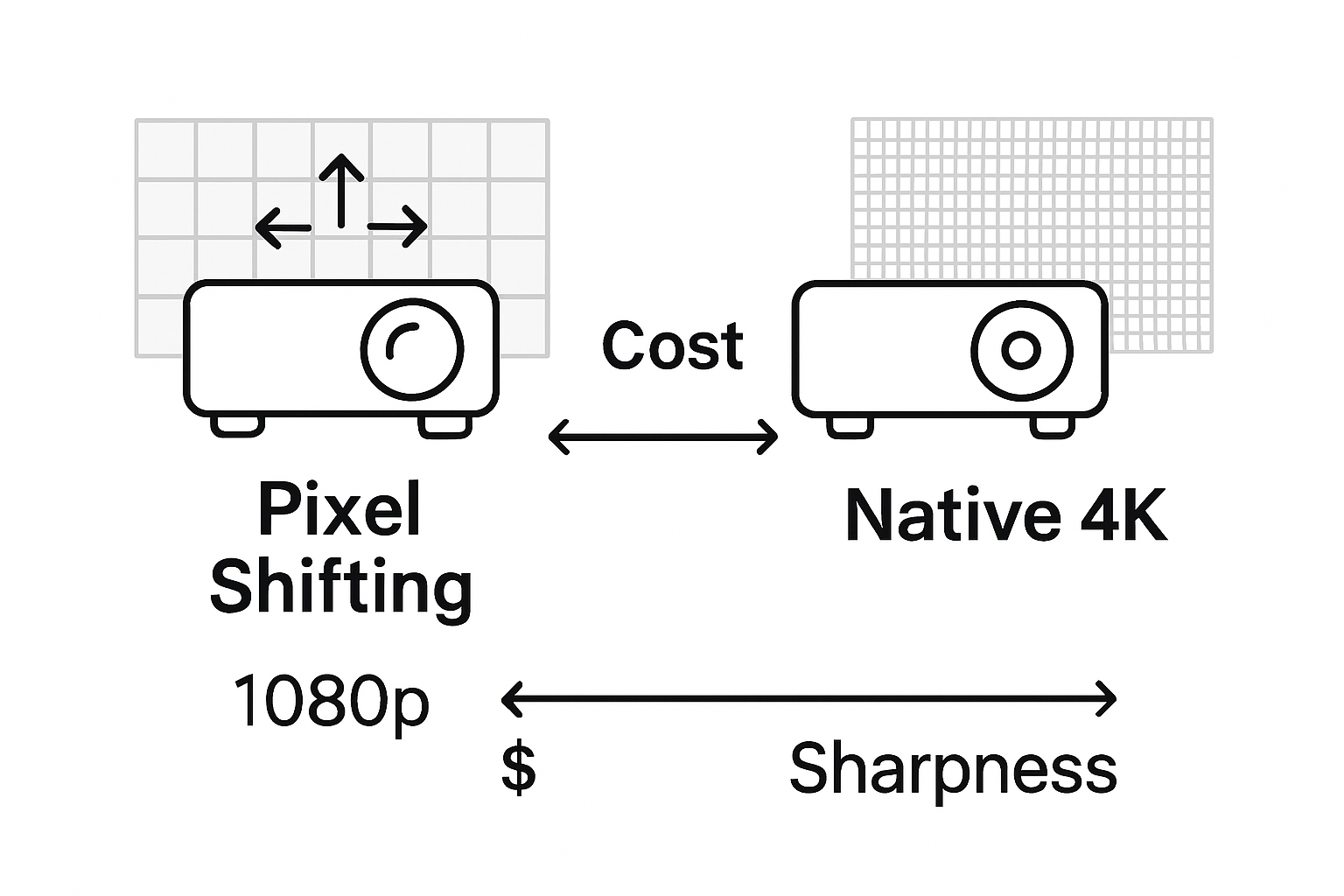
While native 4K projectors utilize physical hardware with true 3840×2160 pixel configurations, pixel shifting creates a similar visual effect through advanced image processing. The primary differences lie in pixel arrangement and computational complexity. Native 4K projectors generate images using dedicated hardware pixels, whereas pixel shifting uses rapid sub-pixel repositioning to simulate higher resolution, creating a perceptually similar result at a significantly reduced cost.
Key comparative aspects between pixel shifting and native 4K include:
- Resolution Simulation: Pixel shifting approximates 4K through computational techniques
- Cost Efficiency: Substantially more affordable than native 4K hardware
- Performance Characteristics: Slight variations in image sharpness and detail
- Processing Requirements: Higher computational complexity for pixel shifting
- Visual Perception: Minimal discernible difference for average viewers
For budget-conscious consumers and professionals seeking high-quality projection, pixel shifting represents an intelligent compromise. By leveraging advanced algorithmic techniques, this technology delivers impressive visual performance that meets the increasing demand for high-resolution displays without requiring significant financial investment.
Limitations, Costs, and Common Misconceptions
Pixel shifting technology, while innovative, comes with inherent limitations that consumers should understand. The effectiveness of resolution enhancement can vary significantly, depending on specific implementation techniques and source content quality.
One persistent challenge is the potential for visual artifacts. The screen-door effect remains a concern, where fine lines between pixels can become visible, potentially diminishing the perceived image quality. This phenomenon occurs more frequently when projector optics have lower pixel density, creating a grid-like appearance that can detract from the viewing experience.
Common misconceptions about pixel shifting include:
- Performance Equivalence: Not identical to true native 4K resolution
- Universal Compatibility: Effectiveness varies across different content types
- Cost-to-Quality Ratio: Not always a direct one-to-one improvement
- Computational Overhead: Requires significant processing power
- Manufacturer Implementation: Quality depends on specific technological approach
Technically sophisticated consumers should recognize that pixel shifting represents a strategic compromise. While it offers an accessible pathway to enhanced visual resolution, the technology is not a perfect substitute for native 4K hardware. Potential buyers must carefully evaluate their specific requirements, balancing performance expectations with budgetary constraints.
Discover Superior Projection Quality with Pixel Shifting Technology
Projectors equipped with pixel shifting technology address the challenge of delivering stunning high-resolution images without the high cost of native 4K hardware. If you seek sharper visuals, reduced artifacts, and enhanced image clarity for your home theater, business presentations, or educational environments, understanding pixel shifting is essential. This technology offers an affordable solution to bridge the gap between budget constraints and the desire for impressive detail and vivid picture quality.
Explore our wide selection of projectors and accessories at ProjectorDisplay.com tailored to deliver exceptional performance using pixel shifting and other cutting-edge display innovations. Whether you need portable projectors for on-the-go use or high-lumen models for bright spaces, we provide quality options supported by fast shipping and expert customer support.

Elevate your viewing experience today by visiting ProjectorDisplay.com to find the perfect projector with pixel shifting technology. Shop now and see how advanced visual solutions can transform your space with crisp, clear, and vibrant images without overspending.
Frequently Asked Questions
What is pixel shifting in projectors?
Pixel shifting is a display technology that enhances visual resolution by manipulating pixel placement. It creates sharper images by rapidly shifting pixels across the projection surface to simulate a higher resolution without needing high-cost hardware.
How does pixel shifting work?
Pixel shifting works by strategically displacing pixels in sub-pixel increments to create the illusion of greater resolution. This involves frame sequencing, sub-pixel displacement, and advanced interpolation processing to trick the human eye into perceiving an enhanced image.
What are the benefits of pixel shifting technology?
The benefits of pixel shifting include improved image quality and enhanced visual performance at a lower cost compared to native 4K projectors. It allows consumers to enjoy high-resolution experiences in various applications such as entertainment, education, and scientific visualization.
How does pixel shifting compare to native 4K projectors?
Pixel shifting simulates higher resolution by using advanced computational techniques, whereas native 4K projectors utilize actual 3840×2160 pixel configurations. While pixel shifting is more cost-effective, there can be slight differences in image sharpness and detail compared to true native 4K resolutions.