

Email communication drives modern business success, yet research shows over 50 percent of American consumers ignore emails that feel generic or irrelevant. For marketers in Malaysia, mastering professional email skills opens new opportunities for product promotion and meaningful client engagement. This guide shares practical strategies to transform everyday messages into impactful tools for building trust and boosting results.
Table of Contents
- Defining Effective Email Communication
- Types of Marketing Emails And Their Uses
- Key Elements Of Persuasive Email Messaging
- Managing Lists, Segmentation, And Personalization
- Legal Compliance And Avoiding Spam
- Common Pitfalls And How To Improve
Key Takeaways
| Point | Details |
|---|---|
| Effective Email Communication | Understanding the strengths and limitations of email is essential for professional correspondence to enhance clarity and engagement. |
| Types of Marketing Emails | Familiarity with various email types allows marketers to tailor messages effectively for different audience segments and campaign objectives. |
| Persuasive Messaging Techniques | Crafting emails with a compelling subject line and a focus on the recipient's perspective enhances the likelihood of engagement and action. |
| List Management and Personalization | Strategic audience segmentation and personalization lead to higher open rates and improved campaign success by addressing the specific needs of subscribers. |
Defining Effective Email Communication
Email communication is a powerful professional tool that enables rapid, documented interaction across diverse business environments. Unlike traditional communication methods, email provides marketers with a structured platform to convey messages quickly and strategically. Effective email communication requires understanding its strengths and limitations as a communication medium.
Successful email communication involves several critical components that distinguish professional correspondence from casual messaging. These include selecting the appropriate tone, crafting clear and concise content, understanding audience expectations, and maintaining a structured format that facilitates quick comprehension. Professional email techniques emphasize matching communication style to both the recipient and the specific business context.
Marketing professionals must recognize that email serves different purposes across various scenarios. Some communication requires immediate action, while others demand detailed explanation or documentation. Effective email communication means strategically choosing email when it represents the most appropriate communication channel – such as distributing information to multiple recipients, documenting discussions, or reaching colleagues across different time zones. The key is understanding when email enhances communication and when alternative methods might prove more effective.
Pro Tip: Before sending any professional email, read it aloud to ensure clarity, tone appropriateness, and eliminate potential misunderstandings.
Types of Marketing Emails and Their Uses
Marketing emails represent a sophisticated communication strategy that enables businesses to engage with customers across different stages of their journey. Email marketing types provide targeted approaches for reaching potential and existing customers through strategically designed communication channels. Understanding the diverse email categories allows marketers to craft precise messaging that resonates with specific audience segments.
The primary categories of marketing emails can be divided into several key types. Transactional emails serve functional purposes like order confirmations and receipts, while promotional emails drive sales through targeted offers. Relationship-building emails such as newsletters help maintain consistent engagement. Inbound marketing communications also include welcome sequences for new subscribers, milestone communications, and re-engagement campaigns designed to reconnect with inactive audience members.
Effective email marketing requires understanding the nuanced roles of different email types. Welcome emails introduce new subscribers to a brand, nurture emails guide potential customers through decision-making processes, and survey emails gather critical customer feedback. Sophisticated marketers strategically sequence these communications to create a comprehensive customer experience that moves recipients through the sales funnel with targeted, relevant content.
Here's a summary of the main marketing email types and their primary objectives:
| Email Type | Main Objective | Typical Audience |
|---|---|---|
| Transactional | Confirm transactions instantly | Current customers |
| Promotional | Drive sales or conversions | Interested subscribers |
| Relationship-Building | Nurture long-term brand loyalty | All audience segments |
| Welcome Sequence | Introduce brand & onboard users | New subscribers |
| Survey/Feedback | Collect user insights | Engaged recipients |
| Re-engagement Campaign | Revive inactive users | Dormant subscribers |
Pro Tip: Segment your email list carefully to ensure each communication type reaches the most appropriate audience for maximum engagement and conversion rates.
Key Elements of Persuasive Email Messaging
Crafting persuasive email messaging requires a strategic approach that balances compelling communication with authentic engagement. Persuasive email techniques involve carefully constructed elements designed to capture attention, build credibility, and motivate action. Successful marketers understand that persuasion is an art form that combines psychological insight with clear, targeted communication.
The fundamental components of a persuasive email include a powerful subject line, a strong opening hook, and a clear value proposition. Subject lines must be concise and intriguing, creating immediate interest. The email body should establish rapport, clearly articulate benefits, and provide supporting evidence that validates the message. Email persuasion strategies emphasize addressing potential recipient concerns while maintaining a tone of professionalism and respect.

Effective persuasive emails balance three critical appeal types: logical, emotional, and credibility-based arguments. Logical appeals present rational reasons for taking action, emotional appeals connect with the recipient's feelings and aspirations, and credibility appeals establish trust through demonstrated expertise or social proof. By integrating these elements seamlessly, marketers can create email communications that not only inform but genuinely influence recipient behavior.
Below is a comparison of the three main appeal types used in persuasive email messaging:
| Appeal Type | Purpose | Example in Email Context |
|---|---|---|
| Logical | Provide rational reasons to act | Highlight cost savings |
| Emotional | Evoke feelings or aspirations | Inspire with success stories |
| Credibility | Build trust and authority | Showcase certifications or awards |
Pro Tip: Always draft your persuasive email from the recipient's perspective, focusing on their potential gains rather than your own objectives.
Managing Lists, Segmentation, and Personalization
Email marketing success hinges on sophisticated list management and strategic audience targeting. Personalization techniques transform generic communication into precision-driven engagement, allowing marketers to craft messages that resonate deeply with specific audience segments. Modern email marketing demands more than mass communication strategies.
Effective list management involves multiple critical components. Segmentation categorizes subscribers based on specific characteristics such as demographics, behavioral patterns, purchase history, and engagement levels. Email segmentation strategies enable marketers to create highly targeted campaigns that speak directly to subscribers' unique interests and needs. By dividing email lists into meaningful groups, businesses can dramatically improve open rates, click-through rates, and overall campaign performance.
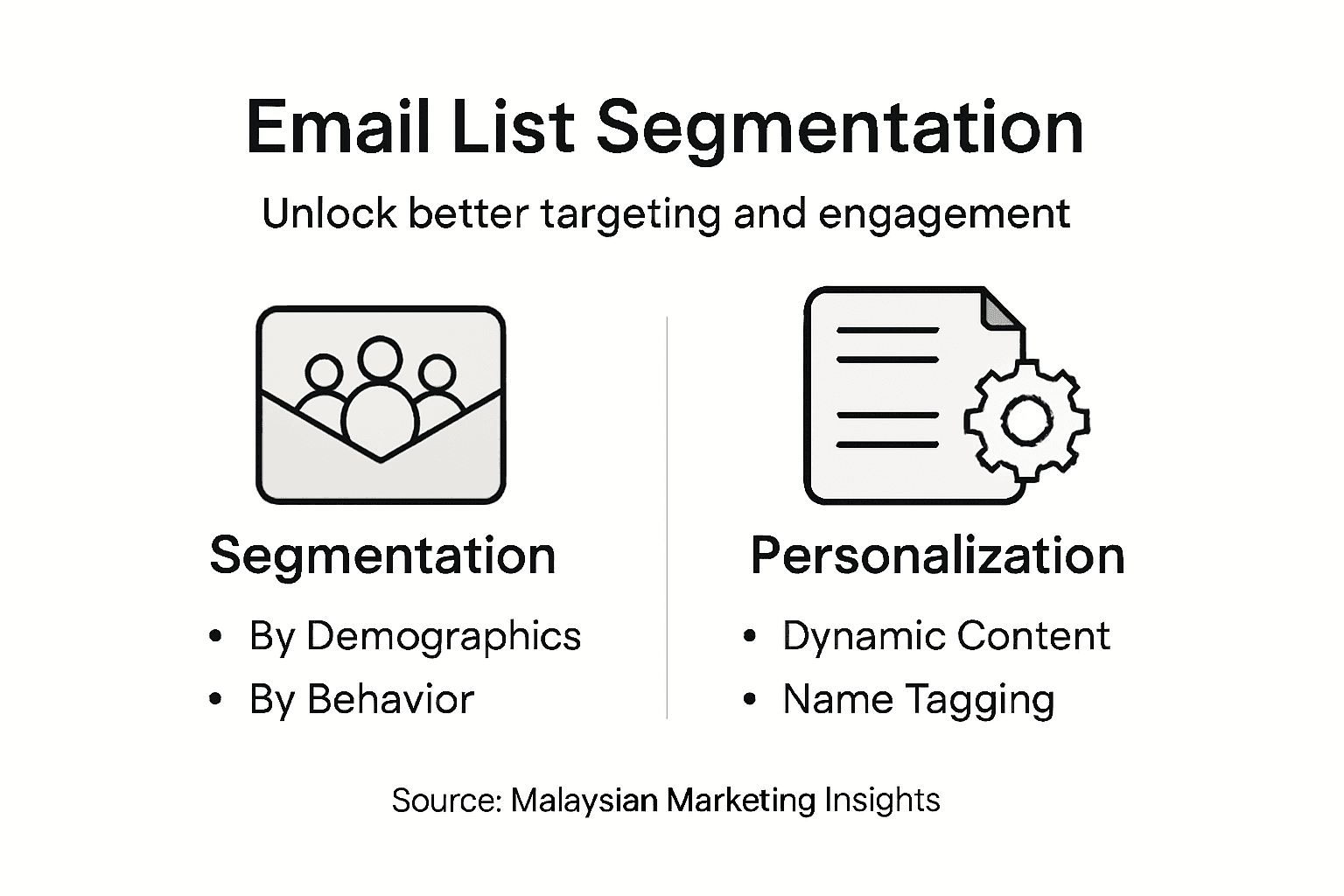
Personalization extends beyond simple name insertion, requiring sophisticated data analysis and dynamic content creation. Advanced marketers leverage behavioral triggers, purchase history, and real-time interactions to create emails that feel individually crafted. This approach transforms generic marketing communications into tailored experiences that demonstrate genuine understanding of each recipient's preferences, challenges, and aspirations.
Pro Tip: Regularly clean your email list by removing inactive subscribers and implementing a re-engagement strategy to maintain high-quality, responsive audience segments.
Legal Compliance and Avoiding Spam
Navigating the complex landscape of email marketing requires a deep understanding of legal requirements and ethical communication practices. Spam regulations in Malaysia present unique challenges for marketers seeking to engage audiences while maintaining legal compliance. The Communications and Multimedia Act provides a framework that balances commercial communication needs with consumer protection.
Electronic messaging regulations demand strategic approaches to email marketing. Critical compliance elements include obtaining explicit consent, providing clear opt-out mechanisms, and ensuring transparent sender identification. Regulatory developments suggest an evolving legal environment that requires marketers to stay informed about emerging guidelines. Best practices involve maintaining detailed records of subscriber consent, implementing robust permission-based marketing strategies, and respecting individual communication preferences.
Understanding the nuanced legal landscape means recognizing that compliance goes beyond mere technical adherence. Ethical email marketing involves creating genuine value for recipients, maintaining transparent communication practices, and developing trust-based relationships. Marketers must proactively design email campaigns that prioritize recipient experience, minimize intrusive communication, and align with both current regulations and emerging digital communication standards.
Pro Tip: Develop a comprehensive consent management system that documents subscriber permissions, tracks communication preferences, and enables immediate opt-out capabilities.
Common Pitfalls and How to Improve
Email marketing success demands strategic awareness of potential challenges that can derail campaign effectiveness. Email marketing mistakes frequently stem from inadequate planning, inconsistent messaging, and a failure to understand audience nuances. Recognizing these pitfalls is the first step toward developing more sophisticated, responsive communication strategies.
One of the most critical errors marketers make is neglecting audience segmentation. Targeted communication strategies require granular understanding of subscriber preferences, behaviors, and engagement patterns. Common missteps include sending identical messages to entire lists, overlooking individual subscriber interests, and failing to adapt content to specific audience segments. This approach leads to decreased open rates, higher unsubscribe rates, and diminished overall campaign performance.
Improving email marketing effectiveness requires a holistic approach that combines data-driven insights, strategic segmentation, and continuous optimization. Marketers must develop robust analytics frameworks, implement dynamic content strategies, and create flexible communication protocols that can adapt to changing subscriber behaviors. This means investing in advanced segmentation tools, developing sophisticated persona-based messaging, and maintaining a commitment to ongoing learning and refinement of email communication techniques.
Pro Tip: Conduct quarterly email list audits to remove inactive subscribers and refresh your segmentation strategy, ensuring your communications remain targeted and relevant.
Elevate Your Marketing Communication with Powerful Visual Tools
Effective email communication is critical for Malaysian marketers aiming to craft persuasive, targeted messages that engage their audience and drive results. As highlighted in the article, addressing challenges like personalization, audience segmentation, and clear value propositions can vastly improve your campaigns. Visual presentation plays a key role in capturing attention and reinforcing your messages, especially when presenting complex ideas or data to diverse recipients.
ProjectorDisplay.com offers a comprehensive range of high-quality projectors and display solutions that perfectly complement your communication strategy. Whether you need portable projectors for dynamic presentations or interactive displays for engaging customer interactions, utilizing cutting-edge visual technology can enhance your email follow-ups and business presentations to greater impact.
Transform your marketing approach today by integrating top-tier projection equipment from ProjectorDisplay.com. Discover how the right visual tools can amplify your message, improve audience engagement, and boost conversion rates. Explore our selection of projectors and screens designed to elevate every client interaction. Start optimizing your communication strategy now by visiting our homepage and experience fast, secure transactions backed by expert customer support.
Frequently Asked Questions
What are the key components of effective email communication?
Successful email communication involves selecting the appropriate tone, crafting clear and concise content, understanding audience expectations, and maintaining a structured format for quick comprehension.
How can I improve my email marketing segmentation?
Effective segmentation categorizes subscribers based on demographics, behavioral patterns, purchase history, and engagement levels, enabling targeted campaigns that resonate with specific audience segments.
What types of marketing emails should I use?
The primary types of marketing emails include transactional emails (for confirmations), promotional emails (to drive sales), relationship-building emails (like newsletters), welcome sequences, survey emails for feedback, and re-engagement campaigns for inactive users.
How can I ensure compliance with email marketing regulations?
To ensure compliance, obtain explicit consent, provide clear opt-out options, and maintain transparent sender identification. Additionally, keep detailed records of subscriber consent and respect individual communication preferences.
Recommended
- Remote Team Communication Tools: Driving Productivity – Projector Display
- Networking Tips for Professionals in Malaysia – Projector Display
- Remote Onboarding Best Practices for HR Success – Projector Display
- 7 Key Digital Marketing Trends 2025 for Malaysian Buyers – Projector Display
- Blog | Sameday Express