

Most managers in Malaysia underestimate how much adopting American leadership strategies can drive team performance and project success. Strong leadership skills are essential for guiding teams through rapid changes and delivering impactful presentations using advanced projection technology. Discover practical ways to build modern leadership abilities that help you navigate complex challenges, inspire your team, and confidently present your best ideas to any audience.
Table of Contents
- Defining Leadership Skills For Managers
- Types Of Leadership Styles In Business
- Essential Leadership Competencies To Build
- Applying Leadership In Team Management
- Risks And Common Mistakes To Avoid
Key Takeaways
| Point | Details |
|---|---|
| Dynamic Leadership Skills | Modern managers must develop strategic thinking, emotional intelligence, and effective communication to navigate complex challenges. |
| Adaptable Leadership Styles | Employing various leadership styles like transformational, transactional, and democratic enhances team motivation and cohesion. |
| Essential Competencies | Key competencies such as decision making, conflict resolution, and empowerment are vital for effective team management and organizational performance. |
| Avoid Common Leadership Pitfalls | Recognizing and addressing risks like micromanagement and poor communication can improve team morale and productivity. |
Defining Leadership Skills for Managers
Leadership skills are more than traditional management techniques. Modern managers must develop comprehensive capabilities that enable them to guide teams through complex organizational challenges. Leadership capabilities research indicates that today's leaders require a sophisticated approach blending strategic thinking, emotional intelligence, and adaptive communication.
Successful managers recognize that leadership skills are dynamic and multifaceted. Key capabilities include strategic planning, empowering team members, demonstrating authentic communication, and creating environments of continuous learning and growth. These skills are not innate but can be systematically developed through targeted training, experience, and self-reflection. Evidence-based leadership development suggests managers must remain flexible and committed to personal and professional evolution.
Core leadership skills encompass several critical dimensions:
- Strategic Vision: Ability to set clear organizational goals
- Emotional Intelligence: Understanding and managing team dynamics
- Communication: Transparent and inspiring interactions
- Decision Making: Analytical and collaborative problem solving
- Adaptability: Navigating changing business environments
Pro tip: Develop a personal leadership growth plan by identifying three specific skills you want to improve and creating measurable monthly objectives to enhance those capabilities.
Types of Leadership Styles in Business
Leadership styles represent diverse approaches managers utilize to guide, motivate, and coordinate their teams. Comprehensive leadership research reveals multiple distinct styles that can significantly impact organizational performance and team dynamics. Understanding these styles enables managers to adapt their approach strategically and effectively across different workplace scenarios.
Business leaders typically employ several fundamental leadership approaches. The most prominent styles include transformational, transactional, autocratic, democratic, and servant leadership. Systematic leadership review highlights that each style carries unique strengths and potential limitations depending on organizational context and team composition. Successful managers often blend multiple styles, demonstrating flexibility and emotional intelligence.
Key leadership styles can be characterized as follows:
Here's a side-by-side look at popular leadership styles for managers:
| Leadership Style | Core Focus | Best Used When | Key Limitation |
|---|---|---|---|
| Transformational | Inspiring team vision | Driving major change | May overlook details |
| Transactional | Rewarding performance | Ensuring task completion | Can limit creativity |
| Autocratic | Centralized decisions | Quick, crisis response | Risks low team morale |
| Democratic | Team involvement | Need diverse viewpoints | Decision speed slows |
| Servant | Supporting team growth | Long-term team building | May delay action |
- Transformational Leadership: Inspires and motivates through vision and personal charisma
- Transactional Leadership: Focuses on structured rewards and clear performance expectations
- Autocratic Leadership: Centralizes decision making with minimal team input
- Democratic Leadership: Encourages team participation and collective decision making
- Servant Leadership: Prioritizes team member growth and organizational service
Pro tip: Conduct a self-assessment to identify your primary leadership style and intentionally practice flexibility by incorporating elements from other approaches to enhance your management effectiveness.
Essential Leadership Competencies to Build
Leadership competencies represent the fundamental skills and capabilities that distinguish exceptional managers from average performers. Core leadership capabilities provide a strategic framework for developing professional effectiveness and organizational impact. These competencies go beyond traditional management techniques, requiring continuous learning and intentional personal development.

Modern leadership demands a comprehensive skill set that integrates emotional intelligence, strategic thinking, and interpersonal dynamics. Evidence-based leadership development emphasizes that successful leaders must cultivate multiple interconnected competencies. These skills enable managers to navigate complex workplace challenges, inspire teams, and drive organizational performance.
Key leadership competencies include:
- Strategic Thinking: Developing long-term organizational vision
- Emotional Intelligence: Understanding and managing team dynamics
- Communication: Clear, transparent, and inspiring interactions
- Adaptability: Responding effectively to changing environments
- Decision Making: Analytical and collaborative problem solving
- Conflict Resolution: Mediating and resolving team challenges
- Empowerment: Developing and supporting team member potential
Pro tip: Create a personal leadership development plan by identifying three core competencies to improve and establish specific, measurable goals for skill enhancement over the next six months.
Applying Leadership in Team Management
Effective team management requires leaders to implement strategic approaches that foster collaboration, motivation, and collective achievement. Leadership practices for team success demonstrate that managers must go beyond traditional supervision and actively create environments where team members can thrive and contribute meaningfully.
Modern leadership involves understanding team dynamics and adapting management strategies to support team growth and performance. High-performance team leadership emphasizes the importance of evolving leadership approaches that align with team maturation stages. This requires leaders to be flexible, responsive, and committed to continuous team development.
Key strategies for applying leadership in team management include:
- Clear Communication: Establishing transparent expectations and goals
- Empowerment: Delegating responsibilities and trusting team capabilities
- Active Listening: Understanding individual team member perspectives
- Conflict Resolution: Addressing challenges constructively
- Performance Coaching: Providing meaningful feedback and support
- Recognition: Celebrating individual and collective achievements
- Skill Development: Supporting ongoing learning and growth
Pro tip: Conduct monthly one-on-one check-ins with each team member to understand their individual goals, challenges, and development needs, creating a personalized approach to team management.
Risks and Common Mistakes to Avoid
Leadership development is fraught with potential pitfalls that can significantly undermine organizational effectiveness. Leadership development risks reveal that managers often encounter critical challenges that can derail their leadership potential if not carefully managed. Understanding these risks is the first step toward creating more robust and adaptive leadership practices.
Research highlights that leadership mistakes frequently stem from rigidity, poor self-awareness, and an inability to adapt to changing organizational dynamics. Methodological leadership mistakes demonstrate that leaders who fail to align their approach with organizational culture and team needs are most likely to experience significant performance challenges. These mistakes can create lasting negative impacts on team morale, productivity, and overall organizational success.
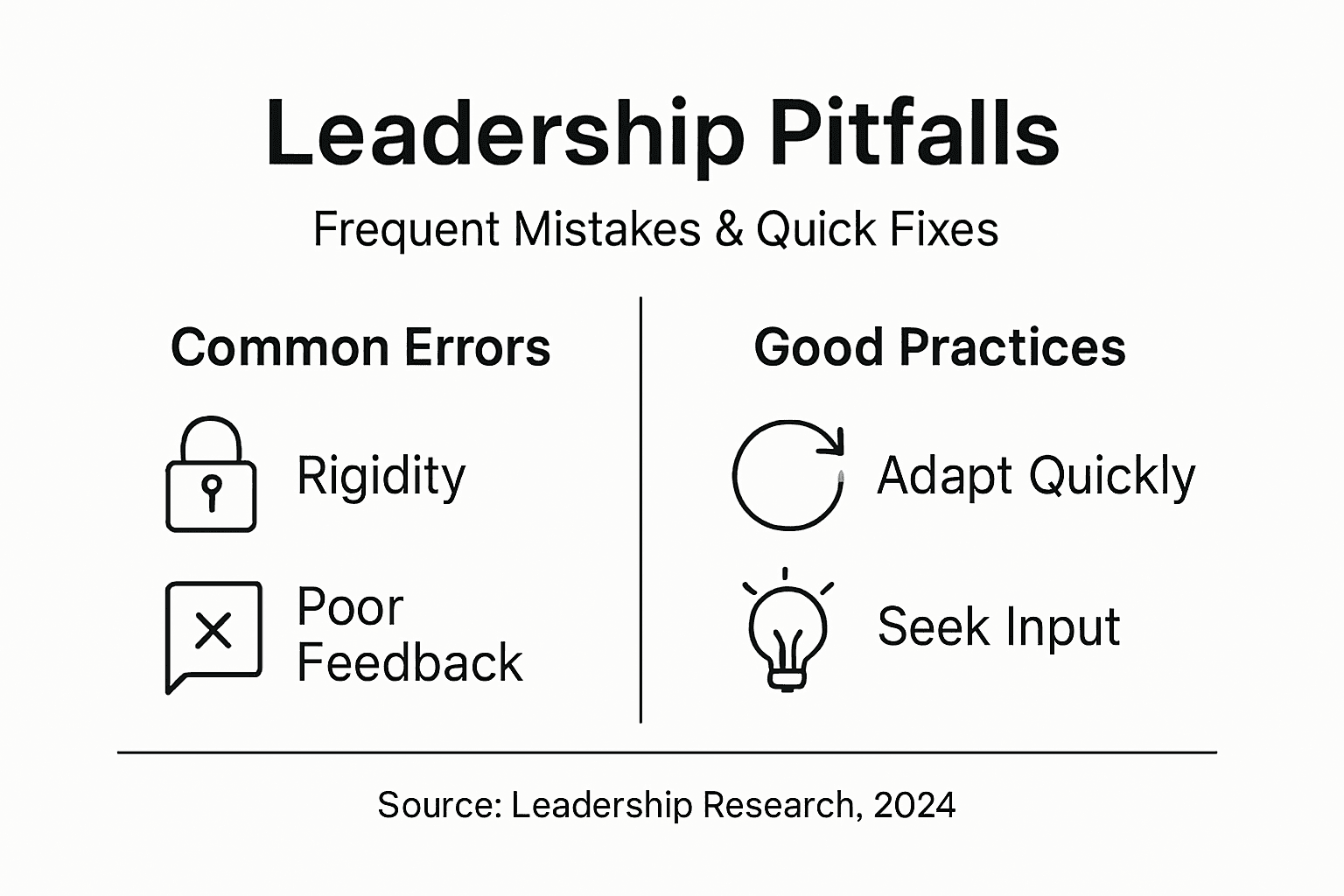
Key risks and common leadership mistakes include:
The following table summarizes top leadership risks and potential impacts:
| Risk/Mistake | Potential Impact | Prevention Tip |
|---|---|---|
| Micromanagement | Low team innovation | Delegate with trust |
| Inconsistent Behavior | Team confusion | Set clear expectations |
| Avoiding Difficult Talks | Unresolved conflicts | Address issues promptly |
| Lack of Adaptability | Missed opportunities | Embrace ongoing learning |
- Micromanagement: Overcontrolling team members and stifling creativity
- Poor Communication: Failing to provide clear expectations and feedback
- Resistance to Feedback: Ignoring team and organizational input
- Inconsistent Behavior: Displaying unpredictable leadership approaches
- Lack of Emotional Intelligence: Failing to understand team dynamics
- Avoiding Difficult Conversations: Neglecting performance and behavioral issues
- Inability to Adapt: Rigidly maintaining outdated leadership strategies
Pro tip: Conduct a quarterly self-assessment of your leadership approach, soliciting anonymous feedback from team members to identify blind spots and areas for improvement.
Elevate Your Leadership Impact with Clear Visual Communication
Developing strong leadership skills means mastering communication, adaptability, and strategic vision. The challenge many managers face is inspiring and guiding their teams effectively during business presentations or training sessions. Clear, engaging visuals can transform how your message is received and boost team motivation. Whether you are presenting a new vision or driving change, the right projection technology plays a critical role in capturing attention and fostering collaboration.

Explore a wide selection of high-quality projectors and interactive display solutions at ProjectorDisplay.com to empower your leadership. From portable models perfect for impromptu meetings to laser and smart projectors ideal for boardrooms, our products ensure sharp visuals and seamless connectivity. Take your strategic communication and team management to the next level today. Visit ProjectorDisplay.com now for secure transactions, fast shipping in Malaysia, and expert support designed to help leaders like you create lasting impact.
Frequently Asked Questions
What are the essential leadership skills that managers should develop?
Essential leadership skills for managers include strategic vision, emotional intelligence, effective communication, decision-making ability, and adaptability. These competencies help navigate complex workplace challenges and drive organizational performance.
How can managers identify their leadership style?
Managers can identify their leadership style through self-assessment tools or feedback from peers and team members. Understanding your primary style enables you to adapt and incorporate elements from other approaches for enhanced effectiveness.
What strategies can be used for effective team management?
Key strategies for effective team management include clear communication of expectations, empowering team members, active listening, conflict resolution, performance coaching, and recognizing achievements. These practices foster collaboration and motivation within the team.
What are the common mistakes managers make in leadership?
Common leadership mistakes include micromanagement, poor communication, resistance to feedback, inconsistency in behavior, lack of emotional intelligence, and avoiding difficult conversations. Recognizing and addressing these pitfalls can improve leadership effectiveness.
Recommended
- The Essential Guide to Teaching Critical Thinking Skills – Projector Display
- Team Productivity Tools: Boosting Collaboration Success – Projector Display
- Future Skills for Students – Preparing for Tomorrow's Needs – Projector Display
- Time Management Strategies: Boost Presentation Impact – Projector Display
- KI-Einsatz in Unternehmen: Zwei Welten, ein Ziel – Wie Führungskräfte und Mitarbeiter von KI profitieren können