
TL;DR:
- Many Malaysian buyers focus heavily on projectors and neglect their screens, which heavily impact image quality. Choosing the correct screen type, material, and size ensures optimal contrast, color, and brightness tailored to different room conditions. Buying locally from trusted suppliers like Projectordisplay guarantees support, warranties, and proper matching to your projector and environment.
Most people shopping for a projector screen malaysia setup spend 90% of their budget research on the projector and almost nothing on the screen. That's a mistake. Projection screens dramatically improve contrast, color accuracy, and perceived brightness, often more than upgrading the projector itself. Whether you're building a home theater, setting up a corporate boardroom, or outfitting a classroom, the screen you choose directly shapes what the audience sees. This guide walks you through screen types, materials, installation, outdoor use, and where to buy projector screens in Malaysia without wasting money.
Table of Contents
- Key takeaways
- Types of projector screens available in Malaysia
- Choosing the right screen material and size
- Installation tips and maintenance for Malaysian settings
- Where to buy projector screens in Malaysia
- Using projector screens outdoors in Malaysia
- My honest take on where Malaysian buyers go wrong
- Find the right projector screen at Projectordisplay
- FAQ
Key takeaways
| Point | Details |
|---|---|
| Screen affects image quality | Your projector screen contributes as much to image quality as the projector itself. |
| Match screen to throw distance | Choosing the wrong screen material for your projector type causes hot-spotting and distortion. |
| ALR screens require the right projector | Standard ALR screens ruin image quality with ultra-short-throw projectors; use lenticular ALR instead. |
| Outdoor screens need special materials | Malaysian humidity and wind demand fiberglass-backed or tab-tensioned materials for durability. |
| Buy locally for better support | Local sellers offer warranties, after-sales support, and faster delivery that imported purchases cannot match. |
Types of projector screens available in Malaysia
Getting the screen type right before worrying about anything else saves you from expensive regrets. There are four main categories you'll encounter when you browse screen types, and each serves a distinct purpose.
Fixed-frame screens are the gold standard for dedicated home cinema rooms. The fabric is stretched permanently across a rigid aluminum frame, giving you a perfectly flat surface with zero wrinkles. If you're building a serious home theater setup in Malaysia, this is where you start. They're not retractable, so they work only where the screen can stay up permanently.
Motorized retractable screens are the smarter choice for multi-purpose rooms, meeting rooms, and classrooms. You roll them up when not in use and drop them down with a remote or wall switch. Multi-purpose rooms benefit greatly from tab-tensioned motorized screens, which use tensioning wires along the sides to keep the fabric perfectly flat, unlike standard roll-up designs that can bow or ripple.
Portable projector screens include tripod-mounted and folding designs. These are the right pick for sales teams, trainers, and anyone who presents in different locations. They set up in minutes and pack into a carry bag. The trade-off is that fabric tension is less consistent than fixed or motorized options.
Outdoor projector screens are built for Malaysia's climate. Foldable polyester designs and inflatable frames dominate this category, and for good reason.
Here's a quick comparison before you commit:
- Fixed-frame: Best image flatness, permanent installation, ideal for home cinema. Price range: RM 400 to RM 2,500+
- Motorized retractable: Versatile, clean look, remote-controlled. Price range: RM 600 to RM 4,000+
- Portable/tripod: Lightweight, fast setup, good for presentations. Price range: RM 150 to RM 800
- Outdoor inflatable/foldable: Weather-resistant, large format available. Price range: RM 300 to RM 1,500
Pro Tip: If you're installing a motorized screen in a living room or boardroom, always choose a tab-tensioned model. The side tensioning wires eliminate the vertical waves that plague standard pull-down motorized screens within a year of regular use.
Choosing the right screen material and size
This is where most buyers go wrong. Picking the wrong material for your projector type doesn't just reduce image quality. It can actively ruin it.
The first thing to understand is projector throw distance. Long-throw projectors sit far from the screen. Short-throw projectors sit 1 to 2 meters away. Ultra-short-throw (UST) projectors sit right at the base of the screen, projecting upward at a steep angle. Matching screen material to throw distance is not optional. Matte white fabric works well for long-throw setups in light-controlled rooms. It reflects light evenly in all directions, which means wide viewing angles and consistent brightness.
Gray screens and Ambient Light Rejecting (ALR) materials are better choices for rooms with windows or overhead fluorescent lights, which is basically every Malaysian office and classroom. Gray screens absorb ambient light better than white, which improves perceived contrast without needing a completely dark room.
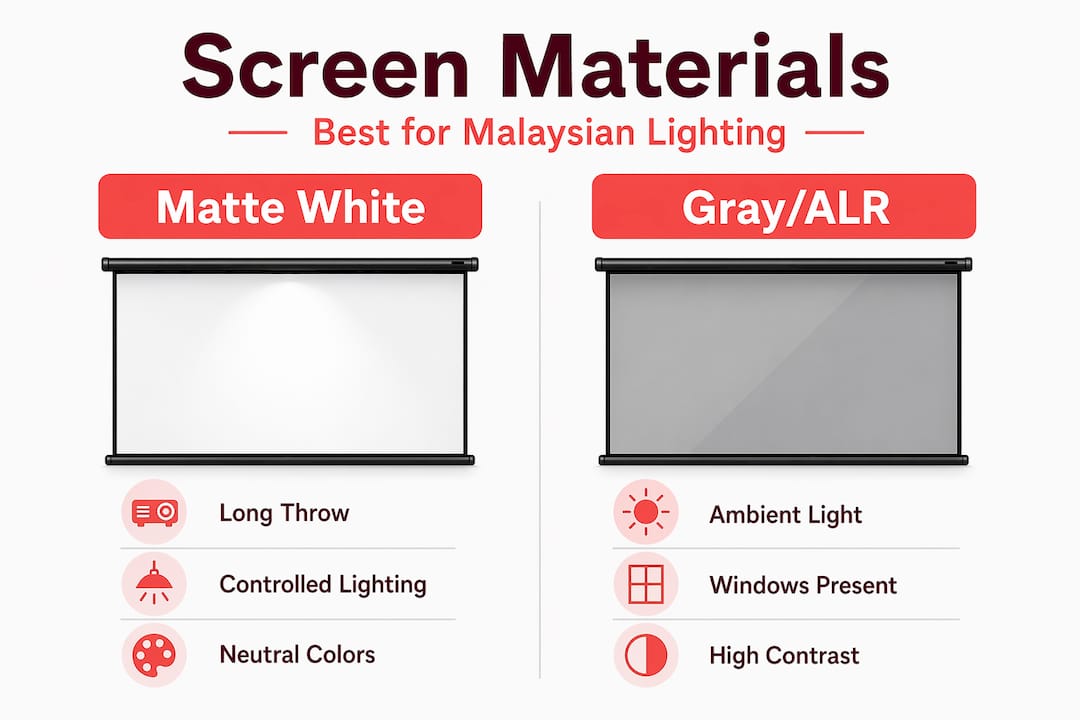
Here's the critical detail most buyers miss: standard ALR screens cause severe issues when used with UST projectors. A regular ALR screen is engineered to reflect light coming from in front of the screen, not from below. Pair it with a UST projector, and you get a distorted, artifact-riddled image. UST projectors require specially designed lenticular ALR screens that reflect light from below while rejecting ambient light from above. Check your projector's throw ratio before selecting any screen material.
| Screen Material | Best Projector Type | Room Lighting | Notes |
|---|---|---|---|
| Matte white | Long-throw | Dark/controlled | Wide viewing angle, accurate colors |
| Gray/high-contrast | Long/short-throw | Moderate ambient light | Better black levels, narrower angle |
| Standard ALR | Long-throw only | Bright ambient light | Do NOT use with UST projectors |
| Lenticular ALR | Ultra-short-throw | Bright ambient light | Mandatory for UST setups |
| Acoustically transparent | Long-throw | Dark/controlled | Allows speaker placement behind screen |
Screen size depends on viewing distance and projector lumen output. A 120-inch screen in a 3.5-meter room with a 2,500-lumen projector will look washed out. For most Malaysian living rooms, 100 to 110 inches at 16:9 aspect ratio hits the sweet spot. Classrooms and boardrooms typically work well with 100 to 120 inches. For a deeper look at size recommendations matched to your space, the home theater screen guide at Projectordisplay covers this in detail.
Installation tips and maintenance for Malaysian settings
Even a high-end screen performs poorly if it's installed incorrectly. A few simple rules make a significant difference.
Screen flatness is everything. Manual pull-down screens develop vertical waves and a "smile" curve at the bottom over time. This distorts the projected geometry and is especially visible when projecting slides, spreadsheets, or any content with straight horizontal lines. Fixed-frame or tab-tensioned motorized screens avoid this problem entirely because the fabric is under constant, even tension.
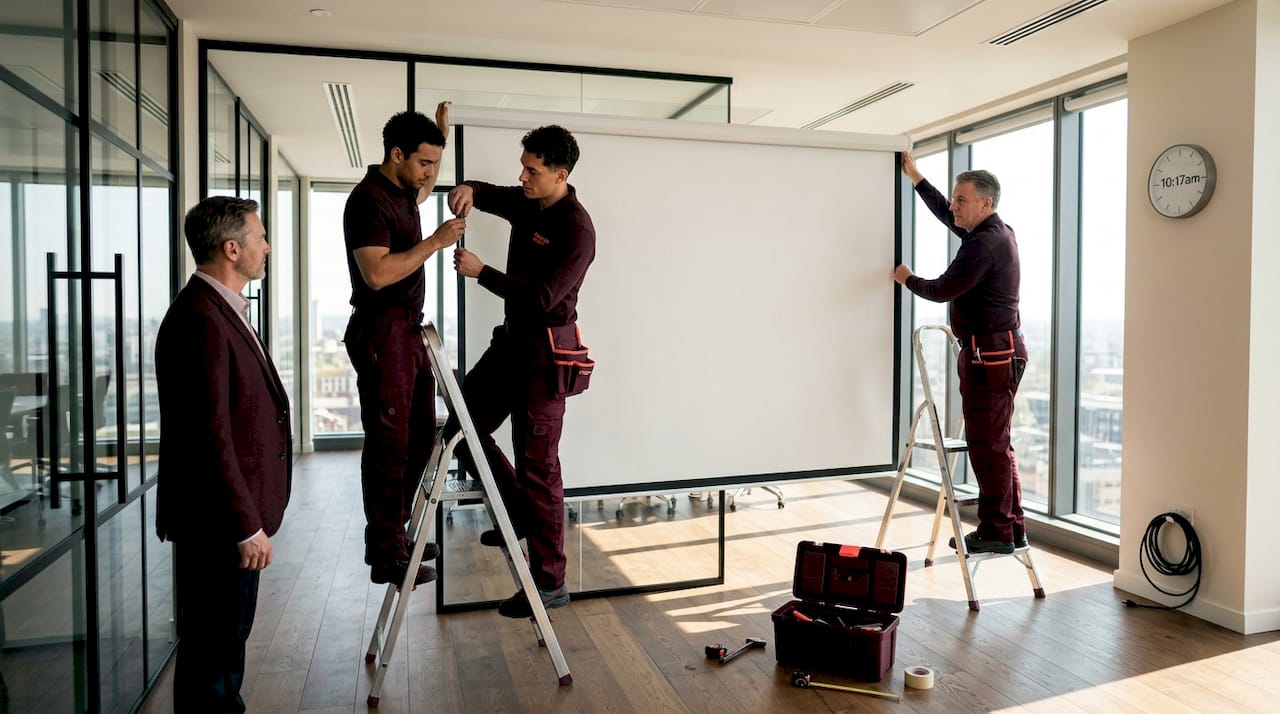
Mounting height is often overlooked. The ideal image center sits at seated eye level, with the bottom of the image roughly 24 to 36 inches above the floor. This prevents neck strain during long presentations or movie sessions. In classrooms where students sit at desks, the bottom of the screen should clear the heads of front-row students.
For motorized screens, plan your power and control routing during installation, not after. Concealed wiring in the ceiling or wall makes the installation look clean and protects cables from Malaysia's humidity. Many motorized screens support trigger inputs, so they can drop automatically when the projector turns on.
Here's what to do to keep your screen in good shape:
- Cleaning: Use a soft, lint-free microfiber cloth slightly dampened with distilled water. Never spray liquids directly onto the screen surface.
- Storage: Portable screens should be stored in their carry case and kept away from direct sunlight when not in use.
- Humidity protection: Malaysia's humidity causes fabric screens to absorb moisture over time. If storing a portable screen for extended periods, use silica gel packets in the case.
- Re-tensioning: If a manual screen develops waves, re-rolling it tightly and leaving it for 48 hours often resolves minor warping.
Pro Tip: For semi-permanent outdoor setups in Malaysia, elevate the screen's lower bar slightly off the ground using sandbags or a weighted base. This keeps moisture from wicking up the fabric during or after rain.
The screen placement guide at Projectordisplay covers Malaysia-specific mounting scenarios for homes, offices, and schools in more detail.
Where to buy projector screens in Malaysia
Whether you want projektor murah options or a premium setup, knowing where to shop and what to ask matters as much as the product specs.
Projectordisplay is one of the best projector sellers in Malaysia with a focused catalog covering projector screen malaysia needs across every use case, from portable projector screens for mobile presenters to full fixed-frame home theater screens. The platform carries reputable brands including Epson projector Malaysia lines, Viewsonic projector Malaysia options, and screens compatible with BenQ projector Malaysia and Optoma projector Malaysia units. You can buy projector screens with confidence knowing that warranty, after-sales support, and fast delivery within Peninsular Malaysia are included.
Here's what to evaluate before you commit to any seller:
| Screen Type | Entry-Level Price (RM) | Mid-Range Price (RM) | Premium Price (RM) |
|---|---|---|---|
| Portable/tripod | 150 to 300 | 300 to 600 | 600 to 800 |
| Manual pull-down | 200 to 400 | 400 to 800 | 800 to 1,200 |
| Motorized retractable | 600 to 1,000 | 1,000 to 2,500 | 2,500 to 4,000+ |
| Fixed-frame | 400 to 800 | 800 to 1,800 | 1,800 to 2,500+ |
Buying locally versus importing directly has a clear winner for most buyers. Local sellers offer warranty registration, easier returns, and technical support in your language. Imported products from gray market channels often come with no warranty, and projector lamp malaysia replacements or accessories may be incompatible. Always check whether the seller offers WhatsApp support and whether the brand has authorized service in Malaysia.
Using projector screens outdoors in Malaysia
Outdoor movie nights and open-air presentations are genuinely enjoyable in Malaysia, but the environment is unforgiving. Getting the screen wrong means spending more time fighting the setup than watching the content.
Outdoor screens require specialized construction. Testing across 60 hours in 2026 confirms that fiberglass-backed materials and tab-tensioned surfaces resist wind and moisture significantly better than plain PVC. Inflatable frame designs are popular for events because they set up quickly and store compactly, but they require a functioning blower during the entire event.
Key considerations for outdoor use in Malaysia:
- Wind: Secure the screen using ropes anchored to ground stakes or heavy sandbags. Lightweight frames tip easily in even moderate wind.
- Rain: Always have a quick takedown plan. Even water-resistant materials should not be left standing in heavy rainfall.
- Sun glare: Position the screen so the sun is behind the audience, not shining directly onto the screen surface. An east-facing setup works well for evening screenings.
- Image brightness: Outdoor use at dusk requires a projector with at least 3,000 to 4,000 lumens to overcome residual ambient light.
The Elite Screens 120-inch outdoor screen with fiberglass-backed material delivers 180-degree wide viewing and holds up well in semi-permanent outdoor setups. Users report easy assembly and minimal image distortion even in less-than-ideal conditions.
For more on selecting the right projector to pair with an outdoor screen, the outdoor projector guide at Projectordisplay covers brand-specific recommendations suited to Malaysian conditions.
My honest take on where Malaysian buyers go wrong
I've seen hundreds of buyers put serious money into an Epson LCD projector or a premium wireless projector malaysia setup, then pair it with a cheap pull-down screen they grabbed as an afterthought. Within six months, the screen develops waves, the bottom sags, and the RM 3,000 projector looks like it cost RM 500.
The most common mistake isn't choosing the wrong screen type. It's treating the screen as a secondary decision. The optical quality of the screen can outweigh even upgrading the projector in terms of what the viewer actually perceives. A matte white fixed-frame screen at RM 800 will outperform a rippled manual pull-down at RM 250 every single time, regardless of what projector you put in front of it.
The second mistake I see constantly is people buying ALR screens without checking their projector type first. If you're running a UST projector and you grab a standard ALR screen because it sounds impressive, you'll get artifacts and brightness inconsistencies that make the image unwatchable. That's an expensive lesson. Check your throw ratio. Then choose your screen material.
My personal recommendation for anyone who wants a versatile, long-lasting setup in a Malaysian home or office: invest in a motorized tab-tensioned screen with a gray or ALR coating suited to your specific projector. Yes, it costs more upfront. But it performs better, requires less maintenance, and doesn't embarrass you in front of guests or clients.
The best projector shop is the one that helps you get this match right before you buy, not after.
— Projector
Find the right projector screen at Projectordisplay
Projectordisplay carries one of the most complete selections of projector screens in Malaysia, covering home theater screens, portable projector screens, motorized and fixed-frame options, and outdoor projector screens built for local conditions. Whether you're comparing a best home projector malaysia package or sourcing a best classroom projector setup for a school, you'll find compatible screens from trusted brands including Viewsonic, Epson, BenQ, and more. Every purchase includes warranty coverage, responsive WhatsApp support, and fast shipping throughout Peninsular Malaysia. The team at Projectordisplay can help you match screen size, gain, and material to your specific projector and room before you commit. Browse the full projection screen catalog or explore current deals to find the right fit at the right price.
FAQ
What type of projector screen is best for home use in Malaysia?
Fixed-frame screens offer the best image quality for dedicated home cinema rooms, while motorized tab-tensioned screens are a better choice for multi-purpose living rooms where you need to retract the screen when not in use.
Can I use an ALR screen with any projector?
No. Standard ALR screens work only with long-throw projectors. Ultra-short-throw projectors require specially designed lenticular ALR screens. Using the wrong type causes severe brightness loss and image artifacts.
How do I choose the right screen size for my room?
For most Malaysian living rooms, a 100 to 110-inch screen at 16:9 works well at a viewing distance of 3 to 4 meters. Multiply your viewing distance in meters by 0.84 to get a rough ideal diagonal screen size in inches.
Are outdoor projector screens suitable for Malaysia's weather?
Yes, if you choose the right materials. Fiberglass-backed and tab-tensioned outdoor screens handle humidity and wind significantly better than plain PVC designs. Always secure the screen with ropes or sandbags and plan for quick takedown during heavy rain.
Where is the best place to buy projector screens in Malaysia?
Buying from a local specialist like Projectordisplay gives you access to genuine products, local warranty support, WhatsApp assistance, and fast delivery within Peninsular Malaysia, which gray market imports cannot reliably offer.
Recommended
- Projector Screen Types: Guide for Malaysia in 2025 – Projector Display
- Home projector buying guide 2026: expert tips for Malaysians – Projector Display
- Choosing the right projector screen for Malaysia 2026 – Projector Display
- Projector Screen Size Guide 2025: Perfect Fit for Malaysian Needs – Projector Display