
TL;DR:
- Using a projector outdoors requires high brightness levels, proper screen surfaces, and reliable power sources for the best picture quality. An ambient light rating of at least 200 ANSI lumens is necessary after sunset, with 1,500 to 3,000 lumens recommended for twilight conditions. External audio and mechanically leveled setups improve viewing comfort and picture clarity during outdoor movie nights.
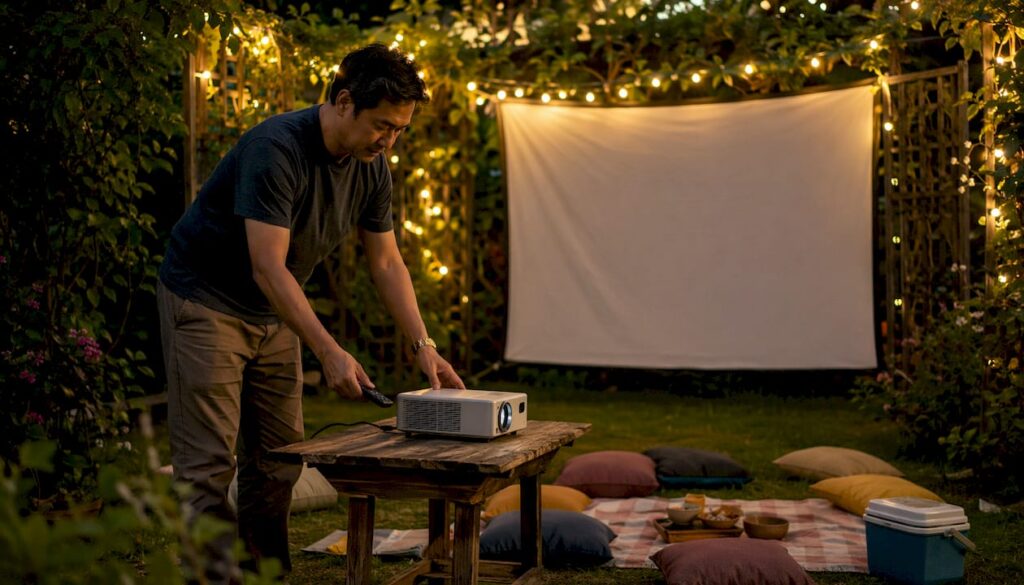
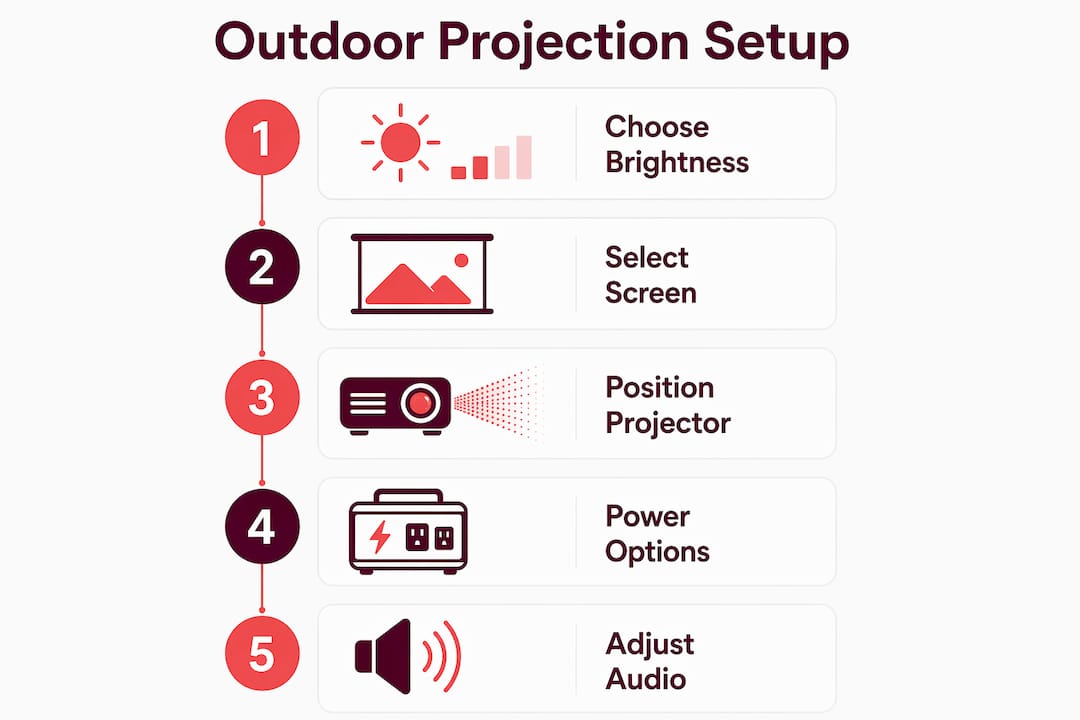
Using a projector outdoors is defined as projecting video or images onto a screen or surface in an open-air environment, requiring specific brightness levels, screen types, and power management to deliver a clear, enjoyable picture. Modern portable projectors and projection screens make backyard movie nights genuinely impressive, even when some ambient light is present. The key variables are ANSI lumens output, throw ratio, and your power source. Get those three right, and you have a setup that rivals any indoor home theater. This guide covers every step, from choosing the right projector brightness to managing audio and power for a smooth outdoor event.
What projector brightness and resolution do you need for outdoor use?
Brightness is the single most important spec for outdoor projection. The industry standard measurement is ANSI lumens, which measures actual light output under controlled conditions. At least 200 lumens are needed for post-sunset viewing. That number climbs fast if you start before full dark or have nearby streetlights.
For twilight conditions or any ambient light, target 1,500 to 3,000 ANSI lumens. A projector rated below that range will produce a washed-out image the moment a porch light turns on. Resolution matters just as much as brightness. A minimum of 1080p Full HD keeps the image sharp at 80–120 inches, which is the typical screen size for backyard setups. Projectors with 4K output are available through Projectordisplay, and they deliver noticeably sharper detail on larger screens.
Pro Tip: Disable Eco mode on your projector before every outdoor session. Eco mode reduces lamp output to extend bulb life, but it cuts brightness by up to 30%, which is the last thing you want outside.
| Brightness Level | Best Viewing Condition | Recommended Use |
|---|---|---|
| Under 500 ANSI lumens | Full dark, no ambient light | Small backyard, late-night only |
| 500–1,500 ANSI lumens | Low ambient light, after sunset | Standard backyard movie night |
| 1,500–3,000 ANSI lumens | Twilight or mild ambient light | Larger gatherings, partial shade |
| 3,000+ ANSI lumens | Partial daylight or large venues | Outdoor events, open fields |
Checking the lumen requirements guide on Projectordisplay helps you match the right model to your specific setup before you buy.
How to set up a projector screen and position your projector outdoors
A dedicated portable projector screen always outperforms a white sheet or painted wall. Sheets sag and wrinkle, which distorts the image. Walls rarely have a neutral enough surface to reproduce accurate colors. A proper screen uses a matte white or gray material with a controlled gain rating.
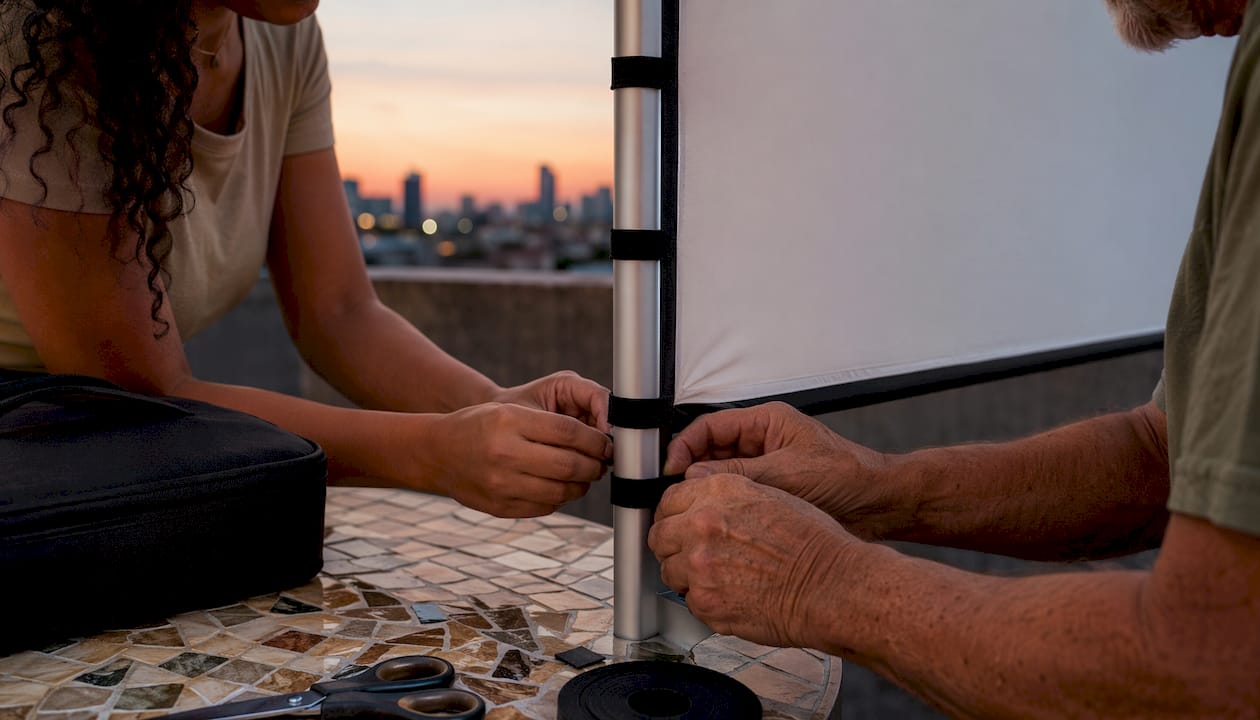
Screen gain measures how much light a surface reflects back toward the viewer. For outdoor use, a gain of 1.0 to 1.3 works best. Higher-gain screens focus reflected light into a narrow viewing cone, which causes hot spots and color shifts for viewers sitting at an angle. Matte white at 1.0 gain gives even brightness across a wide seating area, which is exactly what you need for a group.
Screen size for most backyard setups falls in the 80–120 inch range. That size is large enough to feel cinematic but small enough to keep brightness levels manageable. For an 80–100 inch image using a standard 1.2:1 throw ratio, position your projector 8–10 feet from the screen. Measure this before the event, not during it.
Pro Tip: Test your full setup before sunset. Adjust focus, confirm throw distance, and check the image at the actual screen position while you can still see clearly. Fixing a misaligned image in the dark wastes time and frustrates guests.
Leveling the projector on uneven ground is a common challenge. Mechanical leveling with wedges or a quality tripod outperforms software keystone correction every time. Digital keystone correction crops and scales the image, which reduces effective resolution. A physically level projector preserves every pixel. For screen placement guidance specific to Malaysia, the screen placement guide on Projectordisplay covers positioning for common outdoor configurations.
| Screen surface type | Gain rating | Best for |
|---|---|---|
| Matte white | 1.0 | Wide seating, group viewing |
| Gray / ambient light rejecting | 0.8–1.1 | Mild ambient light conditions |
| High-gain white | 1.3–1.8 | Narrow seating, single-axis viewing |
| Perforated screen | 1.0 | Audio-behind-screen setups |
What power options are best for outdoor projector setups?
Power is where outdoor setups fail most often. Running out of charge or tripping a breaker mid-movie is avoidable with the right planning. Your three main options are built-in projector batteries, portable power stations, and outdoor-rated extension cords.
Built-in batteries on portable projectors typically last 2–4 hours. That covers a single feature film, but nothing more. For extended outdoor movie nights or multi-film events, a high-capacity lithium-ion portable power station is the better choice. Power stations can run projectors, speakers, and lighting for 10+ hours on a single charge. That runtime removes the anxiety of watching a battery indicator all evening.
When using a wall outlet and extension cord, follow these safety steps:
- Use an outdoor-rated extension cord with a ground prong (three-prong plug).
- Run cables along fence lines or walls, never across open walking areas.
- Secure extension cords with cable stakes to prevent tripping hazards.
- Connect to a GFCI-protected outlet, which cuts power instantly if moisture enters the circuit.
- Use IP64-rated smart plugs to control the projector and decorative lighting on a schedule without touching the outlet.
Pro Tip: Test your entire power setup during daylight. Plug in every device, confirm the circuit holds the load, and check that the GFCI outlet does not trip. Discovering a tripped breaker after dark is a frustrating way to start a movie night.
For more on portable power and battery options, the portable outdoor projector guide on Projectordisplay covers the latest models and their runtimes.
How to enhance audio quality for outdoor projector use
Built-in projector speakers are the weakest link in any outdoor setup. Open-air environments scatter sound in every direction, and a 5-watt internal speaker simply cannot fill a backyard. External Bluetooth speakers significantly improve outdoor audio quality and are the most practical upgrade you can make.
Here are the key points for getting audio right outdoors:
- Choose a Bluetooth speaker rated IPX5 or higher for weather resistance. Dew and light rain are real risks after sunset.
- Place speakers at ear level and slightly in front of the seating area for the clearest dialogue.
- For larger groups, use two speakers in a stereo pair positioned on either side of the screen.
- Sync the Bluetooth connection before guests arrive. Pairing delays and audio lag are common first-time issues.
- Keep volume at a level that is clear for your group without disturbing neighbors, especially in residential areas.
For setups where you want permanent outdoor audio, a pair of weatherproof passive speakers connected to a small amplifier delivers better sound than any Bluetooth option. The tradeoff is cable management and a higher upfront cost. For casual outdoor movie nights, a quality Bluetooth speaker is the right call. The Bluetooth projector guide on Projectordisplay walks through pairing steps for common projector models available in Malaysia.
Key Takeaways
Successful outdoor projection requires at least 200 ANSI lumens after sunset, a dedicated screen with 1.0–1.3 gain, mechanical leveling over software correction, reliable power with GFCI protection, and external audio to replace weak built-in speakers.
| Point | Details |
|---|---|
| Brightness minimum | Use at least 200 ANSI lumens after sunset; target 1,500–3,000 for twilight conditions. |
| Screen surface matters | Choose a matte white screen with 1.0–1.3 gain for even brightness across wide seating. |
| Level mechanically | Use a tripod or wedges instead of digital keystone correction to preserve full resolution. |
| Power safely | Run GFCI-protected cords along fence lines and use IP64-rated smart plugs for control. |
| Upgrade your audio | Add an external Bluetooth speaker rated IPX5 or higher to replace weak built-in projector sound. |
What I have learned from setting up outdoor projector events
The single biggest mistake I see is starting the movie too early. Ambient light is the enemy of image quality, and no amount of extra lumens fully compensates for a sky that is not yet dark. Wait until at least 20 minutes after sunset. The difference in image punch is dramatic.
Pre-event testing is non-negotiable. Every time I skip it, something goes wrong. Focus drifts, the throw distance is off by a foot, or the Bluetooth speaker refuses to pair. Running a full test in daylight takes 15 minutes and saves an hour of frustration in the dark.
I also stopped relying on digital keystone correction years ago. The resolution loss is real and visible on a 100-inch screen. A good tripod with a tilt head solves the problem cleanly without touching any software settings.
One thing most guides skip: dew. After sunset, moisture forms on lens surfaces faster than you expect, especially in humid climates like Malaysia. Dew can damage projector lenses if the unit is left outside after the screening ends. Bring the projector indoors within 30 minutes of finishing. It is a simple habit that protects an expensive piece of equipment.
Keep your setup modular. A portable projector, a freestanding screen, a power station, and a Bluetooth speaker fit in two bags. That flexibility means you can move the whole setup to a friend's yard, a park, or a rooftop without rethinking anything.
— Projector
Projectordisplay has what you need for outdoor movie nights
Planning a backyard screening or outdoor event in Malaysia? Projectordisplay carries a full range of portable projectors, projection screens, and accessories built for outdoor use. Whether you need a high-lumen model for twilight conditions or a portable screen that sets up in minutes, the selection covers every budget and screen size.
Projectordisplay also stocks the accessories that make outdoor setups reliable: power-ready portable models, wireless projectors, and screens designed for outdoor conditions. The team is available via WhatsApp for product advice, and fast shipping covers Peninsular Malaysia. For a deeper look at screen options, the projector screen catalog covers portable, fixed-frame, and motorized options. If you are comparing large-format setups, the large venue projector guide on Projectordisplay covers models that scale well for open-air events. As the best projector seller in Malaysia for both home and outdoor use, Projectordisplay makes it straightforward to find the right projector in Malaysia at a price that works.
FAQ
What brightness do I need for an outdoor projector?
At least 200 ANSI lumens are needed for post-sunset outdoor viewing. For twilight or ambient light conditions, target 1,500–3,000 ANSI lumens for a clear, bright image.
What screen size works best for backyard movie nights?
An 80–120 inch screen suits most backyard setups. At a 1.2:1 throw ratio, position the projector 8–10 feet from the screen to achieve an 80–100 inch image.
How do I power a projector outdoors without an outlet?
A high-capacity lithium-ion portable power station runs a projector, speakers, and lighting for 10+ hours per charge, making it the best option when a wall outlet is not available.
Why does my outdoor projector image look blurry or distorted?
Blurry images usually come from a misaligned throw distance or over-reliance on digital keystone correction. Mechanical leveling with a tripod and measuring the correct throw distance resolves both issues without reducing resolution.
Do I need external speakers for an outdoor projector?
Yes. Built-in projector speakers cannot fill an open outdoor space. An external Bluetooth speaker rated IPX5 or higher delivers clear audio and handles light moisture exposure after sunset.
Recommended
- Projector installation guide 2026: Home and business tips – Projector Display
- How to Choose Projector: A Complete Guide for 2025 Success – Projector Display
- Portable Outdoor Projector: What You Need to Know in 2026 – Projector Display
- Essential guide to using projectors outdoors in Malaysia – Projector Display