
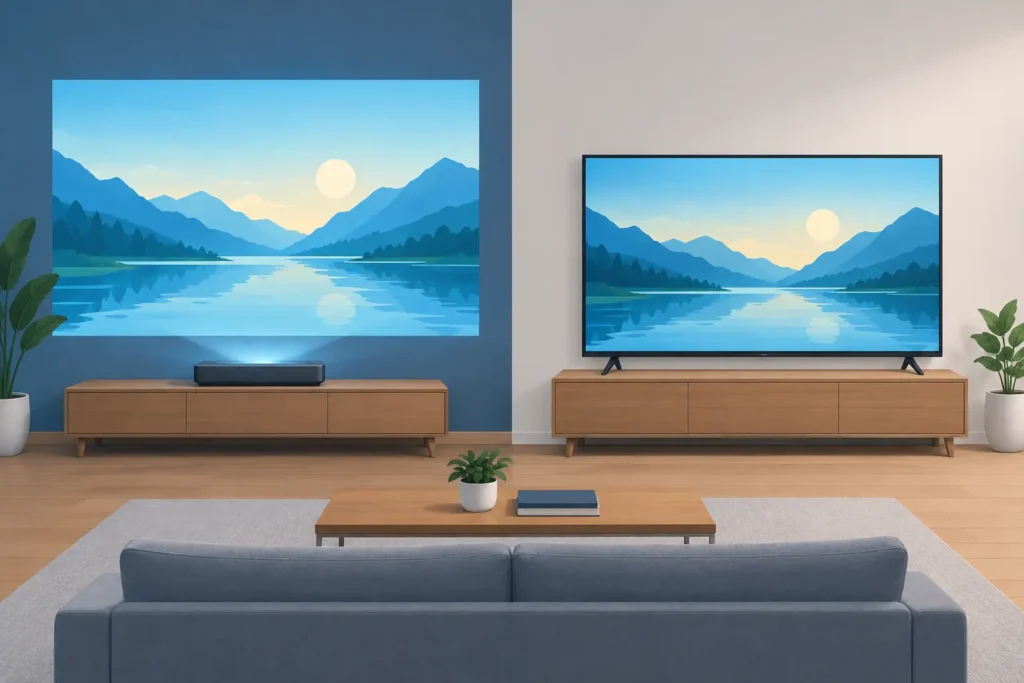
A 100-inch picture changes the way a movie night, sales presentation, or lesson feels. But when comparing ultra short throw versus television, the biggest screen is not automatically the best choice. The right display depends on room light, viewing distance, installation expectations, content habits, and how much flexibility you need after purchase.
An ultra short throw projector can create a cinema-scale image from a cabinet positioned just inches from the wall or screen. A television delivers a bright, all-in-one display with predictable performance. Both can produce an extraordinary visual experience, but they solve different problems.
Ultra Short Throw Versus Television: The Core Difference
An ultra short throw, or UST, projector uses a specialized lens to cast a large image from an extremely short distance. Rather than placing a projector across the room or mounting it on the ceiling, you place the unit directly beneath the image area. Many models can produce 100 inches or more from only a few inches away from the wall.
A television is a self-contained display panel. Its picture size is fixed, its brightness is generally higher, and setup is usually as simple as mounting it or placing it on a stand. If you buy a 75-inch TV, you receive a 75-inch screen every time, with no projection alignment or separate screen to consider.
The practical question is not whether a projector or TV is technically better. It is whether you need a display that prioritizes size and flexibility, or one that prioritizes everyday convenience and brightness.
When an Ultra Short Throw Projector Is the Better Buy
You want a true big-screen experience
This is where UST projection has its strongest advantage. Large televisions become significantly more expensive as screen size increases, especially beyond 85 inches. A quality ultra short throw projector can make a 100-inch, 120-inch, or larger image more attainable for home theaters, training rooms, classrooms, and event spaces.
For films, live sports, and multiplayer gaming, screen size creates impact that is difficult to duplicate with a standard television. A UST projector can turn a media room into a dedicated viewing space without requiring a long-throw ceiling installation.
You have limited room depth
Traditional projectors need distance between the lens and the screen. That can be inconvenient in a compact apartment, meeting room, or classroom where people may walk through the projection path. An ultra short throw projector sits near the wall, keeping the floor area clearer and reducing the risk of shadows crossing the image.
This is also useful for presentations. A presenter can stand near the screen without blocking as much light as they would with a conventional projector. For interactive learning or collaborative work, pairing a UST model with the correct screen or interactive display solution can create a more usable front-of-room setup.
You want a screen size that can evolve
A television locks you into one size. A projector gives you more choice, provided the room and screen support it. You may begin with a 100-inch screen and move to 120 inches later, or choose a smaller image when working within a tighter wall area.
That flexibility is valuable for homeowners moving between properties, businesses fitting out different meeting rooms, and schools standardizing equipment across classrooms. Check the manufacturer's recommended image range before purchasing. Not every UST projector delivers its best focus and geometry at every size.
When a Television Is the Smarter Choice
Your room has strong daylight
TVs have a clear advantage in bright spaces. Their panels produce high brightness and contrast without relying on reflected light from a projection screen. If sunlight enters through uncovered windows, or the display will run all day in a reception area, a TV is typically easier to live with.
Laser UST projectors can be very bright, often specified in ANSI lumens, and they perform well in controlled or moderately lit rooms. But projection is still affected by ambient light. A bright white wall reflects room light as well as projector light, which can make black levels look gray and reduce color depth.
For daytime UST viewing, an ambient light rejecting, or ALR, screen is often worth budgeting for. A screen designed specifically for ultra short throw projection directs more projected light toward viewers while rejecting more light from above and around the room. It can make a dramatic difference, but it adds to the total system cost.
You need the simplest possible setup
A television is usually the lower-effort option. Mount it, connect HDMI devices, sign in to streaming apps, and start watching. There is no image alignment, screen tension, focus adjustment, or concern about a wall surface being perfectly flat.
UST projectors are simpler than ceiling-mounted models, but they are not entirely plug-and-play. A small change in the projector's position can affect the image edges. The console must be level, the screen must be installed precisely, and cables need careful routing. Many current laser models include smart operating systems, HDMI connectivity, wireless casting, and built-in sound, but physical setup still matters.
You watch casual content throughout the day
For news, children's programming, quick streaming sessions, and always-on family-room use, a television is generally more convenient. It wakes quickly, remains visible in bright conditions, and does not require lights to be dimmed for an enjoyable picture.
That does not make a projector unsuitable for daily use. It simply means the room should support it. If your household mostly watches after sunset and values a cinematic image, a UST projector can still be the more rewarding choice.
Picture Quality: Brightness Is Not the Whole Story
A television usually wins on peak brightness, especially in high-end LED and OLED categories. It can show strong highlights in HDR content, maintain contrast in daylight, and deliver consistent performance without a separate screen.
A projector's picture quality is more dependent on the complete environment. The projector, screen, wall color, room lighting, and seating position all influence the result. With a laser UST projector, a proper UST ALR screen, and controlled lighting, the image can look impressively sharp, vibrant, and immersive at 100 inches or more.
Resolution matters as well. Full HD remains suitable for presentations, classrooms, and value-focused entertainment. For close seating and detailed movie or gaming content, 4K is the stronger choice. Look beyond marketing labels and confirm native resolution, supported input formats, HDR capability, and the number of HDMI ports needed for your devices.
Gaming, Sound, and Connectivity Considerations
Gamers should check input lag, refresh-rate support, and HDMI features before choosing either option. A TV may offer more advanced gaming features, such as higher refresh rates and dedicated low-latency modes. However, a UST projector with low input lag can be excellent for console gaming when a massive image is the priority.
Sound deserves equal attention. Televisions have built-in speakers, but thin cabinets limit their impact. Many ultra short throw projectors include enhanced speaker systems, and some are designed as all-in-one home entertainment units. Still, a soundbar or dedicated sound system can improve dialogue, bass, and immersion for either display type.
For offices and schools, confirm compatibility with laptops, document cameras, wireless display dongles, and existing HDMI infrastructure. Wireless features are convenient, but a wired HDMI connection remains the most dependable choice for high-resolution presentations and time-sensitive meetings.
Compare the Total Cost, Not Only the Display Price
A television price is relatively straightforward: the TV, a wall mount or stand, and possibly a soundbar. A UST projector installation can include the projector, UST ALR screen, cabinet or wall mount, HDMI cable, audio equipment, and professional setup support.
That does not mean televisions are always cheaper. At very large sizes, the equation can shift quickly in favor of projection. Compare the cost of achieving the screen size you actually want, not just the price of the first product you see.
For business, education, and multi-room purchases, request a detailed quote that includes mounting, screen options, cables, audio, and any required accessories. A complete display system avoids the common mistake of buying a capable projector without the components needed to get its best picture.
Choose for the Room You Actually Use
Choose a television if you need maximum daytime brightness, fast setup, frequent casual viewing, and a fixed screen size. Choose an ultra short throw projector if you want 100 inches or more, have a controlled-light environment, and value the theater-scale experience without placing a projector across the room.
Before making the final decision, measure the wall, note where windows and lights sit, and think about when the display will be used most. A carefully matched display does more than fill a wall – it makes every film, lesson, presentation, and game feel worth watching.