
TL;DR:
- Ultra short throw projectors use complex optical systems to project large images from very close distances, ideal for small Malaysian rooms and classrooms. They outperform standard projectors in tight spaces but require specialized screens and precise setup for optimal performance. Proper room measurement and screen selection are essential to maximize UST benefits and avoid marketing myths about replacing TVs.
Most people assume "ultra short throw" is just a fancy label on a projector box. It sounds like a minor spec variation, the kind of detail that only matters to AV nerds. But the reality is that UST projectors use an entirely different class of optical engineering compared to anything you've seen before, and understanding that difference changes how you shop, set up, and actually enjoy your display. Whether you're furnishing a KL apartment, upgrading a classroom in Penang, or refreshing your meeting room, this guide breaks down exactly how UST works and whether it belongs in your space.
Table of Contents
- What is ultra short throw? The science behind UST projectors
- How ultra short throw compares: UST vs other projector types
- Core features: What sets UST projectors apart
- Maximizing UST performance: Essential screens and setup in Malaysia
- The surprising truth about ultra short throw projectors in Malaysian spaces
- Explore top UST and projector solutions with Projector Display
- Frequently asked questions
Key Takeaways
| Point | Details |
|---|---|
| Ultra short throw defined | UST projectors use advanced optics to display large images from just centimeters away, making them ideal for compact Malaysian rooms. |
| Requires special screens | ALR/CLR screens are essential for clear, bright UST images since ordinary walls result in distortion and lost brightness. |
| Ideal for limited spaces | UST projectors provide cinema-style viewing where space is tight, such as city homes, classrooms, and business meeting rooms. |
| Specs matter—but setup too | High brightness and color specs are important, but screen choice and room setup are just as crucial for maximum performance. |
What is ultra short throw? The science behind UST projectors
The term "ultra short throw" refers to a projector's ability to cast a very large image from an extremely short distance. Specifically, a true UST projector can produce a 100-inch image from less than 50 centimeters away from the screen or wall. That's roughly the width of a laptop. A standard projector producing the same 100-inch image would need to sit 3 to 4 meters back. The practical gap between these two setups is massive.
What makes this possible isn't just a wider lens. UST projectors use specialized wide-angle lenses, aspherical elements, freeform mirrors, and mirror-lens hybrid systems to fold the optical path, projecting light at steep upward angles while correcting distortions that would otherwise make the image unusable. This is genuinely complex engineering. When you fold a light path that sharply, you introduce chromatic aberration, focus falloff, and geometric distortion. Fixing all three simultaneously is the reason top UST projectors cost significantly more than standard models.
Here's what the core UST optical system typically includes:
- Freeform mirror: Bends and redirects the light beam at extreme angles without losing image geometry
- Aspherical lens elements: Correct edge distortion across a wide projection angle
- Mirror-lens hybrid systems: Combine reflective and refractive optics to manage focus at steep throw angles
- Electronic keystone and distortion correction: Software layer that fine-tunes any remaining geometric errors
"A UST projector isn't just a projector placed closer to the screen. It's a fundamentally different optical instrument, built from the ground up to solve problems that standard throw designs never encounter."
For Malaysian users, this matters because homes and classrooms here tend to have compact layouts. A terrace house living room or a school lab with fixed furniture arrangements rarely offers the 4-meter runway a standard projector demands. The Epson EB-760Wi is a strong example of how UST technology has been adapted for interactive educational environments, projecting large collaborative surfaces even in tight classrooms.
How ultra short throw compares: UST vs other projector types
Not all close-range projectors are the same. The market segments these into three categories: standard throw, short throw, and ultra short throw. Understanding where each fits helps you avoid overspending or underbuying.
| Feature | Standard throw | Short throw | Ultra short throw |
|---|---|---|---|
| Throw distance (100" image) | 3.0 to 4.5m | 0.8 to 1.5m | Under 0.5m |
| Shadow risk | High | Medium | Very low |
| Shadow-free presentations | No | Partial | Yes |
| Screen type needed | Standard | Standard | ALR/CLR preferred |
| Room depth requirement | 4m+ | 2m+ | Under 1.5m |
| Typical price range (Malaysia) | Budget to mid | Mid to upper-mid | Upper-mid to premium |
| Best use case | Home theater, large halls | Small offices, homes | Apartments, classrooms, meeting rooms |
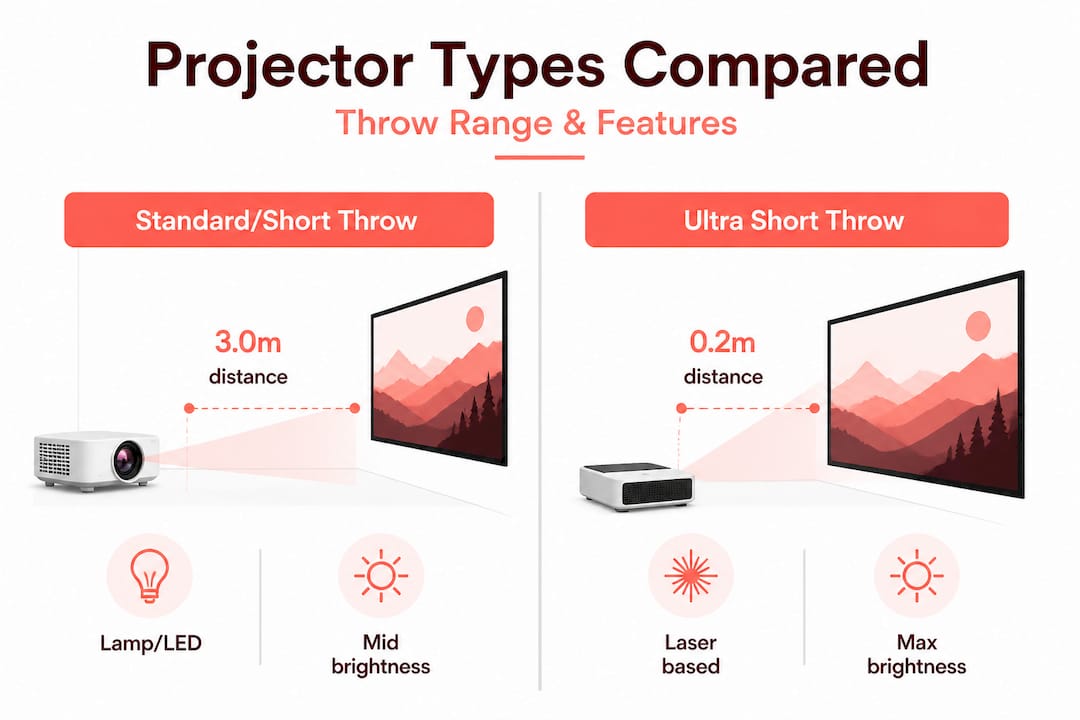
The difference between short throw and long throw projectors is worth reading in full if you're still deciding, especially if your space isn't particularly tight. But for rooms under 3.5 meters deep, UST becomes not just an option but a practical necessity.
Pro Tip: Marketing sometimes overstates UST as a direct TV replacement due to the added cost of ALR screens, brightness trade-offs from steep light angles, and pricing above standard throw alternatives. UST genuinely excels in small rooms under 3.5 meters deep, but if your room has depth to spare and budget is a concern, a standard throw may deliver better value per ringgit.
When UST makes the most sense:
- City apartments in KL or Penang: Rooms often measure 3.5 meters or less from wall to sofa, making standard throw impractical
- School classrooms with fixed furniture: Mounting a UST projector low on the front wall eliminates shadows from students or teachers
- Corporate meeting rooms: Presenters can walk freely without blocking the beam, a real problem with standard throw in tight boardrooms
- Interactive setups: Many UST models support touch or stylus input at large screen sizes, which is nearly impossible with a standard throw due to shadow interference
You can also browse a Bahasa Malaysia guide on short throw versus long throw if that's easier for your team or students to reference.
Core features: What sets UST projectors apart
Once you've confirmed UST is the right category for your space, the next question is which model fits your use case. This is where specs start to matter, and where a lot of buyers get misled by headline numbers.
Brightness is not a simple bigger-is-better stat. Real-world brightness benchmarks show meaningful differences from rated specs: the Epson Lifestudio Grand measures around 3,776 ANSI lumens despite a 3,600 ISO rating, the QS100 hits approximately 4,479 ANSI lumens against a 4,500 ISO rating, and the AWOL Aetherion Max lands between 2,900 and 3,300 ANSI lumens at a rated 3,300 ISO. These are all competitive models with broadly similar brightness, but their image quality in a typical Malaysian living room with daylight coming through sheer curtains varies considerably depending on screen choice.
| Model | Rated lumens (ISO) | Measured ANSI lumens | Panel tech | 4K | Gaming latency |
|---|---|---|---|---|---|
| Epson Lifestudio Grand | 3,600 | ~3,776 | 3LCD laser | Pixel-shift | ~10-20ms |
| Epson QS100 | 4,500 | ~4,479 | 3LCD laser | Pixel-shift | Moderate |
| AWOL Aetherion Max | 3,300 | ~2,900-3,300 | ALPD laser | Native 4K | Low |
Laser sources including RGB, ALPD, and 3LCD are now standard in UST projectors for a good reason: they deliver longer lifespans, faster warm-up times, and significantly wider color gamuts than lamp-based alternatives. Pixel-shift technology processes a lower native resolution panel and shifts pixels rapidly to simulate 4K detail. It's not identical to native 4K but performs well for video content and presentations. For pure gaming or pixel-perfect content, native 4K panels like those in ALPD models offer a more precise result.
Pro Tip: A projector rated at 5,000 lumens means very little without knowing your screen's gain and ambient light conditions. A 3,000-lumen UST paired with a high-gain ALR screen in a controlled room will often look sharper and more vivid than a 5,000-lumen unit hitting a plain white wall. Pair your brightness spec research with screen selection.
Additional features worth checking before you buy:
- Input lag under 30ms for gaming (check the pixel shifting explained page for how panel tech affects this)
- HDMI 2.1 or eARC support for 4K 60fps sources
- Built-in Android TV or smart OS for streaming without an external device
- Voltage compatibility for Malaysian power (220-240V, 50Hz standard)
The ViewSonic LS832WU is a noteworthy UST option with 5,000 ANSI lumens and WUXGA resolution, making it well suited for bright business or classroom environments where ambient light control is limited.
Maximizing UST performance: Essential screens and setup in Malaysia
Buying a UST projector without the right screen is like buying a high-end DSLR and shooting through a dirty window. The screen is not optional equipment. It is half the image quality equation.
Here's why an ordinary wall or standard projector screen fails with UST optics. Because UST projectors cast light at steep upward angles, a flat white surface reflects much of that light toward the ceiling rather than back to your eyes. UST projectors require ALR or CLR screens for optimal performance because the specialized microstructure layers in these screens redirect steeply angled light back toward the viewer while rejecting ambient light coming from above and the sides. Without these rejection layers, walls cause distortion and significant image washout.
Setting up your UST projector for best results:
- Choose the right screen first. Select a CLR (ceiling light rejecting) screen for the highest ambient light performance. These are specifically engineered for the steep projection angle of UST units. ALR screens work well in dimmer rooms but may show hotspots in bright Malaysian living rooms with open windows.
- Place the projector on a stable, level surface. UST units are sensitive to tilt. Even a 2-degree off-level placement shifts the projected image noticeably and strains the electronic correction system.
- Check the throw distance against your screen size. Use the manufacturer's throw ratio calculator. Most UST units have a very narrow acceptable range, sometimes just 5 to 10 centimeters, between "too small" and "too large" for a given screen size.
- Control ambient light from above. Malaysian homes often have downlighting or ceiling fans with integrated lights directly above the viewing area. These sources directly counter CLR screen performance. Dimmer switches or repositioned lighting help significantly.
- Allow ventilation clearance. UST projectors sit close to the screen, but they still generate heat. Leave at least 20 to 30 centimeters of open space around the unit's vents.
Common mistakes to avoid in Malaysian setups:
- Using a screen without checking UST compatibility. Standard gain screens with front-facing fibers scatter UST light incorrectly
- Placing the projector on an unstable entertainment unit. Any vibration from speakers or foot traffic shifts the image mid-use
- Ignoring sunlight from east or west-facing windows. Malaysian afternoon sun through thin curtains will wash out even a 4,000-lumen UST. Block or diffuse that light source
- Skipping the calibration step. Most UST projectors include a dedicated UST or floor-stand mode. Using the wrong preset reduces color accuracy and brightness
Browse our guide on projection screen types to compare ALR, CLR, and standard fixed-frame options before you decide.
The surprising truth about ultra short throw projectors in Malaysian spaces
Here's the perspective that most buying guides skip over entirely: UST projectors are genuinely transformative for the right setup and genuinely wasteful for the wrong one.
We've spoken with many Malaysian buyers who purchased a UST projector based on marketing positioning it as a "TV replacement." Several discovered afterward that their open-plan living areas with ambient light, ceiling fans directly overhead, and plain plastered walls were working against every strength the UST system offered. The projector wasn't the problem. The mismatch between product category and real environment was.
Marketing frequently overstates UST as a TV replacement, driven partly by the "wow factor" of projecting a 120-inch image from inches away. But a quality 85-inch OLED TV will outperform a UST projector on a plain wall in a bright room every single time, and cost less when you factor in the ALR screen. This is an uncomfortable truth that UST marketing rarely volunteers.
Where UST genuinely wins in Malaysia is specific and real. A 3-room apartment in Cheras or Subang where the living area is literally too short for a standard throw. A primary school classroom where the teacher moves constantly and a ceiling-mounted standard projector creates shadow problems daily. A compact boardroom in a Bangsar shophouse where cables and ceiling mounts aren't practical. In these cases, UST isn't a luxury upgrade. It's the practical solution.
Our honest advice: measure your room before you shop. If your viewing distance exceeds 4 meters, a standard throw projector at half the price will serve you better. If you're working with under 3 meters of depth and need a large image without mounting hardware, UST earns its premium price. Understand how to build a home theater around your actual space first, then select the projector category that fits that plan. Technology should serve your room, not force your room to serve the technology.
Explore top UST and projector solutions with Projector Display
You now have a solid foundation for making a smart UST decision. Taking that knowledge into real purchasing territory is where Projector Display can help.
At ProjectorDisplay.com, we carry a curated range of projector screens including ALR and CLR options specifically compatible with UST setups, plus the full UST projector lineup suited for Malaysian homes, classrooms, and boardrooms. Our team provides local advice on installation, screen selection, and ambient light management. Check out our content on future-ready projectors for classrooms for education-specific guidance, or browse current projector deals to find active promotions on UST models and accessories. Reach us via WhatsApp for personalized recommendations based on your actual room measurements and budget.
Frequently asked questions
Can ultra short throw projectors really replace a TV?
UST projectors offer large, high-quality images but require dedicated ALR screens and proper placement for best results. Marketing tends to overstate the TV replacement case because screen costs, ambient light limitations, and higher unit prices make them a specialized solution rather than a universal TV swap.
What type of screen do I need for a UST projector?
You need an ALR (ambient light rejecting) or CLR (ceiling light rejecting) screen for optimal UST performance. Without these specialized rejection layers, steeply angled UST light bounces toward the ceiling, causing washed-out and distorted images on plain walls or standard screens.
Are UST projectors good for gaming?
Yes, many modern UST models are well-suited for gaming thanks to low input latency. Laser-based UST projectors like the Epson Grand Plus achieve input lag in the 10-20ms range, which is competitive with mid-range gaming monitors and well within acceptable thresholds for most game genres.
How bright should a UST projector be for a well-lit room?
For a bright Malaysian living room, target at least 3,000 ANSI lumens from your UST projector and pair it with a high-gain ALR screen. Measured benchmarks from top UST models range from around 2,900 to over 4,400 ANSI lumens, giving you realistic targets to match against your room's ambient light level.
Recommended
- 6 Best Small Room Projectors for Easy Home Theater Setup – Projector Display
- ViewSonic LS710HD Short Throw Laser Projector – Projector Display
- Epson EB-760Wi Laser Ultra Short Throw Interactive Projector – Projector Display
- Epson EB-L200SX XGA 3600 Lumens 3LCD Short Throw Projector – Projector Display