

Only about 40 percent of corporate leaders worldwide feel confident in their ability to drive technological change and engage stakeholders effectively. For emerging professionals in Malaysia, mastering skills that combine visual communication with technology integration has become essential. Learning from American strategies, leaders can build stronger teams and deliver presentations that inspire results. This article reveals practical, innovative techniques to help you communicate with impact in digital-first corporate environments.
Table of Contents
- Defining Skills For Future Leaders
- Key Types Of Leadership Capabilities
- Technology Integration And Ai Fluency
- Visual Communication In Modern Leadership
- Risks, Mistakes, And Effective Development
Key Takeaways
| Point | Details |
|---|---|
| Holistic Skill Development | Future leaders need a diverse range of skills, including cognitive agility, emotional intelligence, and technological adaptability, to navigate complex environments. |
| Visual Communication | Leaders must master visual storytelling and multimedia tools to effectively engage and connect with diverse audiences. |
| Proactive Leadership Development | Emphasizing proactive approaches to leadership development can enhance resilience and prepare leaders for future challenges. |
| Technology Integration | Understanding AI and digital tools is essential; leaders should focus on integrating these technologies into business processes responsibly. |
Defining Skills for Future Leaders
In an era of rapid technological transformation, future leaders must develop a holistic skill set that transcends traditional management approaches. Global skills frameworks highlight the critical need for adaptable competencies that enable professionals to navigate complex, unpredictable environments.
The emerging leadership paradigm demands more than technical expertise. McKinsey research indicates that successful leaders will require a multidimensional skill profile integrating cognitive agility, digital fluency, interpersonal intelligence, and robust self-leadership capabilities. This means moving beyond linear skill acquisition toward developing an integrated, dynamic approach to professional growth that emphasizes continuous learning and strategic thinking.
Key skills for future leaders include advanced problem solving, emotional intelligence, cross-cultural communication, technological adaptability, and the ability to synthesize information from diverse sources. These competencies enable professionals to drive innovation, manage complexity, and create meaningful organizational impact. Effective leaders will need to balance strategic vision with practical execution, leveraging both human creativity and technological capabilities.
Pro tip: Invest at least 5 hours weekly in deliberate skill development through targeted online courses, professional workshops, or cross-functional project experiences.
Key Types of Leadership Capabilities
Modern leadership demands a sophisticated blend of capabilities that extend far beyond traditional management techniques. Critical leadership competencies now encompass a dynamic range of skills that enable professionals to navigate complex organizational landscapes with agility and strategic insight.
The contemporary leadership framework includes several core capabilities: strategic planning, interpersonal communication, emotional intelligence, and adaptive problem solving. These capabilities are not standalone skills but interconnected competencies that work together to create holistic leadership effectiveness. Professionals must develop the ability to think systemically, communicate transparently, and respond flexibly to rapidly changing business environments.

Key leadership capabilities can be categorized into cognitive, emotional, and strategic domains. Cognitive capabilities include analytical thinking, creative problem solving, and technological literacy. Emotional capabilities involve empathy, self-awareness, and relationship management. Strategic capabilities focus on vision development, change management, and organizational alignment. Emerging leadership skills increasingly emphasize the importance of inclusivity, cross-cultural understanding, and the capacity to lead diverse, distributed teams.
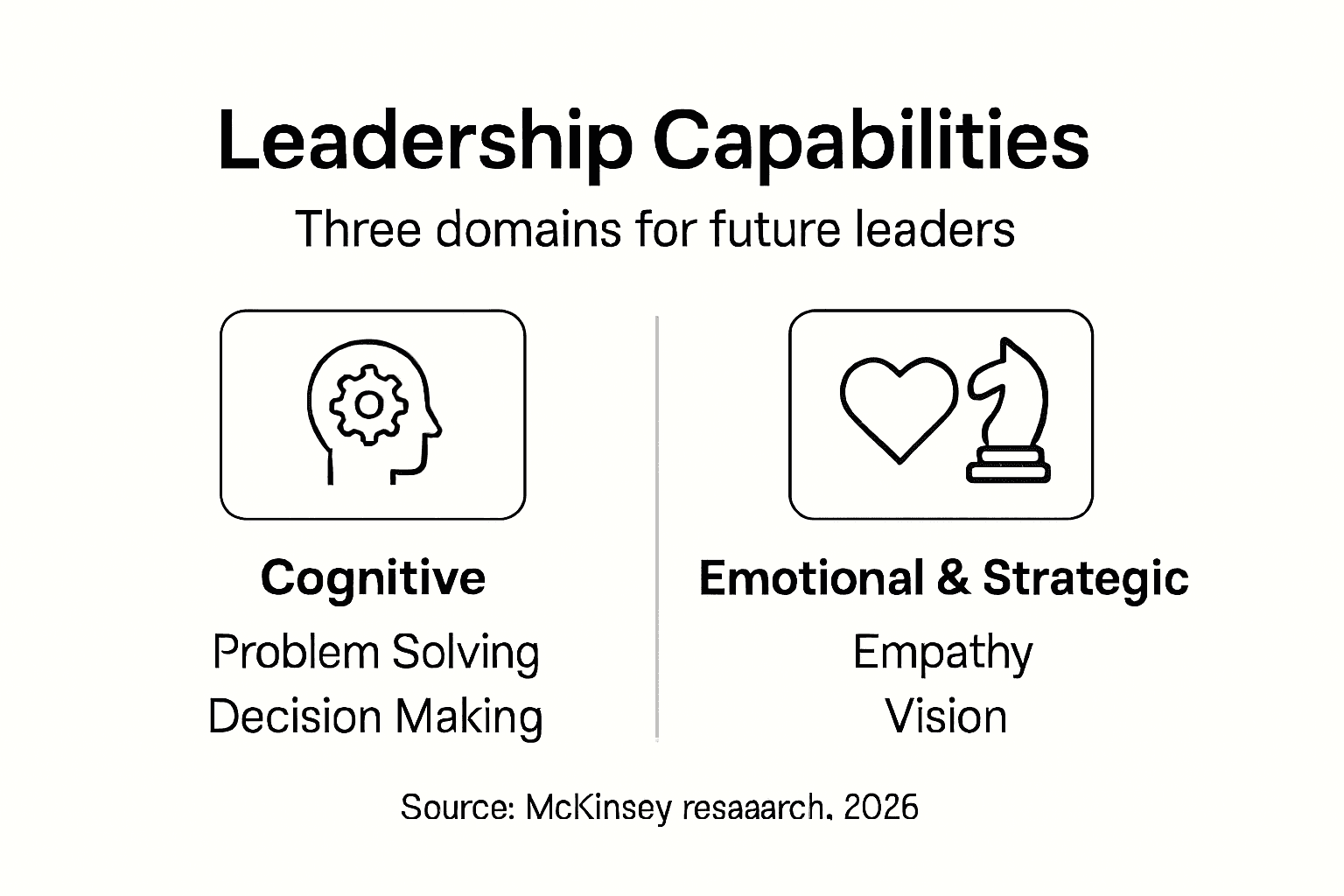
Pro tip: Conduct a quarterly self-assessment of your leadership capabilities, identifying specific areas for targeted development and creating a personalized growth plan.
Here's a summary of essential leadership skill domains and their business impact:
| Skill Domain | Key Components | Business Impact |
|---|---|---|
| Cognitive | Analytical thinking, agility | Drives innovation and strategy |
| Emotional | Empathy, self-awareness, resilience | Enhances team collaboration |
| Strategic | Vision, change management | Aligns organization to goals |
| Technological | AI fluency, tech adaptability | Enables digital transformation |
Technology Integration and AI Fluency
In the rapidly evolving digital landscape, digital literacy and AI fluency have become essential competencies for modern leaders. Professionals must develop a sophisticated understanding of technological tools that goes beyond basic operational skills, focusing instead on strategic implementation and critical evaluation of emerging technologies.
Artificial Intelligence is no longer a distant concept but an immediate organizational reality. Leaders must cultivate the ability to understand AI's potential, integrate intelligent systems into workflow processes, and make informed decisions about technological adoption. This requires a nuanced approach that balances technological innovation with human-centric design, ensuring that AI serves organizational goals while maintaining ethical considerations and human agency.
Technology integration demands a multifaceted skill set that combines technical knowledge with strategic thinking. Future job skills increasingly emphasize the importance of blending analytical capabilities with creative problem solving. Successful leaders will need to demonstrate fluency in data interpretation, AI tool selection, algorithmic understanding, and the ability to translate technological potential into tangible business outcomes. This includes developing skills in machine learning comprehension, understanding algorithmic bias, and creating frameworks for responsible technological implementation.
Pro tip: Dedicate at least two hours weekly to learning about emerging AI technologies and their potential applications in your specific industry context.
Visual Communication in Modern Leadership
Leadership communication strategies have dramatically transformed, demanding proficiency in visual storytelling and digital communication tools. Modern leaders must move beyond traditional text-based communication, embracing multimedia approaches that engage, inspire, and connect with diverse audiences across various platforms and cultural contexts.
Visual communication has become a critical leadership competency, particularly in hybrid and remote work environments. Leaders must develop skills in creating compelling presentations, utilizing data visualization techniques, and crafting narratives that communicate complex ideas through graphics, videos, and interactive digital media. This requires a strategic approach that combines technological literacy with emotional intelligence, enabling leaders to translate abstract concepts into visually engaging and easily digestible formats.
The ability to communicate visually extends beyond mere technical proficiency. Multimodal communication skills now encompass understanding audience perception, cultural nuances, and the psychological impact of visual design. Effective leaders must learn to curate visual content that is not only informative but also emotionally resonant, creating connections that transcend traditional communication barriers and foster deeper organizational understanding.
Pro tip: Invest in developing a personal visual communication portfolio, practicing storytelling through infographics, short videos, and interactive presentations to enhance your leadership communication skills.
Risks, Mistakes, and Effective Development
Leadership development programs provide structured approaches to understanding and mitigating professional risks. Successful leaders recognize that mistakes are not failures but essential learning opportunities that drive personal and organizational growth. By adopting a proactive mindset, professionals can transform potential setbacks into strategic advantages that enhance resilience and adaptability.
Reflective practice stands as a critical component of effective leadership development. Future leaders must cultivate the ability to analyze mistakes objectively, extracting meaningful insights that inform future decision making. This requires emotional intelligence, intellectual humility, and a commitment to continuous improvement. Strategic risk management involves not just avoiding potential pitfalls but developing systematic approaches to understanding, anticipating, and constructively navigating organizational challenges.
Adaptive leadership strategies emphasize the importance of creating institutional frameworks that support learning from mistakes. This means developing organizational cultures that encourage transparent communication, psychological safety, and constructive feedback mechanisms. Leaders must design development programs that integrate comprehensive assessment tools, mentorship opportunities, and targeted skill-building interventions that transform potential vulnerabilities into strengths.
The table below compares proactive vs. reactive approaches to leadership development:
| Approach | Definition | Advantages | Risks |
|---|---|---|---|
| Proactive | Anticipates challenges | Increases resilience and agility | May require more resources |
| Reactive | Responds to problems | Quick response to issues | Can lead to missed opportunities |
Pro tip: Create a personal mistake journal documenting professional challenges, capturing key learnings, and developing actionable strategies for future improvement.
Elevate Your Leadership Impact with Cutting-Edge Visual Solutions
Future leaders face a rapidly evolving landscape where strategic vision and technological fluency are vital for success. As highlighted in "Skills for Future Leaders: Achieving Impact in 2026," mastering digital tools like visual communication and AI integration is key to driving innovation and effectively conveying complex ideas within diverse teams. However, one common challenge leaders encounter is finding reliable, high-quality projection solutions that enhance presentations and remote collaborations while supporting their inclusive and dynamic leadership approach.
At ProjectorDisplay.com, we understand how essential immersive and adaptable display technology is for modern leadership success. Whether you need portable projectors for on-the-go presentations or smart projectors with wireless connectivity to engage distributed teams, our wide range of products is designed to empower your leadership capabilities. Our solutions enable you to translate strategic concepts into compelling visual narratives, fostering stronger organizational alignment and clearer communication.
Take the first step in transforming your leadership effectiveness. Explore our collection of projectors and interactive displays tailored for business presentations and educational environments.

Unlock the power of technology to support your leadership journey now. Visit ProjectorDisplay.com and experience fast shipping and expert support within Malaysia to make your vision a reality.
Frequently Asked Questions
What key skills are essential for future leaders to succeed in 2026?
Future leaders should focus on developing advanced problem solving, emotional intelligence, cross-cultural communication, technological adaptability, and the ability to synthesize information from diverse sources.
How can leaders balance strategic vision with practical execution?
Successful leaders leverage both human creativity and technological capabilities, ensuring they can think systemically and respond flexibly to changing business environments while maintaining a clear vision.
Why is AI fluency important for leaders today?
AI fluency is crucial as it enables leaders to understand AI's potential, integrate it into workflows, and make informed decisions about technology adoption, which is essential in driving digital transformation.
What role does visual communication play in modern leadership?
Visual communication is important as it helps leaders convey complex ideas engagingly and effectively. Proficiency in creating presentations and utilizing data visualization enhances leaders' ability to connect with diverse audiences.
Recommended
- Developing Leadership Skills: Real Impact for Managers – Projector Display
- Future Skills for Students – Preparing for Tomorrow's Needs – Projector Display
- 21st Century Teaching Skills: Everything You Need to Know – Projector Display
- The Essential Guide to Teaching Critical Thinking Skills – Projector Display
- Die Zukunft der Robotik: Trends, KI-Upgrades und neue Systeme 2026 – Robo-Guru