
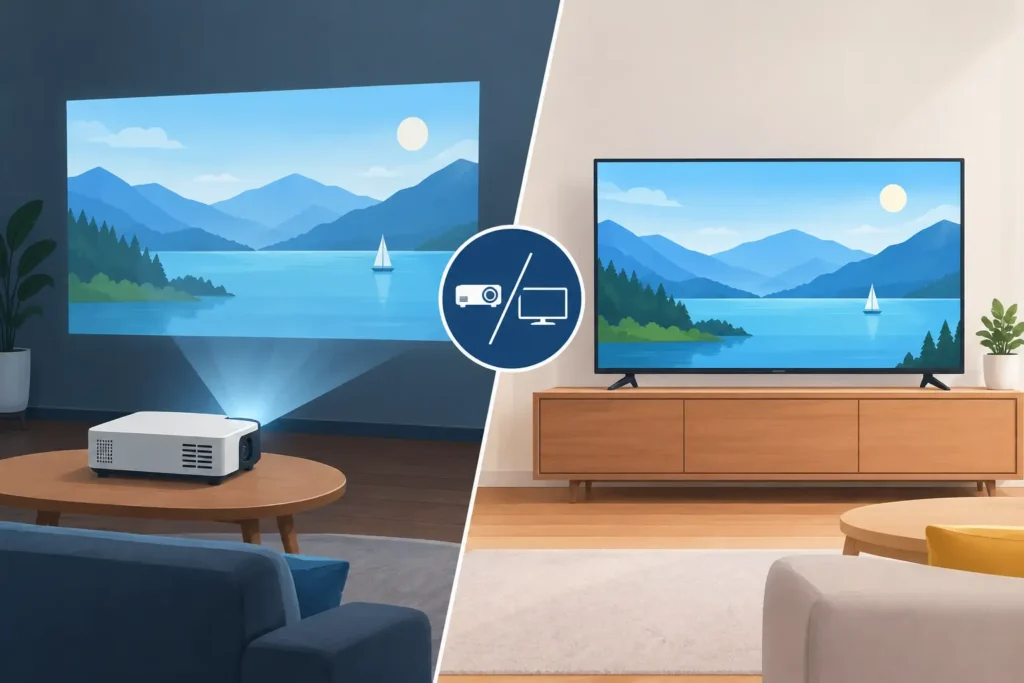
A 75-inch TV can make a room feel premium. A 100-inch projected image can make the same room feel like movie night. That difference is the real starting point for a projector versus television decision: are you buying a display for everyday convenience, or are you building an experience around a larger image?
Neither option wins in every room. Televisions are bright, simple, and ready at the press of a button. Projectors offer screen sizes that most TVs cannot match at a comparable price, with flexible placement options for homes, training rooms, classrooms, and presentations. The right choice depends on how and where the display will be used.
Projector Versus Television: The Core Difference
A television is an all-in-one display. The panel, speakers, smart platform, and inputs are built into one unit. Place it on a stand or mount it on a wall, connect your devices, and it is ready to use. Modern 4K TVs also deliver excellent brightness, contrast, and motion handling without much adjustment.
A projector creates an image by throwing light onto a screen or suitable wall. That means the projector is only one part of the system. Throw distance, screen size, ambient light, mounting position, source devices, and audio all shape the final result. This involves more planning, but it also gives buyers more control over the viewing experience.
For many homes, a TV is the practical main display in a bright living room. A projector becomes the more exciting choice for dedicated entertainment spaces, larger gatherings, flexible setups, and any situation where a 100-inch or 120-inch image changes the way people watch, learn, or present.
Screen Size and Viewing Impact
Screen size is where projectors make their strongest case. Large televisions have become more accessible, but moving from 65 inches to 85 inches still represents a major jump in cost, delivery considerations, wall space, and installation weight. A Full HD or 4K projector can create a 100-inch image and beyond without requiring a panel of that physical size.
That scale matters more than many buyers expect. Movies feel more immersive, sports become easier for a group to follow, and split-screen gaming is genuinely usable. In a classroom or meeting room, larger text, diagrams, and video content can be seen by more people without crowding around a display.
However, bigger is not automatically better. If seating is too close to a low-resolution image, pixels and compression become more noticeable. For large-format viewing, Full HD should be the minimum for most entertainment setups, while 4K is the stronger option for detailed movies, gaming, and close seating. In business and education, resolution should also match the content. XGA may be sufficient for basic slides, but Full HD is clearer for spreadsheets, video, and detailed teaching materials.
Bright Rooms Favor Televisions
Brightness is often the deciding factor. TVs are designed to compete with daylight and overhead lighting. In a sunlit family room, a good television usually produces stronger contrast and a more consistent image than a projector. It is the easier choice for daytime news, casual streaming, and all-day use.
Projectors can perform very well in brighter spaces, but specifications matter. Look beyond marketing claims and compare ANSI lumens where available. A higher ANSI lumen rating helps the image remain visible when some room lighting is present. For presentations in offices and classrooms, brightness is especially important because lights often need to stay on for note-taking and participation.
For home cinema, controlling light remains the best upgrade. Blackout curtains, dimmable lighting, and a proper projector screen can improve perceived contrast dramatically. Laser projectors offer stable brightness, quick startup, and a long light-source life, making them an attractive option for frequent viewing. Still, even a powerful projector cannot fully reproduce the deep blacks of a quality TV in a brightly lit room.
Setup, Space, and Installation
A television asks very little of the room. Measure the wall, choose a suitable mount or cabinet, and allow for power and HDMI connections. It is ideal for renters, compact rooms, and buyers who want minimal setup.
A projector requires a little more geometry. Standard-throw models need enough distance between the lens and screen to create the desired image size. Ceiling mounting is clean and permanent, while a portable table setup is flexible for occasional movie nights. A short-throw projector can create a large image from much closer to the wall, making it useful in smaller rooms, classrooms, and meeting spaces. Ultra-short-throw models sit very close to the screen and can be a smart alternative to an oversized TV, though the screen surface and placement must be precise.
Before buying, measure the room depth, ceiling height, and available screen wall. Check the projector’s throw ratio rather than estimating by image size alone. Also consider cable routing. An HDMI cable may be all that is needed for a simple setup, while wireless display options, AirPlay support, or a streaming device can reduce visible cables and make sharing content easier.
Picture Quality: Contrast, Color, and Motion
Televisions generally have the advantage in black level, HDR impact, and consistency. Their pixels produce light directly, which helps them show dark scenes with more depth, particularly in an OLED or advanced LED display. TVs also tend to handle fast motion well for sports and action gaming.
Projector image quality depends heavily on the model, source material, screen, and room conditions. A well-matched projector can produce rich color and a remarkably cinematic image. 3LCD projectors are valued for strong color brightness, while DLP models are often appreciated for sharpness and motion clarity. Laser light sources bring another benefit: they avoid regular lamp replacements and maintain performance over long operating hours.
Do not judge a projector only by its native resolution. A bright, accurately positioned Full HD projector on a quality screen can look more satisfying than a poorly installed higher-resolution model. Likewise, a white wall may work for casual viewing, but a dedicated screen improves image uniformity, brightness, and color reproduction.
Gaming, Streaming, and Everyday Use
For competitive gaming, a television often remains the easiest recommendation. Many current TVs offer low input lag, high refresh rates, and gaming-focused features with no alignment or warm-up concerns. If fast online play is the priority, compare actual input-lag figures rather than assuming every projector is suitable.
That said, projectors are excellent for cinematic single-player games, racing titles, sports games, and group play. A large projected image creates a scale that televisions struggle to match. Look for a projector with a dedicated low-latency or game mode, Full HD or 4K resolution, and HDMI connectivity compatible with your console or PC.
For streaming, both options are straightforward. Smart TVs put apps directly on the display. Smart Android projectors can do the same, while other projector models work well with a streaming stick, media box, laptop, or wireless dongle. The main consideration is not whether content can be streamed, but whether the projector has enough brightness and audio quality for the room where you plan to use it.
Sound Is Often the Missing Piece
Televisions include speakers, and for casual viewing they may be enough. Projectors may also include built-in audio, especially portable and smart models, but a large image deserves sound that fills the room. A soundbar, powered speakers, or a home theater system can make the setup feel complete.
For a business or classroom installation, audio should be planned around room size and audience position. A projector can display the message clearly, but weak sound can undermine a training video or presentation. Consider the complete display system: projector, screen, mount, cables, wireless sharing, and audio.
Cost and Long-Term Value
The best-value choice depends on desired size. At 55 to 75 inches, televisions offer strong value, simple ownership, and excellent everyday performance. At 100 inches and above, a projector system often becomes the more cost-effective route, even after adding a screen and mounting accessories.
There are operating costs to consider. Traditional lamp projectors eventually need replacement lamps, although they can still offer an attractive upfront price. Laser projectors cost more initially but reduce maintenance and are suited to buyers who expect many years of frequent use. TVs have fewer setup accessories, but their physical size can make upgrades, transport, and installation more demanding.
The sensible move is to budget for the complete experience, not just the display. A projector without the right screen, mount, or cable may disappoint. A large TV placed too high or paired with weak audio can do the same. ProjectorDisplay.com can help buyers compare projector types and build a display solution around the room instead of selling a single box.
If you want effortless daytime viewing and a display that works for every casual moment, choose the television that fits your wall and seating distance. If you want the room to transform when the lights go down, a projector gives you something a TV cannot easily replicate: a truly larger-than-life image.