
TL;DR:
- DLP projectors are best suited for Malaysia's humid and dusty environment due to their sealed design.
- Brightness needs vary from 1,200 lumens for dark rooms to over 3,500 for bright spaces.
- Regular maintenance like vent cleaning and proper storage extends projector lifespan in Malaysia's climate.
Buying a projector in Malaysia sounds straightforward until you're staring at a wall of specs, wondering why your brand-new unit overheats every afternoon or produces a washed-out image in your bright living room. Thousands of Malaysian buyers make the same mistakes every year, often spending between RM300 and RM2,799 on a projector that doesn't fit their actual environment. This guide answers the most common projector questions with local context in mind, covering the right types for Malaysia's humidity, the specs that actually matter, how to troubleshoot real problems, and how to keep your unit running for years.
Table of Contents
- Types of projectors in Malaysia: What works best?
- Projector specs explained: What matters in Malaysia
- Solving common projector issues in Malaysia
- Maintaining your projector: Malaysian best practices
- The real key to projector satisfaction in Malaysia: Test before you buy
- Get expert help and projector deals in Malaysia
- Frequently asked questions
Key Takeaways
| Point | Details |
|---|---|
| Choose climate-resistant models | DLP and laser projectors are best for Malaysia's humid and dusty conditions. |
| Pick the right brightness | Aim for 1200–2000 lumens for home use, and 3000+ for office or ambient light spaces. |
| Prioritize real-world testing | Test projectors in your actual space for true performance, not just on-paper specs. |
| Routine maintenance is key | Clean filters and lens every 3 months and keep humidity in check to extend lifespan. |
| Buy smarter with local advice | Rely on Malaysia-specific recommendations to avoid common regrets and costly mistakes. |
Types of projectors in Malaysia: What works best?
Malaysia's climate is not kind to electronics. High humidity, warm temperatures, and dust from urban and suburban environments mean your projector choice carries more weight than it does in, say, a dry European office. The three dominant technologies you'll encounter are DLP, LCD, and Laser, and each behaves very differently here.
DLP (Digital Light Processing) projectors use a chip covered in tiny mirrors to reflect light. Because the optical system is largely sealed, dust and moisture have fewer entry points. This makes DLP a strong choice for Malaysian homes and classrooms where air conditioning isn't always running. LCD projectors use liquid crystal panels and tend to produce richer colors, but their open design allows dust to settle on internal panels over time, causing visible spots on the image. Laser projectors skip the traditional lamp entirely, using a laser light source that lasts over 20,000 hours with almost no maintenance.
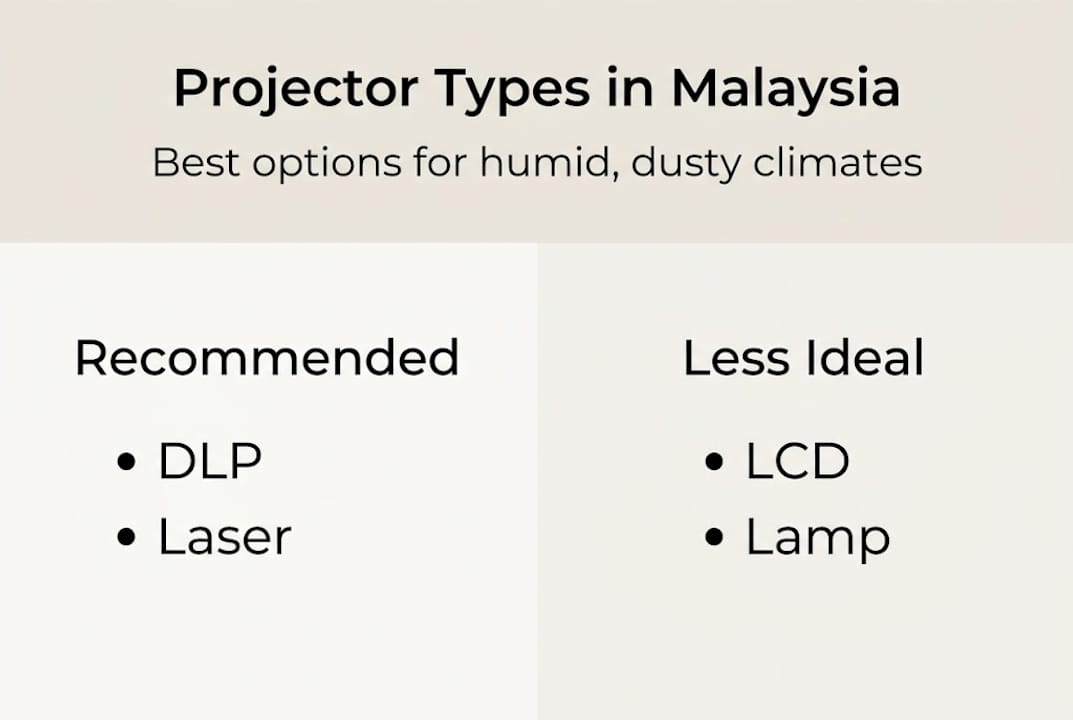
According to local projector data, DLP resists humidity and dust better than LCD, making it the preferred choice in Malaysia's tropical conditions. Laser and LED units are the lowest maintenance option overall, which is a serious advantage when you factor in Malaysia's climate.
Here's a quick comparison to help you decide:
| Type | Best for | Humidity resistance | Maintenance | Typical cost |
|---|---|---|---|---|
| DLP | Home, education, office | High | Low | RM800–RM2,500 |
| LCD | Color-critical work | Medium | Medium | RM600–RM2,000 |
| Laser | Long-term, business | Very high | Very low | RM1,500–RM5,000+ |
Pros and cons at a glance:
- DLP: Sharp images, sealed design, compact. Can show a "rainbow effect" to sensitive viewers.
- LCD: Vivid color, great for detailed presentations. Prone to dust spots and panel degradation.
- Laser: Exceptional lifespan, instant on/off, low heat. Higher upfront cost.
For a deeper breakdown, the projector types guide and LED vs laser comparison are worth reading before you commit.
Pro Tip: If your space isn't air-conditioned regularly, go with DLP or laser. They simply handle Malaysia's environment better than LCD over the long run.
Projector specs explained: What matters in Malaysia
Understanding types is essential, but knowing which specs matter most for your use case makes all the difference. A spec sheet can be misleading if you don't know what to look for, especially when shopping online.
Brightness (lumens) is the single most important spec for Malaysian buyers. Home entertainment needs 1,200–2,000 lumens in a dark room, while business and education settings require 3,000–4,000 lumens or more to compete with ambient light. Resolution determines image sharpness. Full HD (1920×1080) is the sweet spot for most users. Contrast ratio affects how deep blacks look, which matters most in home theater setups. Throw distance refers to how far the projector must sit from the screen to produce a given image size.
Here's a quick reference for Malaysian scenarios:
| Scenario | Brightness | Resolution | Throw type |
|---|---|---|---|
| Dark home theater | 1,200–2,000 lumens | Full HD | Standard |
| Bright living room | 2,500–3,500 lumens | Full HD | Short throw |
| Office presentation | 3,000–4,000 lumens | Full HD/4K | Standard |
| Classroom | 3,500–4,500 lumens | Full HD | Long throw |
To read a spec sheet properly, follow these steps:
- Identify the ANSI lumens rating (not "LED lumens," which is often inflated).
- Check the native resolution, not the "supported" resolution.
- Look at the throw ratio to confirm it fits your room dimensions.
- Confirm the contrast ratio is at least 2,000:1 for home use.
- Cross-check the screen combo recommendations to match screen gain with your room's lighting.
For buyers in smaller spaces, projectors for small rooms and the short throw vs long throw guide will help you narrow down the right throw distance for your layout.
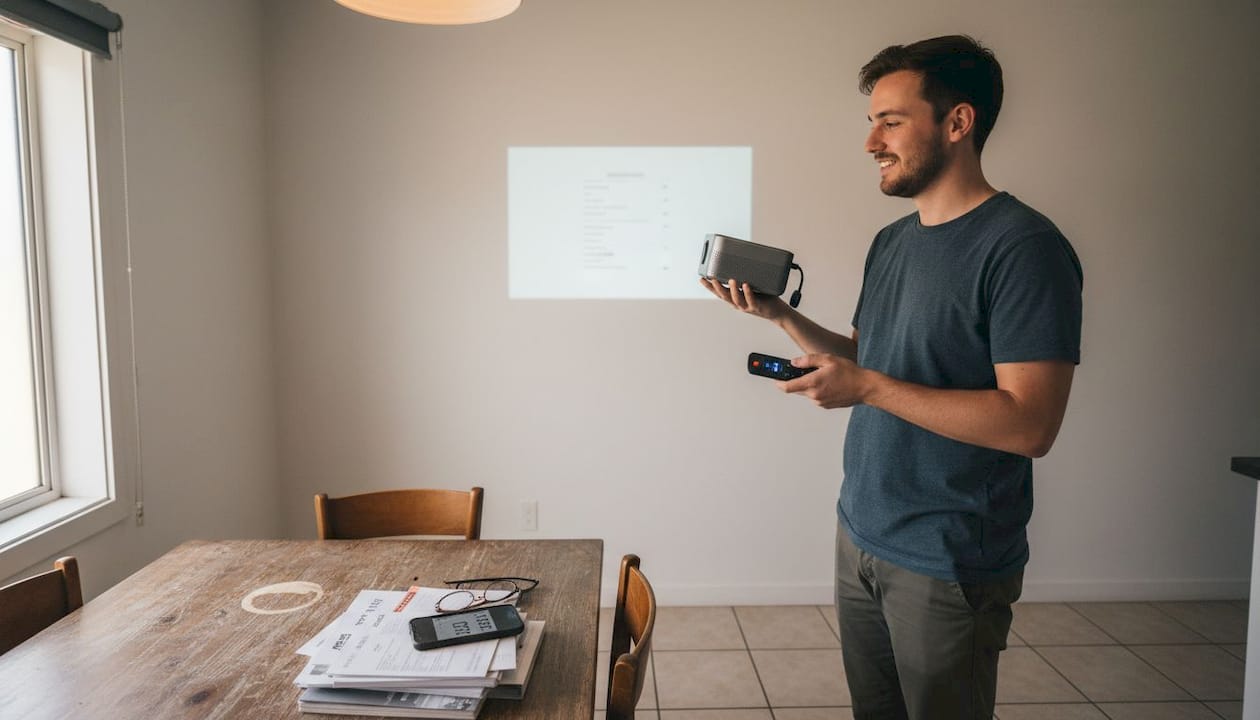
Pro Tip: Always test brightness in your actual room if possible. Showroom lighting is controlled, but your living room at 3pm with sunlight streaming through the window is a completely different story.
Solving common projector issues in Malaysia
Once you know what you want, it's essential to stay ahead of the issues projectors most often face in Malaysian homes or offices. The three most common complaints are overheating, blurry images, and audio problems.
Overheating is the number one issue. Dust, humidity, and poor ventilation are the primary culprits, often causing automatic shutdowns mid-presentation or mid-movie. Blurry images usually come from incorrect focus, dirty lenses, or a mismatch between throw distance and screen size. No sound is almost always a connection or settings issue, but can occasionally point to a faulty HDMI cable.
Here's how to address each problem:
- Overheating: Clean vents monthly, maintain at least 20cm of clearance on all sides, and avoid placing the projector in enclosed spaces.
- Blurry images: Wipe the lens with a microfiber cloth, readjust focus manually, and double-check throw distance.
- No sound: Test a different HDMI cable, check audio output settings, and confirm the projector's internal speaker isn't muted.
- Humidity damage: Store in a sealed bag with silica gel when not in use, especially during the rainy season.
- Dust on image: If you see floating spots, the internal panel likely needs professional cleaning.
Key stat: Projectors need at least 20cm of ventilation clearance and monthly vent cleaning to avoid heat-related shutdowns in Malaysia's warm, humid climate.
For users dealing with space constraints, portable projector comparisons show models with sealed designs and battery backup, which are ideal for Malaysian conditions. Short-throw and portable options also reduce the need for complex setups in smaller rooms.
Pro Tip: Never run your projector continuously for more than 4–5 hours in a warm, humid room without a break. Give it 15–20 minutes to cool down between sessions to extend lamp or laser life significantly.
Maintaining your projector: Malaysian best practices
Avoiding problems is easier when you commit to routine care, especially given Malaysia's tough climate. A projector that's properly maintained can outlast one that isn't by several years, even if both started with the same specs.
Here's a maintenance routine built for Malaysian conditions:
- Every month: Clear the air vents with a soft brush or compressed air. Check that the fan is running quietly.
- Every 3 months: Clean the lens and filters using a microfiber cloth and appropriate lens cleaner. Never use paper towels.
- Every 6 months: Inspect the lamp hours counter. If you're approaching the rated limit, order a replacement in advance.
- When storing: Place the projector in a sealed bag or case with silica gel packs to absorb moisture. This is especially important during Malaysia's monsoon season.
- Ongoing: Keep the projector elevated and away from walls to allow airflow on all sides.
Lamp and laser lifespan in Malaysian conditions:
In Eco mode, traditional lamp projectors last 6,000–12,000 hours, while laser units can run 20,000 to 50,000 hours under similar conditions. If you're using your projector daily in a classroom or office, laser is the smarter long-term investment.
For a full routine tailored to local conditions, the Malaysia-focused maintenance tips page covers seasonal care in more detail.
Pro Tip: Keep a small packet of silica gel inside your projector bag or carry case at all times. It costs almost nothing and actively prevents moisture buildup that can corrode internal components over time.
The real key to projector satisfaction in Malaysia: Test before you buy
After learning about types, specs, and care, one factor stands out that even seasoned buyers often skip: actually seeing the projector perform in your space before committing.
Spec sheets are written under ideal lab conditions. Your living room, classroom, or boardroom is not a lab. Ambient light from windows, the color of your walls, and even your screen's reflective gain all change how a projector performs in practice. A unit rated at 3,000 lumens may look brilliant in a darkened showroom but appear washed out in your sun-facing meeting room at noon.
Throw distance is another variable that ambient light and room layout affect more than most buyers expect. A projector that fits perfectly in one room may produce a distorted or undersized image in another. Most projector FAQs can only be fully answered when you see the unit running in your actual environment.
Our advice: prioritize retailers who offer demo units or a clear return policy. If in-person testing isn't possible, look for detailed video reviews shot in conditions similar to yours. Reading about projector features is a great start, but nothing replaces the moment you see the image on your own wall.
Get expert help and projector deals in Malaysia
Ready to find the ideal projector or need help with installation? You don't have to figure it out alone.
At ProjectorDisplay.com, we specialize in helping Malaysian buyers find the right projector for their exact space and budget. Whether you're setting up a home theater, equipping a classroom, or upgrading your boardroom, our team is ready to guide you through the options. Browse our latest projector deals for current offers across all major types and price ranges. Need help with setup? Our projector installation tips cover everything from mounting to cable management. Reach us directly via WhatsApp for personalized advice.
Frequently asked questions
Which type of projector is most reliable for Malaysia's humid climate?
DLP and laser projectors are the top choices for Malaysia because their sealed optical designs resist humidity and dust far better than open LCD panels.
What brightness do I need for a home projector in Malaysia?
For a dark room, 1,200–2,000 lumens is sufficient; rooms with more ambient light from windows or overhead lighting need at least 2,500–3,500 lumens to maintain a clear image.
How can I prevent my projector from overheating in Malaysia?
Always maintain 20cm of ventilation clearance, clean the vents monthly, and avoid running the unit continuously for more than 4–5 hours in warm, humid conditions.
How often should I clean my projector in Malaysia?
Clean the lens and filters every 3 months, and always store the unit with silica gel packs during humid months to prevent moisture damage.
What's the lifespan of projector lamps or laser units in Malaysia?
Traditional lamp projectors last 6,000–12,000 hours in Eco mode, while laser projectors can exceed 20,000 hours, making them far more cost-effective for daily use in schools or offices.