
TL;DR:
- The true cost of owning a projector extends beyond the initial purchase and includes expenses such as lamps, installation, energy, maintenance, and downtime. In Malaysia, climate, energy rates, and parts availability significantly influence the overall reliability and long-term savings of projector investments. Prioritizing energy-efficient, reliable models and proper maintenance strategies can drastically reduce total ownership costs and ensure consistent performance.
Buying a projector for your classroom or boardroom feels straightforward until the bills start arriving months later. That RM 1,500 unit that looked like a steal? Add lamp replacements, electricity, installation, and unplanned repairs, and the true price can easily double within three years. Total cost of ownership, or TCO, is the framework that exposes this gap between sticker price and real-world spending. This guide breaks down every cost driver, applies it to Malaysian realities, and gives you concrete strategies to make a projector investment that actually saves money over time.
Table of Contents
- What drives projector cost of ownership?
- Breaking down the core costs: Where your budget really goes
- The Malaysian context: Local factors that impact projector ownership
- How to lower your projector TCO: Smart strategies for schools and businesses
- Here's what most TCO calculators miss: The hidden value of reliability
- Find cost-smart solutions with Projector Display Malaysia
- Frequently asked questions
Key Takeaways
| Point | Details |
|---|---|
| Understand TCO | Factor in all costs over a projector's life, not just the purchase price. |
| Energy and maintenance add up | Electricity and routine upkeep can significantly impact long-term costs. |
| Regional factors affect costs | Malaysia's climate and electricity rates influence overall projector expenses. |
| Choose efficiency and reliability | Prioritizing efficient, durable projectors reduces ongoing costs and disruptions. |
| Smart strategies save money | Regular maintenance and the right equipment choices can shrink total cost of ownership. |
What drives projector cost of ownership?
The purchase price is just the entry fee. TCO is the sum of every ringgit your organization spends on a projector from the day it arrives until the day you retire it. For schools and businesses in Malaysia, that window typically spans three to seven years, and the cumulative costs can surprise even experienced procurement managers.
The main cost drivers fall into six categories:
- Device purchase price: The upfront hardware cost, which varies widely by technology, brightness, and brand.
- Installation: Ceiling mounts, cabling, and professional setup fees that many buyers forget to budget.
- Consumables: Lamps, filters, and dust caps that wear out and need periodic replacement.
- Energy: Electricity consumed during active use and standby, which compounds over years of daily operation.
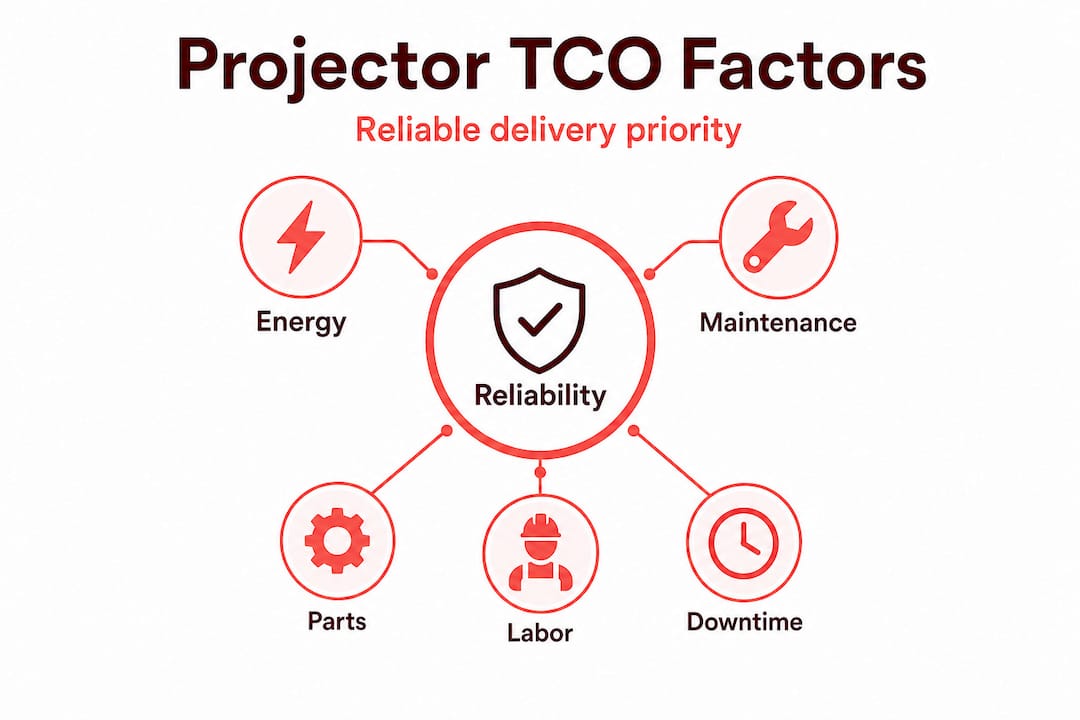
- Labor and downtime: Staff time spent troubleshooting, waiting for repairs, and covering lost productivity when a projector fails mid-session.
- Software and integration: Firmware updates, wireless dongles, or display management software that some setups require.
A widely referenced TCO calculation methodology adds all these components across the ownership period and recommends using power calculators to compare energy costs between models before purchasing. This approach makes it easy to see that a unit costing RM 500 more upfront could actually save thousands if it uses a more efficient lamp or requires fewer replacements.
Good projector installation guidance matters here too. A poorly mounted projector creates alignment problems, excessive heat buildup, and shortened lamp life, turning a simple installation oversight into an ongoing maintenance cost.
Here is a simple TCO component table to frame your analysis:
| TCO component | Typical frequency | Cost impact level |
|---|---|---|
| Purchase price | One-time | High |
| Installation and mounting | One-time | Medium |
| Lamp replacement | Every 2,000 to 5,000 hours | High |
| Filter cleaning or replacement | Every 3 to 6 months | Low to Medium |
| Annual energy cost | Ongoing | Medium |
| Labor and downtime | Variable | High (often underestimated) |
| Software or accessories | Occasional | Low |
Many organizations underestimate maintenance and electricity costs by focusing almost entirely on the purchase price. Over a five-year period, ongoing costs can equal or exceed the initial hardware investment.
Breaking down the core costs: Where your budget really goes
With the framework in place, let's get specific. Real numbers help procurement teams and school administrators make the case internally for choosing the right projector rather than just the cheapest one.
Here is a realistic cost breakdown for a typical meeting room or classroom projector over five years:
| Cost category | One-time or annual | Estimated range (USD) |
|---|---|---|
| Projector purchase | One-time | $300 to $1,500 |
| Ceiling mount and installation | One-time | $80 to $250 |
| Lamp replacement (x2 to x4) | Every 2 to 3 years | $50 to $200 per lamp |
| Filter replacement or cleaning | Annual | $10 to $40 |
| Annual energy cost | Annual | $40 to $80 |
| Labor for maintenance | Annual | $50 to $150 |
| Downtime cost (estimated) | Variable | $100 to $500 per incident |
Notice that energy alone can cost around $50 per year for a typical classroom running at 18 cents per kWh. That figure is calculated using idle watt consumption multiplied by idle hours, added to active watt consumption multiplied by use hours, divided by 1,000, and then multiplied by the local electricity rate. Spread over five years, that is $250 in electricity from a single classroom projector, before any lamp or maintenance costs.
Step-by-step breakdown of the TCO calculation process:
- Record the projector's active wattage and standby wattage from the spec sheet.
- Estimate daily usage hours and idle or standby hours per school day or workday.
- Apply the formula: (idle watts x idle hours + use watts x use hours) / 1,000 x kWh rate = daily cost.
- Multiply daily cost by operating days per year.
- Add lamp replacement cost divided by expected lamp hours to get cost per hour of use.
- Add installation, filter, and estimated labor costs.
- Sum all figures over your expected ownership period.
Choosing energy efficient projectors from the start reduces the figure in step 4 significantly. Laser projectors, for example, consume less power in eco mode and eliminate lamp replacement costs entirely, which has a major effect on steps 5 and 6.
Following a solid projector maintenance checklist is equally important. Dusty filters force the projector to work harder, increasing heat and wattage consumption, which compounds the energy cost while simultaneously shortening component life.
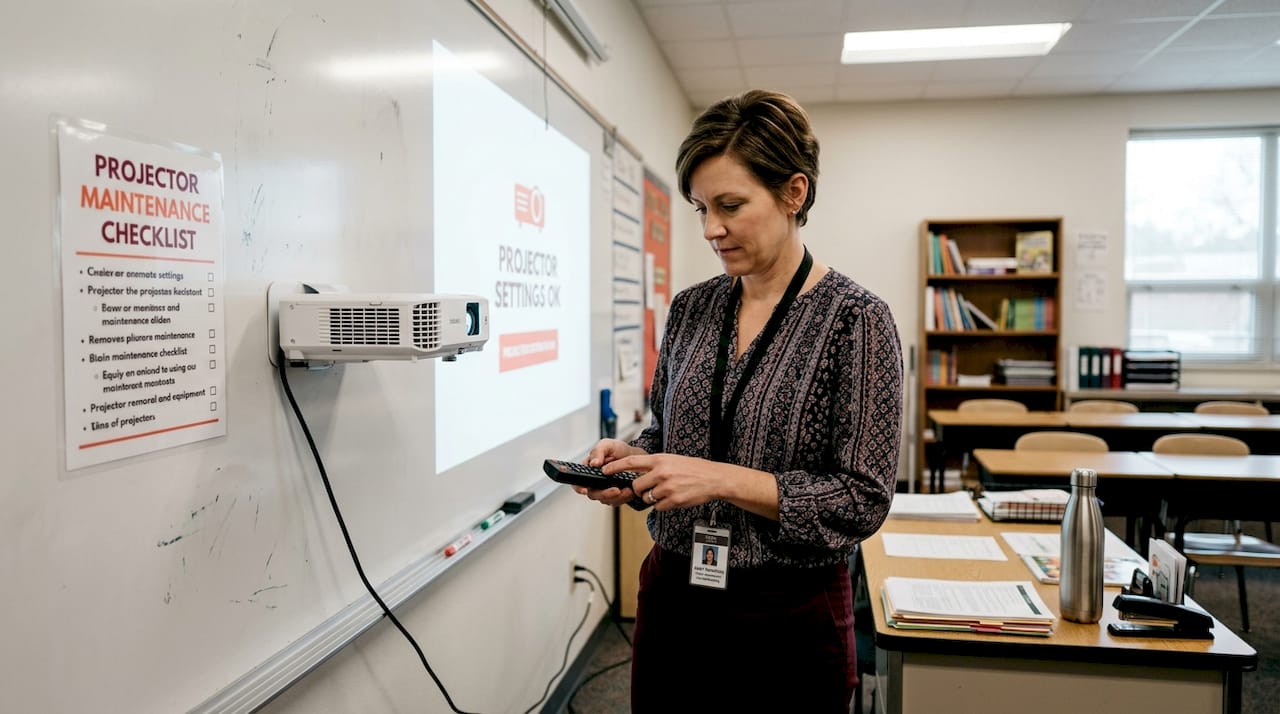
Pro Tip: Projectors with laser light sources often have rated lifespans of 20,000 hours or more compared to 2,000 to 5,000 hours for traditional lamps. Over a five-year period with four hours of daily use, that difference can mean zero lamp replacements versus two or three, saving hundreds of dollars per unit. Always factor lamp life into your purchase decision, and review maintenance tips to extend whatever technology you choose.
The Malaysian context: Local factors that impact projector ownership
Understanding the numbers is one thing. Knowing how those numbers behave inside a Malaysian school or office is another. Several local factors push projector TCO in directions that generic calculators simply do not account for.
Energy rates and usage patterns
Malaysia's electricity tariff for commercial and institutional users varies by Tenaga Nasional Berhad (TNB) tier, but a reasonable planning figure for schools and SMEs is around RM 0.50 to RM 0.70 per kWh. Using the classroom benchmark of approximately $50 per year at 18 cents per kWh as a baseline, Malaysian organizations may see proportionally different results depending on their actual rate and usage hours. Schools that run projectors during extended co-curricular sessions or night classes accumulate more energy cost than the standard estimate.
Climate and humidity effects
Malaysia's tropical climate is genuinely hard on electronics. High ambient humidity accelerates dust buildup inside projector filters and optical paths. High temperatures mean projectors run hotter, pushing fans harder and shortening the lifespan of internal components. Organizations in poorly ventilated rooms or older school buildings will likely need to clean filters more frequently than the manufacturer's standard recommendation, typically every three months rather than every six.
Here are the key climate-related considerations every Malaysian buyer should weigh:
- Filter cleaning intervals should be shortened to every eight to twelve weeks in high-humidity environments.
- Projectors with sealed optical engines, common in many laser models, are significantly more resistant to dust damage and are worth prioritizing for Malaysian conditions.
- Ensure installation locations have adequate air conditioning or ventilation to keep the projector operating within its rated temperature range.
- Store spare lamps in dry cabinets where possible, since humidity can degrade lamp quality before the lamp is even installed.
Parts availability and support logistics
Imported projector parts, especially proprietary lamps, sometimes have long lead times in Malaysia. A lamp that takes two to three weeks to arrive from overseas means two to three weeks of downtime, which multiplies the productivity loss cost dramatically. Choosing brands with strong local distributor networks reduces this risk considerably.
Investing in sustainable office solutions that include projectors with locally stocked parts is a practical way to cut average downtime cost. For schools specifically, reviewing recommendations for projectors for Malaysian classrooms helps identify models already proven in similar local environments.
Labor and downtime in local context
Malaysian IT support for schools is often shared across multiple campuses or contracted to external vendors. This means a projector failure might not be resolved within hours but rather within days. In a school with four periods of projector-dependent lessons per day, even two days of downtime represents eight lost instructional sessions. That intangible cost is real, even if it does not appear in any invoice.
How to lower your projector TCO: Smart strategies for schools and businesses
Knowing where money goes is the first step. Systematically reducing those costs is the goal. Here is a structured action plan that works for both schools and businesses.
Step-by-step TCO reduction plan:
- Audit your current usage. Document how many hours each projector runs daily and whether standby mode is used appropriately. Many projectors left on between classes or meetings waste significant energy.
- Switch to eco mode. Most projectors have an eco or power-saving lamp mode that reduces brightness slightly but cuts energy consumption by 20 to 30 percent. In a conference room where ambient light is controlled, the brightness reduction is barely noticeable.
- Schedule preventive maintenance. Build filter cleaning into your facility schedule every eight weeks. Catching a clogged filter early prevents overheating, which is one of the top causes of premature lamp failure.
- Choose longer-life technology on your next purchase. Laser projectors eliminate the lamp replacement cycle almost entirely. Reliable projector lamps are still worth stocking for traditional units, but the shift to laser is the single biggest lever for long-term savings.
- Centralize procurement. Buying multiple units at once from a single supplier often unlocks volume pricing and ensures consistent spare parts availability.
- Evaluate the projector classroom benefits beyond cost. Knowing what value a projector genuinely delivers helps you justify spending more upfront on a reliable model rather than cycling through cheaper units that fail faster.
Quick wins for energy, lamp, and downtime savings:
- Enable auto-shutoff timers so projectors power down after a set idle period.
- Use a screen saver or blank screen function during breaks instead of leaving the image running.
- Track lamp hours using the projector's built-in hour meter and replace before failure, not after.
- Keep a logbook of maintenance actions so patterns of frequent issues signal a deeper problem early.
Pro Tip: A saving energy guide principle applies here too. Small behavioral changes, like consistently using eco mode or enabling auto-shutoff, add up to hundreds of ringgit saved per projector over five years. When multiplied across ten classrooms or fifteen meeting rooms, those savings become genuinely significant budget line items.
The TCO framework reinforces this point clearly: energy, lamps, and labor savings across a three-to-seven-year ownership period can dwarf the upfront price difference between a budget model and a well-specced unit.
Here's what most TCO calculators miss: The hidden value of reliability
Every TCO calculator we have seen handles the numbers well. None of them adequately handles the cost of a lesson that never happened or a client presentation that fell apart because the projector froze mid-slide.
Think about it practically. A school projector that fails during an exam review session does not just inconvenience a teacher. It disrupts thirty students in a high-stakes moment. A boardroom projector that cuts out during a pitch does not just waste fifteen minutes. It changes how a potential client perceives your organization's competence. These costs are real and often larger than any lamp replacement bill, but they show up nowhere in a standard TCO spreadsheet.
This is why we argue that TCO should be reframed as the total cost of reliable delivery. The calculation should factor in not just what it costs to run a projector but what it costs when the projector fails to run at all. Organizations that choose higher-reliability units, even at a premium, consistently report lower total frustration costs over the ownership period. That is not a soft benefit. It translates directly into retained clients, uninterrupted instruction, and IT teams that are not constantly fielding emergency calls.
Understanding long throw projector advantages is one example of how a thoughtful technology choice protects reliability. Proper throw distances reduce lens stress and thermal load, both of which affect long-term projector health.
The uncomfortable truth is that the lowest-TCO projector on paper and the lowest-stress projector in practice are rarely the same unit. Reliability deserves its own line in your budget.
Find cost-smart solutions with Projector Display Malaysia
Making sense of TCO is easier when you have the right product options in front of you.
At ProjectorDisplay.com, we curate a selection of projectors specifically suited to Malaysian schools and businesses, including energy-efficient and laser models that significantly reduce long-term ownership costs. Whether you are comparing LED vs laser projector options for your next classroom upgrade or looking for a reliable business unit that holds up in Malaysia's climate, our catalog covers the full range. Browse our complete selection of projectors in Malaysia or check our current projector sale deals for cost-smart options across every budget tier. Fast shipping within Peninsular Malaysia and WhatsApp support make it easy to get started.
Frequently asked questions
What is included in the projector total cost of ownership?
TCO includes purchase price, installation, lamps, filters, energy, maintenance, labor, downtime, and software costs accumulated over a three-to-seven-year ownership period. Ignoring any of these categories leads to budgeting surprises down the road.
How much does it cost to run a projector in a Malaysian classroom?
A typical classroom projector costs approximately $50 per year in electricity at 18 cents per kWh, though Malaysian energy rates and longer usage hours may shift this figure for your specific setup.
How can I lower my projector's total cost of ownership?
Choose energy-efficient or laser projectors, perform regular filter maintenance, enable eco and auto-shutoff modes, and use the full TCO methodology to compare models before purchasing rather than comparing sticker prices alone.
Do laser projectors really have lower maintenance costs?
Yes. Laser projectors use light sources rated at 20,000 hours or more, eliminating most lamp replacement costs and reducing filter cleaning needs, especially in sealed-engine models that resist dust in Malaysia's humid environment.
Why does reliability matter for projector TCO?
Unplanned downtime and repairs generate costs beyond repair bills, including lost instructional time, missed business opportunities, and IT labor that standard TCO calculators rarely capture. Reliability directly protects the value a projector is supposed to deliver.
Recommended
- Projector FAQ Malaysia: Your Complete Guide to Smart Buying – Projector Display
- Malaysia Projector Buying Guide: Features, Tips & Choices – Projector Display
- Home projector buying guide 2026: expert tips for Malaysians – Projector Display
- Projector warranty in Malaysia: what buyers must know – Projector Display