
TL;DR:
- Understanding projector technology and light sources helps you make an informed purchase for your space. Brightness, resolution, contrast, and throw distance are key specs that directly impact image quality and suitability. Choosing a reliable brand with local support and considering long-term maintenance costs ensures a smart investment in Malaysia.
Getting projector basics explained clearly makes all the difference between a smart buy and an expensive mistake. Whether you're setting up a home cinema in Kuala Lumpur or upgrading a classroom in Penang, the sheer number of projector types, specs, and brands can feel overwhelming fast. DLP or LCD? Laser or lamp? Short throw or standard? These aren't just buzzwords. They directly affect image quality, maintenance costs, and how well a projector works in your specific space. This guide cuts through the noise and gives you a clear, practical foundation.
Table of Contents
- Key Takeaways
- Understanding projector types and light sources
- Key specs every beginner needs to understand
- Matching the right projector to your space
- Projector setup and maintenance in Malaysia
- My honest take on buying projectors in Malaysia
- Find the right projector at Projectordisplay
- FAQ
Key Takeaways
| Point | Details |
|---|---|
| Projection technology shapes image quality | DLP, LCD, and LCoS each offer different strengths for home, office, or classroom use. |
| Brightness and room lighting must match | Well-lit rooms require projectors exceeding 3,000 ISO lumens to deliver a visible image. |
| Throw distance determines room fit | Ultra-short-throw projectors can project a 100-inch image from as close as 10 inches away. |
| Laser projectors last significantly longer | Laser light sources can last 20,000 to 50,000 hours, far outlasting traditional lamp-based models. |
| Screen surface affects final image quality | A dedicated projection screen delivers better contrast and color than projecting onto a painted wall. |
Understanding projector types and light sources
Understanding projector types starts with knowing two things: the display technology inside the unit, and the light source powering it. These two factors shape everything from color accuracy to how often you'll spend on maintenance.
Display technologies: DLP, LCD, and LCoS
DLP (Digital Light Processing) uses microscopic mirrors to reflect light. The result is sharp, high-contrast images with minimal "screen door" effect (that faint grid you sometimes see between pixels). DLP projectors are compact, durable, and common in portable projectors and business models. The tradeoff is a potential "rainbow effect" where some viewers notice brief flashes of color in high-contrast scenes.
LCD (Liquid Crystal Display) splits light through three LCD panels for red, green, and blue. This produces vivid, accurate colors with no rainbow effect. Brands like Epson have built their reputation on LCD technology, and an Epson LCD projector remains one of the most popular choices for classrooms across Malaysia. The downside is that LCD panels degrade over time due to heat, sometimes faster than the rated lamp life.
LCoS (Liquid Crystal on Silicon) combines elements of both. It's found in premium projectors like certain JVC projector Malaysia models and produces exceptional image depth. LCoS suits dedicated home theater setups more than everyday classrooms due to its higher price point.
Light source types: lamp, LED, and laser
| Light Source | Typical Lifespan | Brightness Range | Best For |
|---|---|---|---|
| Lamp (UHP) | 2,000–5,000 hours | High (3,000+ lumens) | Budget classrooms, presentations |
| LED | 20,000–30,000 hours | Up to 2,000 lumens | Portable use, small dark rooms |
| Laser | 20,000–50,000 hours | 2,000–5,000+ lumens | Home cinema, large classrooms |
LED projectors offer good color accuracy and low maintenance, making them a practical choice for educators who want reliability without frequent bulb replacements. However, they can struggle in brightly lit rooms. Laser projectors sit at the premium end, covering a wider DCI-P3 color gamut and handling ambient light far better. They break even on maintenance costs around year four or five, which makes the upfront price easier to justify for schools and frequent users.
Pro Tip: If you're buying a projector for a Malaysian school with no budget for frequent lamp replacements, prioritize LED or laser light sources. In educational contexts, low-maintenance projector types are strongly favored for reliability and long-term cost savings.
Key specs every beginner needs to understand
Specs on a product page can look like a foreign language if you don't know what matters. Here are the ones that actually change your day-to-day experience.
-
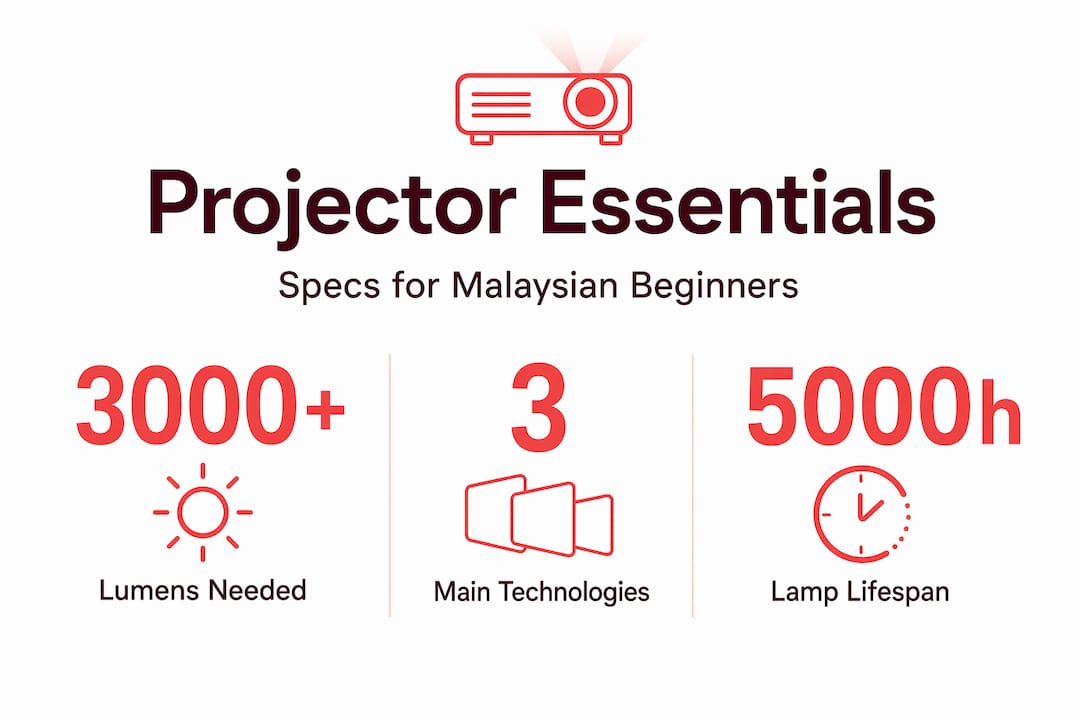
Brightness (lumens): This is measured in ISO lumens and tells you how much light the projector outputs. For a dark home cinema room, 1,500 to 2,000 lumens is sufficient. For a brightly lit classroom or meeting room, you need at least 3,000 ISO lumens to maintain a clear image. Modern laser projectors can push past 5,000 lumens for daytime viewing.
-
Resolution: 720p (HD) works for basic presentations. 1080p (Full HD) is the sweet spot for most home and classroom use today. 4K makes a visible difference for movie watching on large screens, but the jump in price is significant. Most of the best home projector Malaysia buyers choose sits in the 1080p range.
-
Contrast ratio: This measures the difference between the darkest black and the brightest white. A high contrast ratio creates depth and detail in dark scenes. Experts emphasize contrast over pure brightness for cinematic quality. For classrooms focused on presentation slides, contrast matters less.
-
Throw distance: This describes how far back the projector needs to sit to produce a specific image size. Standard throw projectors need 8 to 15 feet for a 100-inch image. Short throw models need 4 to 8 feet. Ultra-short-throw projectors can project a 100-inch image from just 10 to 12 inches away, which completely changes what's possible in a tight classroom or apartment living room.
-
Keystone correction: When a projector is placed at an angle rather than perfectly centered with the screen, the image comes out trapezoidal. Keystone correction digitally adjusts the image to make it rectangular again. Modern projectors offer both vertical and horizontal keystone correction, which gives you far more flexibility in where you place the unit.
Pro Tip: Don't get distracted by maximum brightness specs. A projector rated at 5,000 lumens in a dark room produces the same watchable image as a 2,500-lumen model. Match the brightness spec to your actual room lighting conditions, not the largest number on the box.
Matching the right projector to your space
There is no universally best projector. Environment and intended use always determine the right choice. Here's how to think through that practically for Malaysian homes and schools.
-
Assess your room size and lighting first. A bright open-plan living room needs a higher-lumen projector than a dedicated home theater with blackout curtains. Malaysian classrooms with large windows facing afternoon sun need at least 3,000 lumens to stay readable.
-
Decide on your primary use case. Home cinema watching favors high contrast ratios, 1080p or 4K resolution, and laser or LED light sources. Classroom presentations prioritize brightness, durability, and low maintenance. Business presentations often benefit from portable projectors with wireless connectivity. Check out guidance on choosing for business use if meetings are your primary context.
-
Factor in throw distance against room dimensions. Measure the distance from where you plan to mount or place the projector to your screen wall before buying. For small apartments or compact classrooms, a short-throw or ultra-short-throw model removes a lot of placement headaches.
-
Consider total cost of ownership, not just purchase price. A projector bulb Malaysia replacement can cost RM 200 to RM 600 depending on the model. Lamp-based projectors may look cheaper upfront but add up over years of use. Factor in projector lamp Malaysia costs when comparing options.
-
Stick with brands that have strong local support. Popular options in Malaysia include Epson projector Malaysia, BenQ projector Malaysia, Optoma projector Malaysia, and Viewsonic projector Malaysia. Each offers authorized service centers and readily available replacement parts. Brands like Hisense projector Malaysia and Jmgo projector Malaysia are growing in the local market with strong value offerings in the laser segment.
Projector setup and maintenance in Malaysia
Good setup habits make a measurable difference in image quality. Proper maintenance protects your investment, especially given Malaysia's warm, humid climate.
-
Place the projector at the right height and angle. Mounting it too high or too low forces excessive keystone correction, which softens the image slightly. Ceiling mounts using a solid projector mounting solution keep the unit stable and aligned.
-
Choose your screen surface carefully. Projecting onto a textured or colored wall degrades color accuracy and contrast noticeably. A dedicated projection screen with a white or light gray matte surface consistently delivers better results. The screen material matters as much as the projector spec in many setups.
-
Clean filters regularly. Dust is a projector's enemy. A clogged filter traps heat, which accelerates component wear. In Malaysia's humid conditions, dust and humidity are the two biggest threats to projector longevity. Clean filters every one to three months depending on how dusty the environment is.
-
Monitor lamp hours and plan replacements proactively. Waiting until a lamp fails mid-presentation or mid-lesson is avoidable. Understanding projector lamp lifetime helps you schedule replacements before the unit forces the issue.
-
Use sealed optical engine projectors in challenging spaces. For classrooms near construction sites, workshops, or outdoor-adjacent areas, sealed engines protect internal components from fine particles that standard filters miss.
Pro Tip: Always check if your projector model has an "eco mode" for the lamp. Running in eco mode reduces brightness slightly but can extend lamp life by 30 to 50 percent. For a school projector running six hours a day, that's a meaningful difference in replacement frequency.
My honest take on buying projectors in Malaysia
I've worked with enough Malaysian buyers and educators to say this plainly: most first-time projector buyers underestimate how much ambient light destroys image quality. They buy a 2,000-lumen model, set it up in a room with open windows, and then blame the projector when the image looks washed out. The projector isn't the problem. The room is.
What I've also seen is that beginner buyers often fixate on resolution at the expense of brightness and contrast. A 4K projector with 1,500 lumens will look noticeably worse in a normal Malaysian living room than a 1080p projector with 3,500 lumens. Resolution only rewards you when the other specs are already strong enough for the environment.
My strong recommendation is to invest in a mid-range model from a reputable projector seller in Malaysia rather than chasing the cheapest option. The best projector brands for Malaysian buyers tend to be the ones with accessible local service. A projektor murah that needs a RM 500 lamp replacement every 18 months ends up costing more than a slightly pricier laser model that runs for years without intervention. As laser and interactive projector technology continues to mature, the price gap is narrowing fast. If your budget allows it, laser is increasingly the smarter long-term call for both homes and schools.
— Projector
Find the right projector at Projectordisplay
Projectordisplay is Malaysia's leading projector seller, carrying a full range of options to match every budget and use case. From Epson projector Malaysia and BenQ projector Malaysia models for classrooms, to laser and smart projectors for home cinema setups, the catalog covers the best projector in Malaysia across all major categories. You'll also find projector screen Malaysia options, wireless projector Malaysia models, and replacement accessories including projector lamp Malaysia and projector bulb Malaysia stock. Whether you need a short-throw unit for a compact classroom or an interactive display for a school lab, the team offers expert guidance via WhatsApp and fast shipping across Peninsular Malaysia. Browse the full range and find your match today.
FAQ
What does DLP vs LCD mean for projector quality?
DLP produces sharper contrast and a more compact unit, while LCD delivers more accurate color with no rainbow effect. The best choice depends on whether you prioritize portability or color fidelity.
How many lumens do I need for a classroom in Malaysia?
For a typical Malaysian classroom with windows and natural light, you need at least 3,000 ISO lumens to maintain a clear, readable image throughout the day.
What is throw distance and why does it matter?
Throw distance is how far back a projector sits to produce a given image size. Standard throw needs 8 to 15 feet for a 100-inch image, while ultra-short-throw models can achieve the same from just 10 to 12 inches away.
How often should I replace a projector lamp in Malaysia?
Lamp-based projectors typically need replacement every 2,000 to 5,000 hours depending on usage mode. Checking the lamp hour counter regularly and understanding projector lamp lifespan helps you plan ahead and avoid unexpected failures.
Are laser projectors worth the higher price in Malaysia?
For users running a projector daily in a school or home cinema, laser projectors are worth the investment. They typically last 20,000 to 50,000 hours and break even on total cost compared to lamp-based models by year four or five of ownership.
Recommended
- Projector FAQ Malaysia: Your Complete Guide to Smart Buying – Projector Display
- Home projector buying guide 2026: expert tips for Malaysians – Projector Display
- Malaysia Projector Buying Guide: Features, Tips & Choices – Projector Display
- How Projectors Work: A Simple Guide for Malaysians – Projector Display