
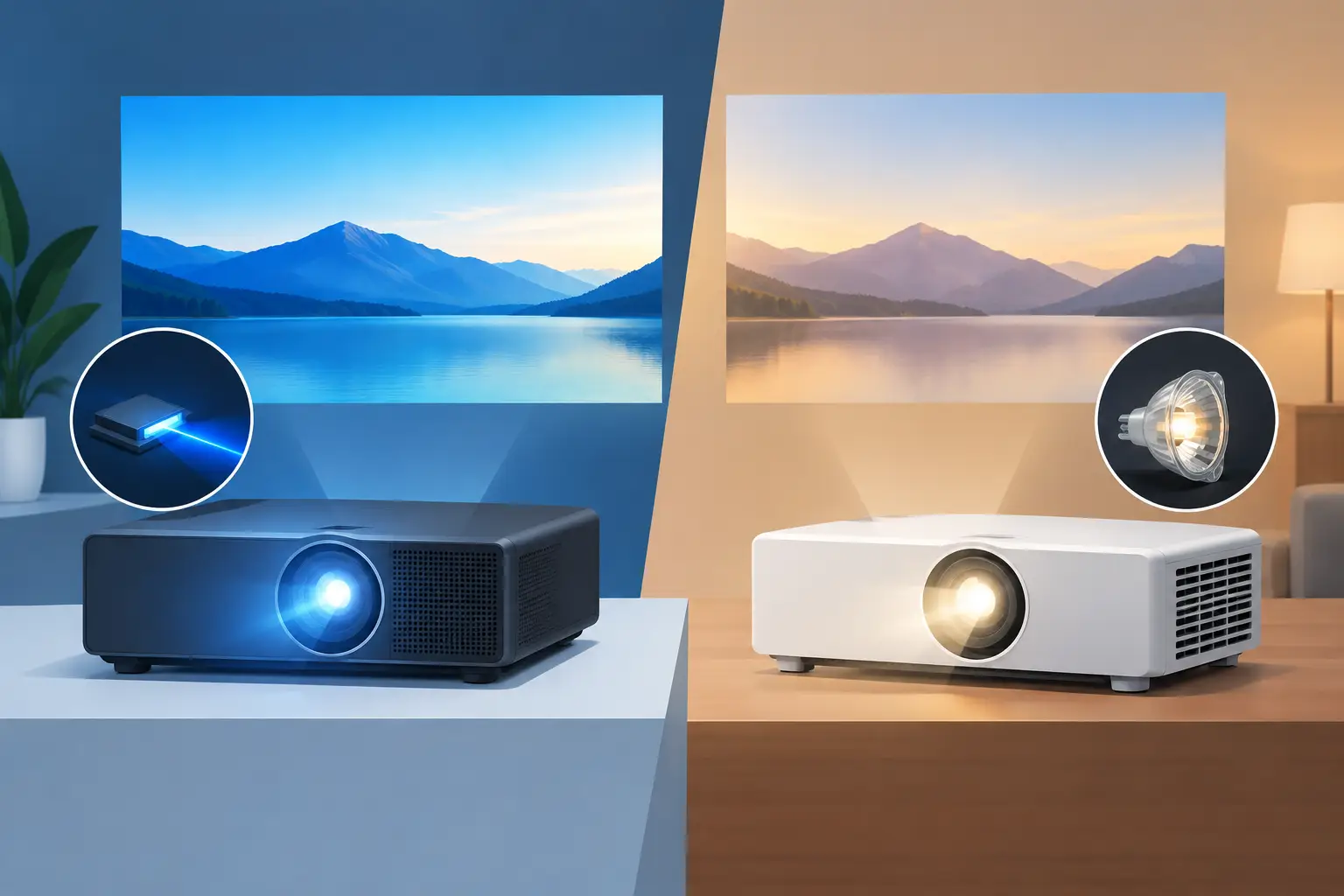
A projector's light source can change far more than the picture on screen. It affects how quickly a meeting can start, whether a classroom stays bright through the afternoon, how often a home-theater setup needs service, and what the ownership cost looks like over several years. In the laser projector vs lamp projector decision, neither option is automatically best. The right choice depends on how often you use the projector, the room's ambient light, your image-quality expectations, and your budget.
For buyers who only compare resolution and ANSI lumens, this distinction is easy to miss. Yet the light source is one of the biggest reasons two Full HD or 4K projectors with similar specifications can suit very different environments.
Laser projector vs lamp projector: the core difference
A lamp projector uses a high-pressure mercury lamp to produce light. This technology has been used in home, education, and business projectors for many years. The lamp is bright, proven, and often helps keep the projector's upfront price lower. However, it gradually loses brightness and will eventually need replacement.
A laser projector uses a laser light engine rather than a replaceable lamp. The laser produces light more consistently over a much longer operating life, commonly around 20,000 hours depending on the model and operating mode. That can translate to years of regular use without purchasing a new lamp.
Both technologies can deliver excellent images. A projector's resolution, optical engine, color technology, contrast performance, lens quality, and installation all still matter. A laser light source is not a substitute for choosing the right brightness or throw ratio for the room.
Brightness and image consistency
Lamp projectors can look extremely bright when new. They remain a practical choice for occasional movie nights, smaller meeting rooms, and installations where lights can be controlled. The trade-off is lamp aging. After hundreds or thousands of hours, the image becomes less bright, so presentations and video may lose some punch in rooms with windows or overhead lighting.
Laser models are designed for steadier brightness across a much longer period. This is especially valuable in classrooms, training rooms, retail displays, and conference spaces where the projector may run for several hours every day. A consistent image means fewer surprises when someone turns on the projector for an important lesson or client presentation.
Ambient light remains the deciding factor. A high-lumen lamp model can outperform a lower-lumen laser model in a bright room. Check ANSI lumens, not only marketing claims, and match the projector to the actual lighting conditions. For a room with lights on, screen size and viewing distance also matter. A larger image spreads available light over more area, reducing perceived brightness.
Lifespan and maintenance costs
This is where laser projectors have their clearest advantage. Traditional projector lamps often last roughly 3,000 to 6,000 hours in normal use, with longer figures possible in Eco mode. Once the lamp reaches the end of its life, it must be replaced. That adds parts cost, downtime, and the task of fitting the replacement correctly.
For a home user who watches a movie on weekends, a lamp may last many years. In that case, the savings on the initial purchase may outweigh the future cost of a replacement lamp. A lamp projector can be a smart value purchase when usage is modest and the space is dedicated to entertainment.
For a school, office, or organization running projectors every weekday, the calculation changes quickly. A laser light engine can reduce lamp-change schedules and avoid interruptions during classes, workshops, or meetings. It also helps facilities teams maintain a more predictable fleet of equipment.
Laser does not mean zero maintenance. Air filters, ventilation paths, cables, mounts, and screen surfaces still need attention. The projector should have adequate airflow, particularly in a ceiling-mounted installation. But the absence of a regular lamp replacement cycle is a meaningful operational benefit.
Startup, shutdown, and daily convenience
Lamp projectors need time to warm up and cool down. The delay may only be a minute or two, but it matters when users frequently start and stop sessions. Turning off a lamp projector improperly can also shorten lamp life, so users need to wait for the cooling fan to finish.
Laser projectors typically start faster and shut down more quickly. This convenience is useful in busy meeting rooms where several people may use the equipment, or in classrooms where a teacher needs the display ready immediately. For portable use, quicker shutdown also makes packing up after a presentation easier.
Some laser projectors also support long-duration use more comfortably, which suits digital signage, exhibition areas, and shared spaces. Always check the manufacturer's stated operating guidance, especially for installations expected to run all day.
Color, contrast, and picture quality
It is tempting to assume that laser always provides better color and contrast. The reality is more nuanced. Laser projectors can produce vivid colors, strong brightness, and good perceived contrast, especially in premium home-theater and professional models. Many are available with 3LCD, DLP, Full HD, 4K, short-throw, and ultra-short-throw configurations.
But lamp projectors can also produce satisfying, cinematic images. A well-calibrated lamp-based home projector in a dark room may offer excellent movie performance at a lower purchase price. If your priority is occasional film viewing with blackout curtains, a lamp model can deliver more value than a laser unit with features you will not use.
For gaming, look beyond the light source. Input lag, refresh rate, HDMI capability, resolution, and gaming modes deserve equal attention. For movies and streaming, consider contrast, color reproduction, smart features or external streaming devices, audio output, and the quality of the projector screen.
Upfront price versus total ownership cost
Lamp projectors are generally more affordable at the point of purchase. This makes them attractive for first-time buyers, budget-conscious families, and temporary setups. They are also a sensible option when the projector will only be used for a limited event schedule.
Laser projectors usually cost more initially, but their longer light-source life can make them better value over time. The difference becomes easier to justify when the projector is used frequently, installed in a difficult-to-access ceiling position, or relied upon by many users. Replacing a lamp in a high ceiling classroom is not simply a parts expense – it may require maintenance labor, access equipment, and scheduling around room use.
When comparing models, do not stop at the product price. Consider expected annual hours, replacement lamp pricing, installation requirements, warranty coverage, and whether your room needs a standard-throw, short-throw, or ultra-short-throw projector. A lower-priced unit that does not fit the room can become the more expensive choice.
Which projector is right for your space?
A lamp projector is often the practical choice for a dedicated home cinema, occasional presentations, or buyers who want strong performance at a lower initial cost. It works best when you can control room lighting and accept that a lamp replacement may be needed in the future.
A laser projector is usually the stronger choice for frequent use, brighter shared rooms, classrooms, training centers, offices, and premium home entertainment. Its longer operating life and stable brightness are particularly useful when reliability matters more than the lowest purchase price.
For a small room, a short-throw laser projector can create a large image without placing the unit far from the screen. For collaborative teaching or meetings, pair the projector with the correct screen, HDMI or wireless display solution, suitable mount, and audio system. The best projection setup is an ecosystem, not just a projector in a box.
Before buying, measure the room, decide the desired screen size, note where the projector can be mounted, and identify how much daylight enters the space. ProjectorDisplay.com can help buyers compare models and request a quotation for complete display requirements. Choose the light source that supports how your room will actually be used, then give it the screen, placement, and connectivity needed to make every image count.