
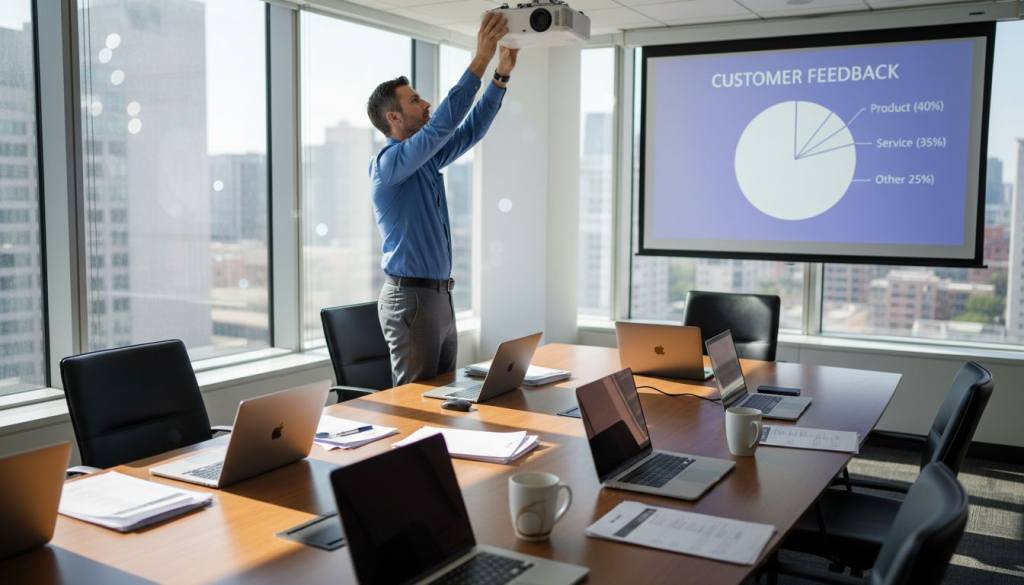
Over 60 percent of business professionals worldwide recognize that the right presentation tools can define customer experience. For Malaysian organizations, delivering a seamless event or meeting now requires more than just good content. Companies are adopting advanced projector technology inspired by American innovation to create lasting impressions and gain a competitive edge. This resource highlights key projector advancements and practical strategies to help Malaysian businesses turn every presentation into an outstanding client experience.
Table of Contents
- Defining Customer Experience In E-Commerce
- Types Of Projector Technology For Business
- Key Features Enhancing User Satisfaction
- Case Studies In Malaysian Business Settings
- Risks, Costs, And Common Pitfalls
Key Takeaways
| Point | Details |
|---|---|
| Understanding Customer Experience | E-commerce success hinges on integrating trust, perceived value, service quality, and security to create a seamless customer journey. |
| Selecting Projector Technologies | Businesses should evaluate projector technologies based on specific presentation needs and characteristics such as brightness, maintenance, and image quality. |
| User Satisfaction Elements | Key features like connectivity, image quality, and ease of maintenance significantly impact user satisfaction in projector technologies. |
| Managing Risks and Costs | Strategic planning is essential to address initial and ongoing costs, ensuring a thorough understanding of total cost of ownership for projector investments. |
Defining Customer Experience In E-Commerce
Customer experience in e-commerce represents a multidimensional framework that extends far beyond simple transactional interactions. A comprehensive conceptual model reveals the complex interactions between various customer engagement elements, demonstrating how digital platforms transform consumer interactions.
The e-commerce customer journey encompasses multiple critical touchpoints that shape overall perception and satisfaction. Key constructs include trust, perceived value, service quality, and security. These interconnected elements work together to create a holistic experience that influences consumer behavior and brand loyalty. Research investigating the e-commerce journey highlights the importance of integrating online and offline fulfillment processes to deliver seamless interactions.
Understanding customer experience requires analyzing several fundamental dimensions:
- Digital interface design
- Website navigation quality
- Product information clarity
- Transaction security
- Post-purchase support
- Delivery and returns process
Businesses must recognize that modern consumers evaluate their experience through a comprehensive lens, considering every interaction from initial browsing to final product receipt. Successful e-commerce platforms prioritize creating smooth, intuitive, and responsive digital environments that anticipate and fulfill customer needs.
Pro tip: Conduct regular user experience audits to identify and eliminate potential friction points in your online customer journey.
Types Of Projector Technology For Business
Businesses today have multiple projector technologies to choose from, each offering unique advantages for professional settings. Comparative studies of projector technologies reveal significant variations in technical specifications and operational efficiency, highlighting the importance of selecting the right technology for specific business needs.
The primary projector technologies for business applications include:
- LCD Projectors: Delivering vibrant colors and sharp image quality
- DLP Projectors: Offering high contrast and compact design
- Laser Projectors: Providing long-lasting performance and instant on/off capabilities
- LED Projectors: Featuring energy efficiency and minimal maintenance requirements
Each technology presents distinct characteristics that impact presentation quality, operational costs, and user experience. Laser projectors have emerged as a particularly compelling option for businesses seeking advanced display solutions, combining superior brightness, longer lifespan, and reduced maintenance compared to traditional lamp-based systems.
Modern business environments require projector technologies that seamlessly integrate performance, reliability, and cost-effectiveness. Factors such as lumens output, resolution, connectivity options, and total cost of ownership play crucial roles in determining the most suitable projector for specific professional contexts.
Here is a comparison of projector technologies and their ideal business use cases:
| Projector Type | Best Use Case | Strength Highlight |
|---|---|---|
| LCD Projector | Conference rooms | Vivid color reproduction |
| DLP Projector | Portable presentations | High contrast, compact |
| Laser Projector | Large venues | Long lifespan, low upkeep |
| LED Projector | Small offices | Energy efficient operation |
Pro tip: Evaluate your specific business presentation requirements before selecting a projector technology to ensure optimal performance and return on investment.
Key Features Enhancing User Satisfaction
User satisfaction in projector technologies is driven by a complex interplay of technical and experiential factors. Comprehensive research reveals multiple critical features that directly influence user perception and overall experience, transforming how businesses approach visual presentation technologies.
Key features that significantly enhance user satisfaction include:
- Connectivity Options: Seamless integration with multiple devices
- Image Quality: High resolution and color accuracy
- Interactive Capabilities: Touch and gesture control functions
- Ease of Maintenance: Simple setup and minimal technical complexity
- Energy Efficiency: Reduced operational costs and environmental impact
Modern projector technologies prioritize user-centric design, focusing on creating intuitive interfaces that minimize technical barriers. Advanced features like wireless connectivity, automatic keystone correction, and smart device mirroring have become critical expectations for professionals seeking streamlined presentation experiences.
Beyond technical specifications, user satisfaction stems from holistic performance metrics. Factors such as instant startup times, noise reduction, compact design, and reliable performance play crucial roles in determining overall user experience. Businesses must consider these nuanced elements when selecting projection technologies that align with their operational requirements and user expectations.

Pro tip: Conduct periodic user experience surveys to understand specific feature preferences and evolving technological expectations in your professional environment.
Case Studies In Malaysian Business Settings
The Malaysian business landscape demonstrates remarkable adaptability in integrating advanced projector technologies across diverse industry sectors. Business presentation technologies have transformed operational efficiency in critical market segments including financial services, educational institutions, and corporate training environments.
Key case study insights reveal significant technological implementations:
- Banking Sector: Implementing interactive projection systems for client presentations
- Educational Institutions: Utilizing high-resolution projectors for immersive learning experiences
- Manufacturing: Leveraging projection technologies for technical training and design visualization
- Telecommunications: Enhancing multimedia communication and collaborative workspace technologies
Small and medium enterprises in Malaysia have particularly benefited from strategic projector technology investments. Wireless connectivity and smart projection systems enable businesses to create more dynamic, engaging presentation environments that dramatically improve knowledge transfer and client interaction capabilities.
Technological adoption patterns demonstrate that Malaysian businesses prioritize projection technologies offering seamless integration, user-friendly interfaces, and robust performance. The ability to quickly adapt visual communication tools has become a critical competitive advantage, allowing organizations to streamline communication processes and enhance overall operational effectiveness.
Pro tip: Conduct a comprehensive technology audit to identify specific projection technology needs tailored to your organization's unique communication requirements.
Risks, Costs, And Common Pitfalls
Projector technology investments require strategic planning and comprehensive understanding of potential challenges. Detailed analyses reveal multiple complex risks businesses encounter during technology implementation, emphasizing the critical importance of thorough pre-investment assessments.
Common financial and operational risks include:
- Initial Investment Costs: High upfront equipment expenses
- Compatibility Challenges: Integration difficulties with existing infrastructure
- Maintenance Expenses: Ongoing technical support and replacement requirements
- Performance Degradation: Potential technological obsolescence
- Training Requirements: Additional staff skill development costs
Total cost of ownership extends far beyond the initial projector purchase price. Organizations must consider long-term expenses including electricity consumption, replacement parts, technical support, and potential productivity disruptions during technology transitions. Small and medium enterprises are particularly vulnerable to underestimating these comprehensive financial implications.
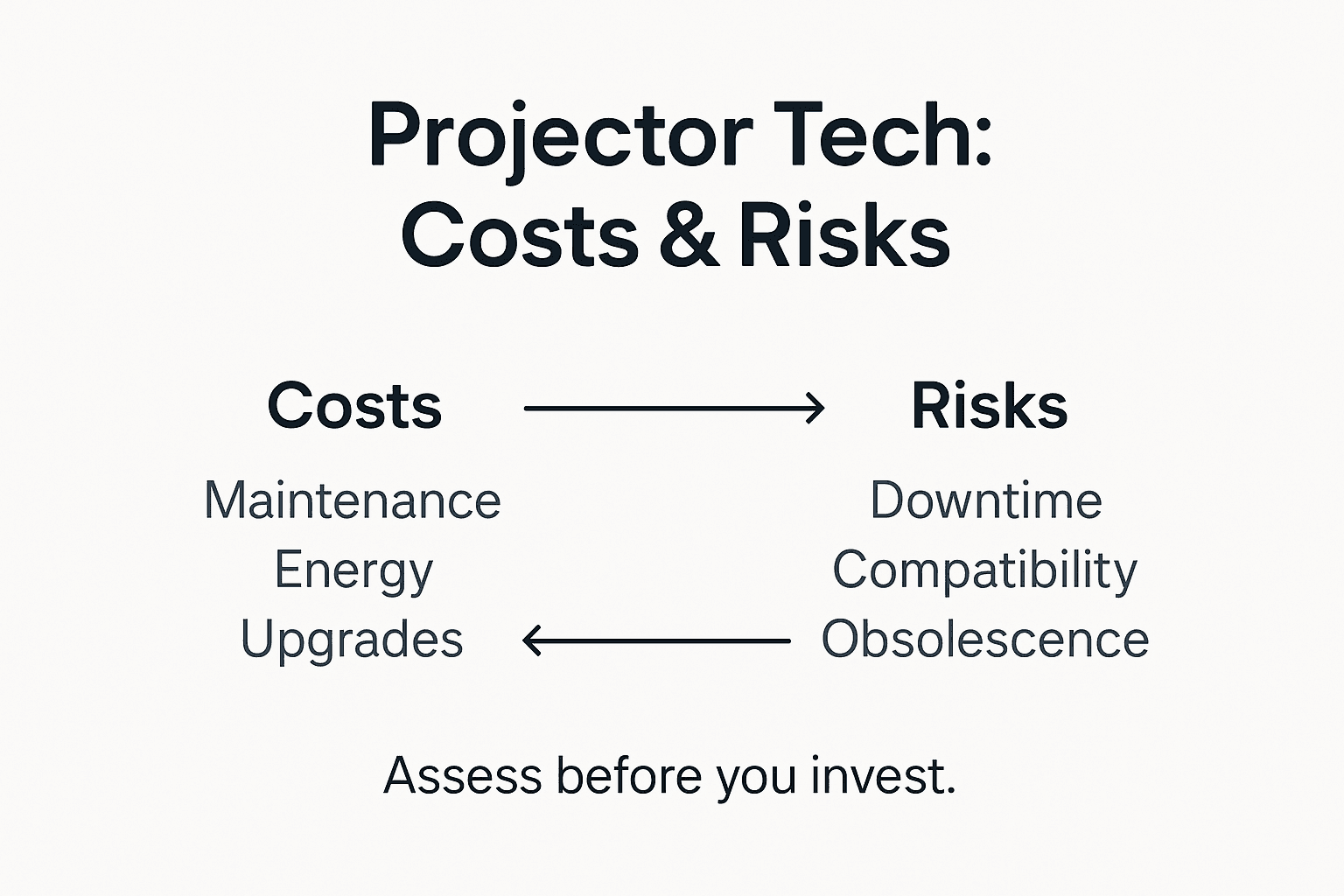
The following table summarizes the main factors affecting total cost of projector ownership:
| Cost Factor | Long-Term Impact | Example Consideration |
|---|---|---|
| Electricity usage | Ongoing utility expenses | High-wattage vs. low-power |
| Maintenance & parts | Recurring repair needs | Lamp or laser replacements |
| Technical support | Operational interruptions | Staff training, vendor help |
| Productivity losses | Disruption during changes | Downtime during migrations |
Technological risk management demands a proactive approach. Businesses should conduct rigorous needs assessments, evaluate multiple vendor options, and develop flexible implementation strategies that accommodate potential technological shifts. Understanding the nuanced relationship between projected benefits and actual performance helps mitigate potential financial and operational vulnerabilities.
Pro tip: Develop a comprehensive technology migration plan that includes detailed cost projections, potential risk scenarios, and flexible adaptation strategies.
Elevate Your Customer Experience with Cutting-Edge Projector Solutions
Improving customer experience in e-commerce means delivering seamless interactions and powerful presentations that build trust and value. If you want to overcome challenges like poor image quality, limited connectivity, or complicated setup—choosing the right projector technology is essential. At ProjectorDisplay.com, we offer a comprehensive range of projectors including laser, smart, and portable models designed to enhance service quality and security in your business presentations or educational settings.
Discover projectors with high lumens, full HD resolution, and wireless connectivity that transform customer engagement and deliver flawless visuals every time. Don't let outdated equipment hold back your customer experience. Visit ProjectorDisplay.com now to explore our selection and get tailored advice for your specific needs. Take the first step toward a smoother, more impactful e-commerce journey today.
Frequently Asked Questions
What is the importance of customer experience in e-commerce?
Customer experience in e-commerce is crucial as it influences consumer behavior and brand loyalty through various touchpoints, including trust, perceived value, and service quality.
How can businesses enhance customer experience using projector technology?
Businesses can enhance customer experience by utilizing advanced projector technology that provides high image quality, interactive capabilities, and seamless connectivity, all of which improve presentations and engagement during customer interactions.
What are the different types of projector technologies available for improving business presentations?
The main types of projector technologies include LCD, DLP, laser, and LED projectors. Each type has unique advantages tailored for specific presentation needs, such as color accuracy and energy efficiency.
What factors should businesses consider when selecting a projector technology?
Businesses should consider image quality, connectivity options, maintenance requirements, and total cost of ownership when selecting projector technology to ensure optimal performance and user satisfaction.
Recommended
- Memahami Teknologi Baru dalam Projektor – Projector Display
- Improving Student Engagement: Strategies for Modern Classrooms – Projector Display
- 7 Top Digital Transformation Trends for Smarter Display Solutions – Projector Display
- Understanding Panasonic Projector Technology and Benefits – Projector Display