
TL;DR:
- A home theater screen size depends on room dimensions, seating distance, and projector brightness for optimal viewing. Most Malaysian homes suit 100 to 120-inch screens in living rooms and smaller options for bedrooms, considering ambient light and projector specs. Proper matching of size, resolution, and light conditions ensures a cinema-like experience without overspending or visual compromise.
A home theater screen size chart is a reference tool that maps your room dimensions, seating distance, and projector specifications to the optimal screen diagonal for your setup. Most Malaysian home theater enthusiasts pick a screen size based on what looks impressive in a showroom, then discover it overwhelms a 12-by-15-foot living room or looks underwhelming from a 15-foot couch. The right screen size depends on three fixed variables: viewing distance, aspect ratio, and projector brightness. Get those three right, and every movie night feels like a proper cinema experience.
What does a home theater screen size chart actually tell you?
A home theater screen size chart translates your seating distance into a recommended screen diagonal using proven visual science. The two most cited professional standards come from SMPTE and THX. SMPTE recommends a 30° viewing angle, while THX pushes for 36° to 40° for true cinematic immersion. That difference matters more than most buyers realize. A 30° angle at 12 feet of seating distance calls for roughly a 90-inch screen, while a 40° angle at the same distance demands a 120-inch screen.
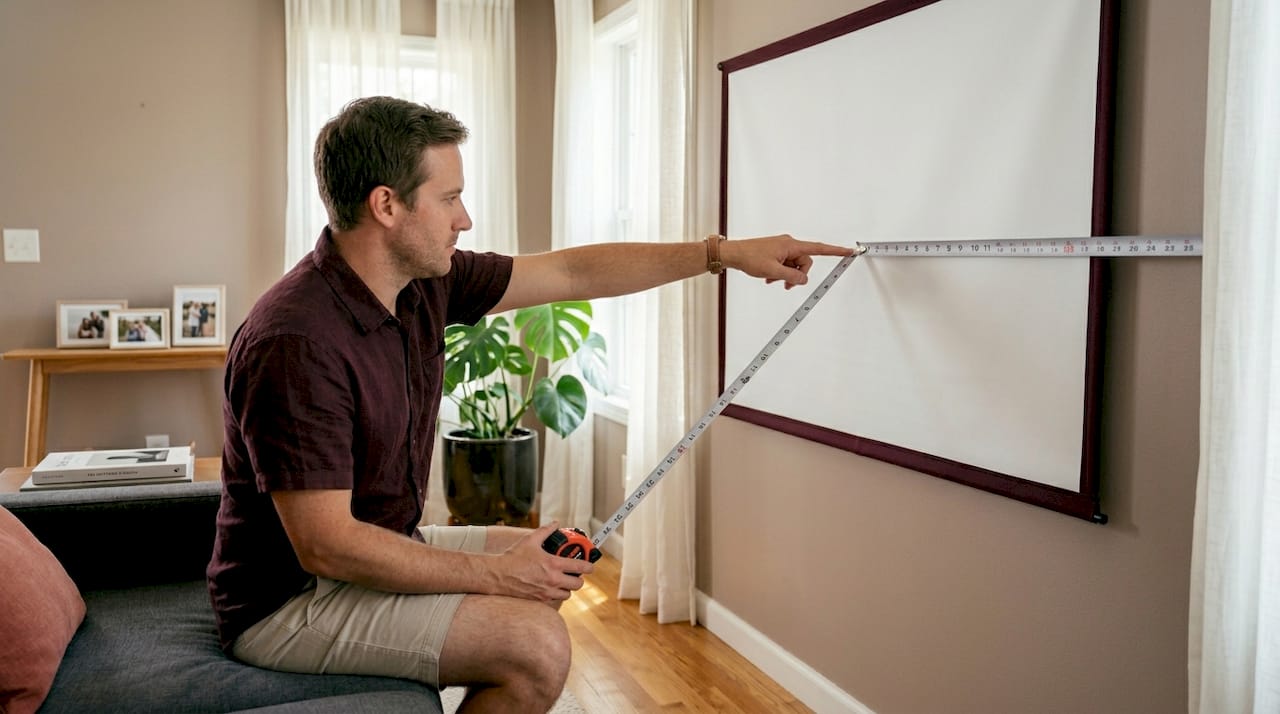
The practical formula most home theater designers use is straightforward. Optimal viewing distance is 1.2 to 1.5 times the screen diagonal for an immersive 4K experience. That means if you sit 10 feet (120 inches) from the screen, your ideal diagonal falls between 80 and 100 inches. If you sit 12 feet back, the range shifts to 96 to 120 inches.
Here is a quick reference for common seating distances:
- 8 feet (96 inches): Ideal screen diagonal is 64 to 80 inches
- 10 feet (120 inches): Ideal screen diagonal is 80 to 100 inches
- 12 feet (144 inches): Ideal screen diagonal is 96 to 120 inches
- 15 feet (180 inches): Ideal screen diagonal is 120 to 150 inches
- 18 feet (216 inches): Ideal screen diagonal is 144 to 180 inches
Pro Tip: Measure from your primary seating position to where the screen center will hang, not to the wall itself. In Malaysian homes where sofas often sit against the back wall, the actual viewing distance is frequently 18 to 24 inches shorter than people assume.
Aspect ratio also changes the physical dimensions of a screen even when the diagonal stays the same. A 120-inch 16:9 screen measures roughly 105 by 59 inches, while a 120-inch 2.35:1 cinemascope screen measures 111 by 47 inches. The wider format feels more cinematic for films but creates letterboxing on standard 16:9 content. Use a projector screen size calculator to convert your diagonal into exact width and height before ordering.
How do aspect ratios affect your screen dimensions?
Aspect ratio is the width-to-height relationship of your screen, and it directly determines how much of your wall a given diagonal will consume. The three formats you will encounter most often are 16:9 (standard widescreen), 4:3 (legacy square format), and 2.35:1 (anamorphic widescreen used in cinema films).
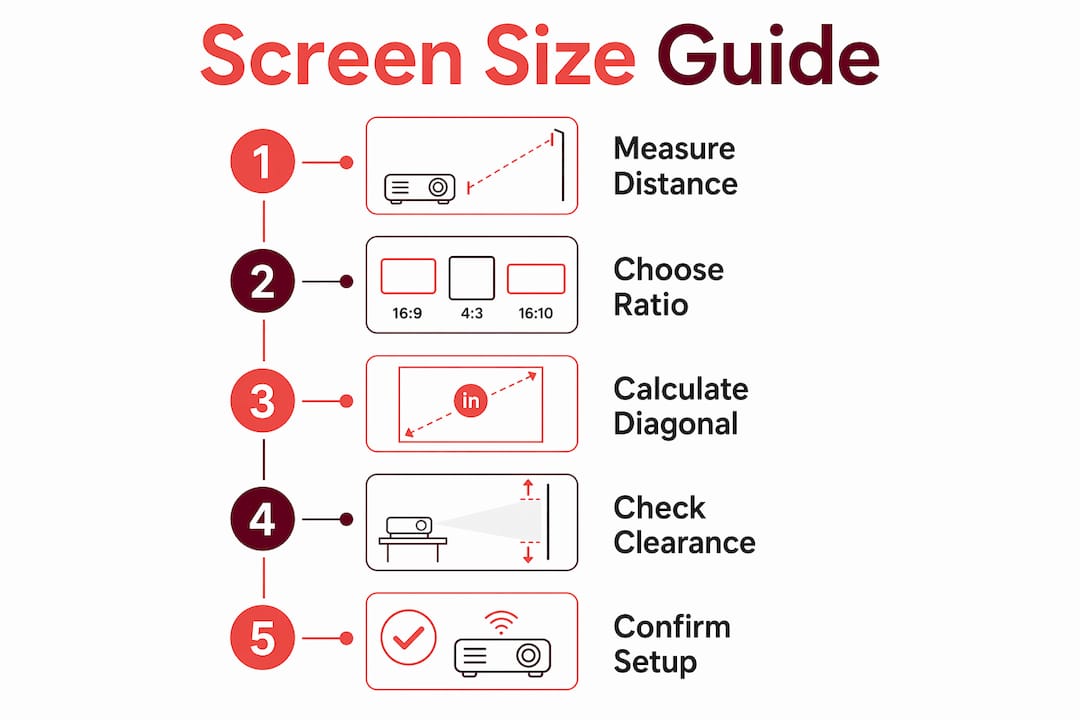
The table below shows how the same diagonal produces very different physical dimensions across these three formats:
| Diagonal (inches) | Aspect ratio | Width (inches) | Height (inches) |
|---|---|---|---|
| 100 | 16:9 | 87.2 | 49.0 |
| 100 | 4:3 | 80.0 | 60.0 |
| 100 | 2.35:1 | 95.7 | 40.7 |
| 120 | 16:9 | 104.6 | 58.8 |
| 120 | 4:3 | 96.0 | 72.0 |
| 120 | 2.35:1 | 114.8 | 48.9 |
| 150 | 16:9 | 130.7 | 73.5 |
| 150 | 2.35:1 | 143.5 | 61.1 |
For most Malaysian homes running a mix of Netflix, gaming, and Blu-ray movies, 16:9 is the correct choice. It handles 99% of modern content without letterboxing. The 2.35:1 format suits dedicated cinema rooms where you primarily watch Hollywood films and want zero black bars. The 4:3 format is now largely obsolete for home theater use, though it still appears in business and classroom projectors from brands like Epson and NEC.
One factor buyers consistently overlook is wall clearance. A 120-inch 16:9 screen needs at least 110 inches of clear wall width to accommodate the frame and any masking borders. Add speaker placement on either side and you need a wall at least 130 inches (roughly 11 feet) wide. Many Malaysian terrace house living rooms measure exactly that, leaving zero margin for error.
Choosing the right screen size for your room and projector
Screen size selection is not just about viewing distance. Your projector's brightness and resolution set hard limits on how large you can go before image quality degrades visibly.
Key factors to evaluate before finalizing your screen size:
- Projector brightness (lumens): Large screens require higher lumens, and pushing a low-brightness projector onto a 150-inch screen in a room with any ambient light produces a dull, washed-out image. A 2,000-lumen projector works well on a 100-inch screen in a dark room but struggles on anything larger in a typical Malaysian living room with windows.
- Resolution and pixel density: 4K resolution allows sitting closer and using larger screens without visible pixelation compared to 1080p. At 120 inches, a 1080p projector starts showing pixel structure if you sit closer than 10 feet. A native 4K projector from brands like Epson, BenQ, or JVC remains sharp at 8 feet on the same screen.
- Wall surface: Cream walls and textured surfaces cause washed-out or soft images. A dedicated projection screen with a gain of 1.0 to 1.3 reflects light more uniformly than any painted wall. This matters especially in Malaysian homes where off-white walls are the default finish.
- Ambient light control: Rooms without blackout curtains need an Ambient Light Rejecting (ALR) screen. ALR and acoustically transparent screens are gaining importance for mixed-use rooms where full light control is not possible. This is the reality for most Malaysian living rooms doubling as home theaters.
- Room type and ceiling height: Malaysian apartments and terrace houses typically have 9 to 10-foot ceilings. A 120-inch 16:9 screen is 59 inches tall, which fits comfortably. A 150-inch screen at 74 inches tall leaves only 8 to 10 inches of clearance above and below, which feels cramped.
Pro Tip: When a projector is marketed as "4K-compatible" or "4K-enhanced," that usually means it accepts a 4K signal but displays it at 1080p or uses pixel-shifting technology. Native resolution matters far more than marketing claims when choosing your maximum screen size.
Home theater screen size chart for Malaysian rooms
The chart below is built around typical Malaysian residential room types, using standard construction dimensions common to terrace houses, condominiums, and semi-detached homes across Peninsular Malaysia.
| Room type | Room size (approx.) | Recommended screen diagonal | Viewing distance | Aspect ratio |
|---|---|---|---|---|
| Bedroom | 10 x 12 ft | 60 to 80 inches | 8 to 10 ft | 16:9 |
| Master bedroom | 12 x 14 ft | 80 to 100 inches | 10 to 12 ft | 16:9 |
| Living room (apartment) | 12 x 18 ft | 100 to 120 inches | 10 to 14 ft | 16:9 |
| Living room (terrace house) | 14 x 20 ft | 110 to 130 inches | 12 to 16 ft | 16:9 |
| Dedicated theater room | 16 x 24 ft | 130 to 150 inches | 14 to 18 ft | 16:9 or 2.35:1 |
Recommended screen sizes in 2026 align closely with this chart: 60 to 80 inches for bedrooms, 100 to 120 inches for living rooms, and 120 to 150 inches for dedicated theater rooms. The Malaysian context adds one important nuance: most local living rooms have furniture pushed against walls, which shortens the effective viewing distance by 1 to 2 feet compared to Western open-plan layouts.
Room-type based screen guidance also confirms that larger cinema rooms in the 150 to 200-inch range require dedicated acoustic treatment alongside screen sizing. Sound integration must be considered alongside screen size, especially for rooms smaller than 150 square feet where acoustic space is limited. A 130-inch screen in a 12-by-16-foot room will overwhelm the space sonically unless you account for speaker placement and wall absorption.
For a bedroom setup, a portable projector from brands like Hisense, JMGO, or Optoma paired with an 80-inch screen delivers a satisfying experience without dominating the room. For a living room, a full HD or 4K projector from Epson, BenQ, or Viewsonic on a 110 to 120-inch screen hits the sweet spot between immersion and practicality. Dedicated theater rooms give you the freedom to go to 150 inches, but only if your projector delivers at least 3,000 lumens and native 4K resolution.
Projectors vs. large-screen TVs for home theater sizing
The projector-versus-TV decision is fundamentally a screen size decision. A 120-inch TV does not exist at any reasonable price point in Malaysia. A 120-inch projection setup using a quality projector and a fixed-frame screen from Projectordisplay costs a fraction of what an 85-inch OLED TV commands.
Key tradeoffs to consider:
- Brightness and ambient light: TVs win in bright rooms. A 65-inch Samsung or Hisense QLED TV at 1,000 nits outperforms any projector in a sunlit Malaysian living room. Projectors need at least partial light control to compete.
- Input lag for gaming: Most modern TVs offer 1 to 4ms input lag in game mode. Projectors from brands like BenQ and Optoma designed for gaming achieve 8 to 16ms, which is acceptable for casual play but noticeable for competitive gaming.
- Screen size ceiling: Projectors scale to 150 inches and beyond. TVs top out practically at 98 inches for residential use, and the cost curve becomes steep above 75 inches.
- Setup and maintenance: Projectors require ceiling mounting, cable management, and occasional projector lamp replacement. Laser projectors from brands like Hisense and JMGO eliminate the lamp concern but carry a higher upfront cost.
- Pixel density: Projector pixel density is much lower than fixed TVs, so seating distance must increase to avoid perceived softness on large diagonal screens. A 120-inch projector image viewed at 8 feet looks softer than a 65-inch TV viewed at the same distance.
Pro Tip: Choose a projector when your target screen size exceeds 100 inches or your budget is under RM 8,000 for the display alone. Choose a TV when your room has significant ambient light and your target size is 85 inches or smaller. Read the full breakdown at projector vs TV comparison for Malaysian homes.
Key takeaways
Optimal screen size is determined first by viewing distance, then constrained by projector brightness and resolution. No screen size decision is complete without checking all three variables.
| Point | Details |
|---|---|
| Use the 1.2x to 1.5x rule | Multiply your seating distance by 0.67 to 0.84 to find your ideal screen diagonal. |
| Match lumens to screen size | A projector under 2,500 lumens should not drive a screen larger than 110 inches in a typical Malaysian room. |
| Verify native resolution | Native 4K allows larger screens at closer distances without visible pixelation. |
| Use the room-type chart | Bedrooms suit 60 to 80 inches, living rooms 100 to 120 inches, dedicated theaters 130 to 150 inches. |
| Consider ALR screens | Malaysian living rooms with limited light control benefit significantly from Ambient Light Rejecting screen materials. |
Why most people get screen size wrong the first time
The most common mistake I see among home theater buyers in Malaysia is prioritizing screen size over projector brightness and resolution. Someone walks into a showroom, sees a 150-inch display running a demo reel in a pitch-black room with a 5,000-lumen laser projector, and orders the same screen size for a condo living room with floor-to-ceiling windows. The result is a washed-out, gray image that no amount of projector settings can fix.
The second mistake is ignoring sound. A 130-inch screen in a 12-by-15-foot room creates a visual experience that the audio simply cannot match unless you invest equally in the sound system. The screen dominates the room visually, but thin walls and hard floors in Malaysian terrace houses kill the bass response. The experience feels unbalanced.
My honest recommendation: start with a screen size that your projector can drive properly, then upgrade the projector before upgrading the screen. An Epson or BenQ 4K projector at 3,500 lumens on a 110-inch ALR screen in a living room with some ambient light will outperform a 150-inch screen with a 2,000-lumen projector every single time. The ALR screen guide on Projectordisplay is worth reading before you commit to any screen purchase in a non-dedicated room.
— Projector
Find your ideal screen and projector at Projectordisplay
Projectordisplay is the best projector seller in Malaysia for home theater enthusiasts who want the right screen size matched to the right projector from day one. The projector screen collection covers fixed-frame, motorized, and ALR options from 60 to 200 inches, with sizes suited to every room type in the chart above. Whether you are setting up a bedroom projector with an Optoma or Viewsonic unit, or building a dedicated theater with a laser projector from Hisense or JMGO, Projectordisplay carries the screens and projectors to complete the setup. Fast shipping across Peninsular Malaysia and WhatsApp support make it easy to confirm your screen dimensions before ordering.
Browse the full range of projector screens and projectors at Projectordisplay, and use the on-site sizing guidance to match your room to the right diagonal before you buy.
FAQ
What screen size is best for a Malaysian living room?
A 100 to 120-inch screen suits most Malaysian living rooms, where seating distances typically fall between 10 and 14 feet. Use the 1.2x to 1.5x viewing distance formula to confirm the right diagonal for your specific room.
How do I calculate the right projector screen size?
Divide your seating distance in inches by 1.5 for the minimum screen diagonal, and by 1.2 for the maximum. A 12-foot (144-inch) seating distance gives a range of 96 to 120 inches.
Does a 4K projector allow a larger screen than 1080p?
Yes. 4K resolution allows sitting closer and using larger screens without pixelation, while a 1080p projector on a 120-inch screen starts showing pixel structure at distances under 10 feet.
What is an ALR screen and do I need one in Malaysia?
An Ambient Light Rejecting screen filters out side-angle ambient light while reflecting the projector beam directly to viewers. Most Malaysian living rooms benefit from ALR screens because full blackout conditions are rarely achievable in mixed-use spaces.
Should I choose a projector or a large TV for home theater use?
Choose a projector when your target screen size exceeds 100 inches or your budget favors a large image over pixel-perfect brightness. Choose a TV when your room has significant ambient light and your target size is 85 inches or smaller.
Recommended
- Projector Screen Size Guide 2025: Perfect Fit for Malaysian Needs – Projector Display
- Best Projector and Screen for Home Theater in Malaysia 2025 – Projector Display
- Best Home Theater Screen: Top Choices and Buying Guide – Projector Display
- Find your perfect projector screen size with calculator – Projector Display