

Managing classrooms with mixed abilities in Malaysia often feels like balancing countless learning needs at once. The promise of adaptive learning systems lies in their ability to personalize lessons for each student, adjusting difficulty, pacing, and content using real-time data. By leveraging artificial intelligence and machine learning, these systems naturally fit the realities of large, diverse classes, freeing teachers to focus on mentorship. This article highlights what these concepts mean, practical types available, and strategies for effective classroom integration.
Table of Contents
- Defining Adaptive Learning Systems And Concepts
- Major Types Of Adaptive Learning Technologies
- Key Features And How They Work
- Implementing Adaptive Systems In Classrooms
- Challenges, Costs, And Common Pitfalls
Key Takeaways
| Point | Details |
|---|---|
| Adaptive Learning Systems Personalize Education | These systems tailor learning experiences for each student based on individual needs, improving engagement and outcomes. |
| Data and Teacher Involvement are Crucial | Successful implementation relies on teachers understanding the technology and how to leverage student data effectively. |
| Challenges Must Be Addressed Proactively | Schools face high costs, data privacy concerns, and technical issues that require thoughtful planning and regular support. |
| Pilot Programs are Essential | Starting with small-scale implementations allows for troubleshooting and adjustment before wider adoption. |
Defining Adaptive Learning Systems and Concepts
Adaptive learning systems represent a fundamental shift in how classrooms operate across Malaysia and beyond. Rather than treating all students as a single group moving through identical lessons, these systems use technology to personalize each student's learning journey based on their unique needs and performance levels. Think of it like having a dedicated tutor for every student who adjusts explanations, pacing, and difficulty in real-time based on how well each learner grasps the material.
At their core, AI powered systems dynamically personalize instruction by using machine learning and data analysis to track student progress, identify knowledge gaps, and recommend tailored content. These systems don't just deliver the same lesson faster for quick learners. They actually change what students see, learn, and practice based on their individual performance patterns and learning preferences. A student struggling with algebra concepts receives additional scaffolding and simpler examples, while a student demonstrating mastery moves forward to more complex problem-solving challenges.
What makes adaptive learning particularly valuable in Malaysian classrooms is how it addresses the reality of mixed-ability classes. Teachers managing 30 to 40 students with vastly different skill levels can now provide personalized instruction tailored to current ability levels without burning out trying to create individual lesson plans for each student. The system handles the heavy lifting of content adjustment and progress tracking, freeing teachers to focus on mentorship and deeper instruction.
These systems operate through several key mechanisms. Bayesian knowledge tracing analyzes what students know and don't know at each moment. Natural language processing helps the system understand student responses beyond simple right or wrong answers. Reinforcement learning continuously improves recommendations based on outcomes. Together, these technologies create learning experiences that adapt automatically as students progress.
Implementation requires more than just uploading content into software. Teachers act as co-designers, curating content and deciding which concepts matter most for their students. Your role involves understanding how the system works, selecting appropriate materials, and monitoring which students need extra support despite the system's personalization.
Pro tip: Start by piloting adaptive learning systems with one subject or grade level rather than rolling out school-wide, allowing your team to understand how these tools work before expanding to classrooms with different equipment like interactive displays or best office projector setups.
Major Types of Adaptive Learning Technologies
Adaptive learning technologies come in several distinct varieties, each designed to solve different classroom challenges in Malaysian schools. Understanding these types helps you select the right tools for your specific teaching needs and student populations.
Content Delivery Personalization Systems form the foundation of many adaptive platforms. These technologies track what students know and adjust the difficulty and type of content they receive in real-time. When a student masters a concept quickly, the system moves them to harder material. When they struggle, it provides additional explanations and practice. Rather than every student grinding through the same textbook chapter, each learner gets a customized progression.
Real-Time Assessment Technologies continuously evaluate student understanding as they learn. Unlike traditional quizzes given at lesson end, these systems monitor every interaction, every answer, every hesitation. This allows teachers to identify misconceptions immediately rather than waiting until after the test. The data flows back to instructional systems, which then adjust upcoming content automatically.
Engagement Tracking Tools monitor motivation and participation patterns. AI-driven adaptive learning technologies utilize varied machine learning approaches to reveal behavioral patterns that predict whether students will persist or disengage. Some students need more interaction. Others respond better to visual content. The system learns these preferences and adapts presentation style accordingly.
Immersive Technologies like virtual reality and augmented reality create adaptive experiences where students learn through experiential exploration rather than passive content consumption. A chemistry student might virtually manipulate molecules in 3D space, with difficulty adjusting based on their performance. These approaches prove particularly powerful for visual learners and hands-on skill development.
Multimodal Integration Systems combine multiple data sources to build comprehensive learner profiles. Academic performance data, engagement metrics, learning style preferences, and even emotional responses get analyzed together. This holistic approach prevents the system from making decisions based on incomplete information.
The variety exists because classrooms are not monolithic. Your mathematics classroom may benefit most from content personalization, while your science class thrives with immersive VR elements and real-time assessment. Your special education students might need engagement tracking that prompts interaction when attention wanes.
Here's a summary of the main adaptive learning technology types and their classroom benefits:
| Technology Type | Main Function | Ideal Use Case | Unique Classroom Benefit |
|---|---|---|---|
| Content Personalization | Adjusts lesson difficulty in real time | Mathematics and literacy classes | Ensures students learn at optimal pace |
| Real-Time Assessment | Monitors ongoing student responses | Science and problem-solving courses | Detects misconceptions immediately |
| Engagement Tracking | Tracks motivation and participation | Special education and mixed-ability classes | Improves student retention and focus |
| Immersive Technologies | Delivers experiential VR/AR learning | Visual and hands-on subjects | Enhances practical understanding |
| Multimodal Integration | Merges academic, behavioral, and emotion data | Diverse classrooms | Builds a holistic learner profile |
Pro tip: Start by auditing which classroom challenge affects your students most, then research which technology type addresses that specific problem rather than adopting the most advanced or expensive option available.
Key Features and How They Work
Adaptive learning systems operate through interconnected components that work together to personalize each student's educational experience. Rather than functioning as a black box, these systems rely on transparent mechanisms that track, analyze, and respond to learner behavior continuously.

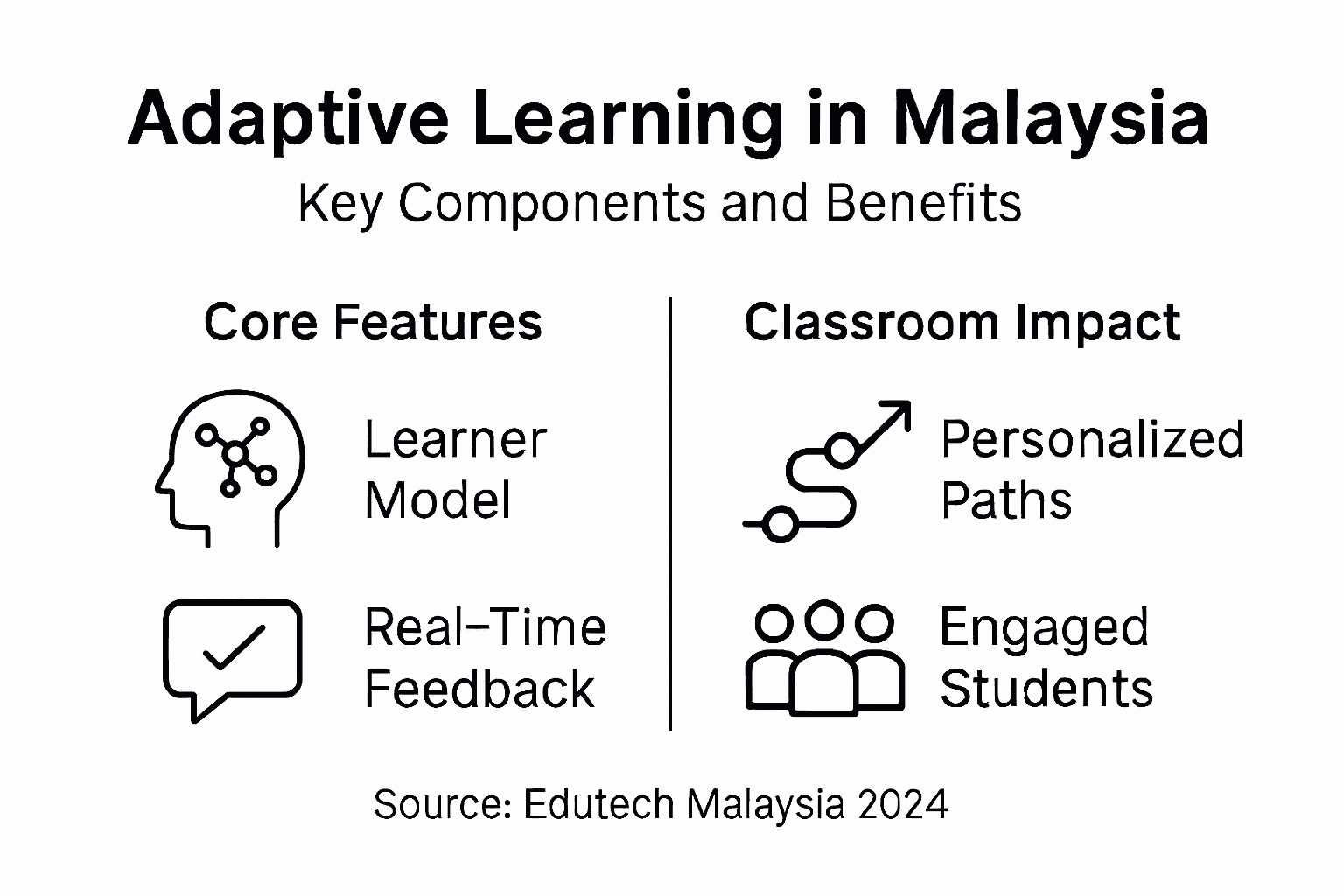
The learner model forms the foundation. This component captures detailed information about each student: their knowledge gaps, preferred learning styles, pace of understanding, and engagement patterns. Think of it as a digital profile that updates constantly. As a student answers questions or completes tasks, the system records not just right or wrong answers but also response time, attempts taken, and confidence level.
The domain model represents subject knowledge itself. It breaks down your curriculum into interconnected concepts and skills, mapping how topics relate to one another. When teaching fractions, the system understands that fraction comprehension depends on whole number understanding. This allows the system to identify precisely where a student's learning chain breaks and what foundational concept needs reinforcement.
The adaptation model represents the decision-making engine. Real-time analysis of learner behavior drives dynamic content adaptation and determines which instructional adjustments optimize learning. If a student demonstrates mastery of a concept, the model recommends progression. If confusion emerges, it suggests alternative explanations, visual representations, or interactive practice before advancement.
These components interact seamlessly. Your student progresses through a mathematics lesson. The learner model registers that they solved three geometry problems correctly but hesitated on angle relationships. The domain model identifies angle relationships as dependent on basic geometric principles. The adaptation model then recommends a visual interactive activity exploring angles before presenting the next concept.
Personalized feedback mechanisms complete the system. Rather than waiting until assessment day, students receive immediate, specific guidance. A student writing an essay gets feedback on structure before completing the final draft. A student solving science problems receives hints targeting their specific misconceptions rather than generic instruction.
The power lies in continuous cycling. Assessment feeds the learner model. Updated learner profiles trigger adaptation decisions. New instructional content generates fresh performance data. This loop operates hundreds of times daily across your classroom.
Pro tip: Request access to your adaptive system's dashboard before implementation so you understand what data it collects about students and how it makes instructional decisions.
Implementing Adaptive Systems in Classrooms
Successful implementation of adaptive learning requires more than installing software and hoping teachers figure it out. It demands deliberate planning, teacher preparation, and institutional commitment to change how classrooms operate.
Start by assessing your current classroom environment and infrastructure. Adaptive systems require reliable internet connectivity, devices for students to access content, and compatible hardware. If your school lacks basic technology foundation, address those gaps first. A projector display system supporting interactive content delivery, whether through a best classroom projector or interactive display, creates the visual infrastructure students need for engaging with personalized content.
Teacher preparation forms the critical foundation. Teachers cannot simply activate an adaptive platform and step back. Effective classroom implementation requires teachers to act as co-designers and content creators for adaptive technologies. Your staff needs professional development covering how the system works, how to interpret student data, and how to intervene when the system detects struggles. Without this training, teachers feel confused and defensive about technology replacing their expertise.
Integrate adaptive systems with pedagogical approaches your teachers already value. Successful implementation involves integrating adaptive strategies with diverse techniques such as flipped classrooms, where students preview content independently before class discussion, or microlearning, which breaks concepts into digestible chunks. These approaches complement rather than contradict adaptive systems.
Implementation phases matter significantly. Begin with one subject or grade level rather than school-wide rollout. This allows teachers to develop confidence and troubleshoot issues in a contained setting. Collect student performance data, teacher feedback, and technical issues. Use this evidence to refine approach before expanding.
Provide ongoing institutional support. Technology coordinators should establish regular check-ins with teachers, maintain the system infrastructure, and advocate for continued professional development as platforms evolve. Single training sessions accomplish little. Sustained support builds competence and buy-in.
Monitor both learning outcomes and teacher confidence. If students show improved engagement but teachers feel overwhelmed, something needs adjustment. Success means teachers feel equipped, students show growth, and the system functions reliably.
Pro tip: Designate one teacher champion from each subject area to become the adaptive system expert at your school, providing peer support and translating technical concepts into classroom language that colleagues understand.
Challenges, Costs, and Common Pitfalls
Adaptive learning systems promise personalization, but implementing them reveals significant obstacles that catch many schools off guard. Understanding these challenges upfront prevents costly mistakes and wasted effort.
Cost represents the first barrier. Initial software licensing, content development, hardware infrastructure, and teacher training demand substantial budgets. A single adaptive platform can cost between RM50,000 and RM200,000 annually for a school, depending on student population and customization needs. Beyond software, you need reliable internet infrastructure, student devices, and display systems like a best classroom projector or interactive display for content presentation. Many Malaysian schools lack these foundational investments.
Data privacy and security create legal and ethical complications. Adaptive systems collect extensive student data: learning patterns, response times, mistakes, behavioral indicators. Adaptive learning systems face challenges including data privacy concerns and high implementation costs that require careful governance. Who owns this data? How long is it stored? What happens if the company providing the platform goes out of business? Malaysian schools must navigate both Ministry of Education requirements and increasingly strict data protection expectations from parents.
Teacher resistance presents a human obstacle. Some educators view adaptive systems as threatening their expertise or suggesting they cannot meet individual student needs. Others feel overwhelmed by technology complexity. This resistance slows adoption and prevents systems from reaching their potential. Teachers need genuine buy-in, not mandated compliance.
Technical challenges emerge during implementation. Developing effective adaptive learning environments faces numerous challenges including usability difficulties and modeling learner behavior complexity. Systems may not work reliably with your existing infrastructure. Content may not align perfectly with Malaysian curriculum standards. Algorithmic bias can disadvantage certain student groups if the system was trained on unrepresentative data.
Scalability poses practical difficulties. What works for 50 students in one classroom may struggle with 500 students across your school. Maintaining system performance, updating content, and providing teacher support at scale requires significant ongoing effort and resources.
Many schools purchase expensive systems then use them minimally because implementation planning was inadequate. Success requires honest assessment of your readiness before committing financially.
The following table highlights major challenges of adaptive learning systems and possible mitigation strategies:
| Challenge | Impact on Schools | Example Mitigation Strategy |
|---|---|---|
| High upfront costs | Limits system adoption | Start with small pilot projects |
| Data privacy concerns | Legal and ethical risks | Establish clear data policies |
| Teacher resistance | Low classroom buy-in | Provide ongoing professional training |
| Technical infrastructure | Ineffective system use | Upgrade school network and devices |
| Scalability issues | Inconsistent outcomes | Invest in support and maintain systems |
Pro tip: Request a pilot program from vendors, allowing you to test the system with one classroom for one semester before making school-wide financial commitments.
Elevate Your Adaptive Learning Experience with Advanced Display Technology
Adaptive learning systems rely on real-time content personalization and dynamic feedback to transform classrooms. However, to maximize their impact, these systems need reliable and high-quality visual display solutions that engage students and enhance interaction. The challenge many Malaysian schools face is creating an immersive and clear learning environment that supports personalized content delivery and interactive assessments effectively.
At ProjectorDisplay.com, we understand these needs and offer tailored projection and interactive display solutions that perfectly complement adaptive learning technologies. Whether you require smart projectors with wireless connectivity for seamless classroom flow or interactive display systems that foster hands-on experimentation and engagement, our selection addresses the core pain points educators face like low visibility, limited interaction, and lack of scalable classroom infrastructure.

Empower your classrooms with crystal-clear projection and intuitive interactive displays from ProjectorDisplay.com. Explore our wide range of projectors designed for educational settings and provide students with the visual tools they need to thrive in adaptive learning environments. Don't wait to create the future-ready classroom your students deserve. Visit us today and equip your school with the technology that turns adaptive learning promise into reality.
Frequently Asked Questions
What are adaptive learning systems?
Adaptive learning systems use technology to personalize educational experiences for students, adjusting content, pace, and difficulty based on individual performance and needs.
How do adaptive learning technologies benefit teachers?
These technologies help teachers manage mixed-ability classes by providing personalized instructional support without requiring individual lesson plans for every student, allowing them to focus more on mentorship and deeper instruction.
What types of adaptive learning technologies are available?
There are several types, including content delivery personalization systems, real-time assessment technologies, engagement tracking tools, immersive technologies, and multimodal integration systems, each tailored to address different classroom challenges.
What are the challenges in implementing adaptive learning systems?
Challenges include high upfront costs, data privacy concerns, potential teacher resistance to technology, technical infrastructure issues, and scalability difficulties. Proper planning and pilot programs can help mitigate these issues.
Recommended
- Personalized Learning Benefits for Malaysian Classrooms – Projector Display
- 7 Key EdTech Trends in 2025 Every Malaysian Should Know – Projector Display
- Gamification in Learning: Transforming Classroom Engagement – Projector Display
- Classroom AV Solutions: Complete Guide – Projector Display
- ENGAGE | Formation WhatsApp avec IA pour Formateurs