

More than 80 percent of teachers worldwide report higher student engagement when gamification and interactive tools are combined. Malaysian educators looking to motivate learners are now blending innovative techniques found in American classrooms with projector technology. This approach transforms lessons into immersive experiences and helps students stay focused. Discover how game-inspired teaching strategies and digital projection can reshape education, making learning more active and measurable for every age group.
Table of Contents
- Defining Gamification In Educational Contexts
- Types Of Gamification Strategies In Learning
- How Projectors Enhance Interactive Learning
- Key Benefits And Measurable Outcomes
- Common Pitfalls And How To Overcome Them
Key Takeaways
| Point | Details |
|---|---|
| Gamification Enhances Learning | Integrating game elements into education significantly boosts student motivation and engagement by making learning interactive and immersive. |
| Diverse Strategies Available | Educators can adopt various gamification strategies like points, badges, and narrative learning to cater to diverse learning preferences. |
| Measurable Outcomes | Implementing gamification often results in measurable improvements in academic performance, student motivation, and engagement levels. |
| Mindful Implementation Required | Successful gamification requires careful design to avoid over-relying on extrinsic rewards and to align with core educational objectives. |
Defining Gamification in Educational Contexts
Gamification represents a strategic approach to transforming traditional learning environments by integrating game design elements into educational frameworks. At its core, gamification is about making learning more engaging, interactive, and motivational by borrowing mechanics typically found in video games and board games. Researchers examining global educational trends define this approach as systematically applying game components like points, badges, leaderboards, and narrative structures into non-game academic settings.
The fundamental goal of gamification goes beyond mere entertainment. It aims to enhance student motivation, encourage active participation, and create more immersive learning experiences. By introducing elements such as challenge levels, reward systems, and competitive frameworks, educators can tap into students' intrinsic desires for achievement, recognition, and progression. Comprehensive scientometric reviews reveal that gamification strategies have been successfully implemented across diverse educational contexts, from primary school classrooms to professional training programs.
Understanding gamification requires distinguishing it from related concepts like game-based learning and serious games. While these approaches share similarities, gamification specifically focuses on applying game design principles to non-game environments. This means transforming traditional learning activities by adding game-like elements such as progress tracking, immediate feedback mechanisms, and interactive challenges. The key is not to replace educational content but to redesign how that content is presented and experienced, making learning more dynamic and student-centered.
Pro tip: Start small by introducing one gamification element at a time, such as a point system or achievement badges, to gradually build student engagement and assess its effectiveness in your specific classroom context.
Types of Gamification Strategies in Learning
Gamification strategies encompass a diverse range of techniques designed to transform learning experiences by integrating engaging game-like elements. A comprehensive meta-analysis examining educational research reveals several prominent strategies that educators can leverage to enhance student motivation and participation. These strategies include points systems, badge achievements, leaderboards, narrative-driven learning, progress tracking, and social competition mechanisms.
The most common gamification approaches can be categorized into distinct types. Points-based systems reward students with numerical values for completing tasks, assignments, or demonstrating specific learning behaviors. Badge systems provide visual recognition of achievements, allowing students to collect and showcase their academic accomplishments. Research exploring educational gamification platforms highlights platforms like Duolingo and Kahoot as excellent examples of how these strategies can be implemented effectively across different learning contexts. Leaderboards introduce a competitive element by ranking student performance, which can motivate learners through transparent progress visualization and peer comparison.

Beyond traditional game mechanics, advanced gamification strategies incorporate more sophisticated approaches. Narrative-driven learning transforms educational content into storytelling experiences, where students progress through learning modules like characters in an interactive story. Adaptive challenge systems dynamically adjust difficulty levels based on individual student performance, ensuring that learning remains challenging yet achievable. These strategies are particularly effective in maintaining student engagement by providing personalized learning experiences that respond to each learner's unique pace and capabilities.
Pro tip: When implementing gamification strategies, start by selecting one or two complementary approaches that align with your specific subject matter and student demographics, and gradually expand your gamification toolkit based on observed student responses and engagement levels.
Here's a quick comparison of gamification strategies and their unique impacts on learning environments:
| Strategy Type | Primary Benefit | Example Platform | Ideal Use Case |
|---|---|---|---|
| Points System | Boosts motivation | Duolingo | Daily skill practice |
| Badges/Achievements | Visual recognition | Kahoot | Rewarding major milestones |
| Leaderboards | Fosters competition | Quizizz | Tracking group performance |
| Narrative Learning | Enhances engagement | Classcraft | Story-driven lesson modules |
| Adaptive Challenges | Personalizes difficulty | Smart Sparrow | Differentiated instruction |
How Projectors Enhance Interactive Learning
Interactive learning technologies have transformed traditional classroom dynamics, with projectors emerging as powerful tools for creating engaging educational experiences. Innovative research exploring classroom technology demonstrates how projectors enable dynamic, collaborative learning environments that transcend conventional teaching methods. These visual display systems allow educators to seamlessly integrate multiple media types, transforming static lessons into interactive, multimedia experiences that capture students' attention and promote deeper understanding.
Projectors facilitate multiple dimensions of interactive learning through advanced technological capabilities. Visual content sharing becomes instantaneous, enabling real-time annotations, collaborative problem-solving, and immediate feedback mechanisms. Teachers can display complex diagrams, scientific simulations, historical documentaries, and interactive software applications, creating immersive learning experiences that adapt to diverse learning styles. The ability to quickly switch between different visual resources allows for more flexible and responsive instructional approaches, breaking down traditional lecture-based learning barriers.
Beyond simple content display, modern projectors support collaborative classroom interactions. Interactive projection systems enable students to directly manipulate on-screen content, participate in group activities, and engage with digital learning platforms. Touch-sensitive projection screens and wireless connectivity transform classrooms into dynamic spaces where technology becomes an extension of the learning process. These technological innovations support active learning strategies, encouraging student participation, critical thinking, and peer-to-peer knowledge exchange through shared visual experiences.
Pro tip: When integrating projectors into classroom settings, start by selecting interactive software and content that aligns with your specific curriculum objectives, and gradually introduce collaborative features that encourage student engagement and participation.
Key Benefits and Measurable Outcomes
Gamification in learning provides substantial, quantifiable benefits that extend far beyond traditional educational approaches. Research documenting educational intervention outcomes reveals impressive statistical improvements, demonstrating gains between 15-30% in critical areas such as academic achievement, student motivation, classroom participation, and knowledge retention. These measurable outcomes highlight the transformative potential of integrating game-based learning strategies into educational environments.
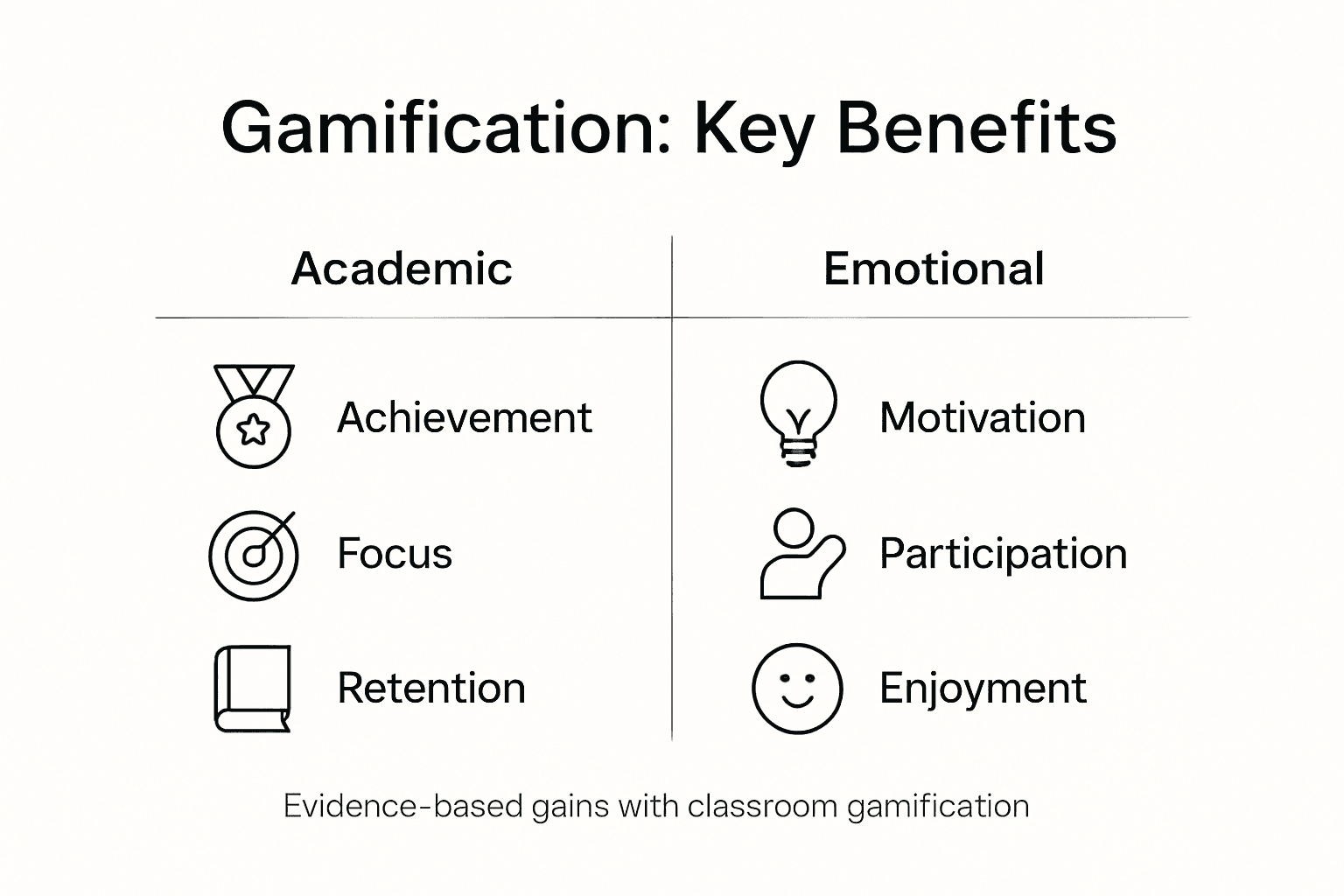
The cognitive and emotional benefits of gamification are multifaceted and profound. Academic performance metrics show significant improvements across various learning domains, with students experiencing enhanced engagement, reduced learning anxiety, and increased self-confidence. Global research examining learning technology impacts indicates that gamified learning environments foster stronger collaborative skills, encourage critical thinking, and create more inclusive educational experiences. These outcomes are particularly notable in how they support diverse learning styles and provide personalized pathways for student development.
Beyond immediate academic gains, gamification cultivates essential long-term skills and psychological attributes. Students develop enhanced problem-solving capabilities, improved resilience, and more sophisticated intrinsic motivation mechanisms. The competitive yet supportive framework of gamified learning helps students understand failure as a learning opportunity, promotes growth mindset principles, and builds emotional intelligence through structured challenges and collaborative interactions. These broader developmental outcomes demonstrate that gamification is not merely an educational technique but a comprehensive approach to holistic student growth.
Pro tip: When implementing gamification strategies, start by establishing clear, measurable objectives and select game mechanics that directly align with your specific learning outcomes to ensure meaningful and impactful educational experiences.
Consider these measurable outcomes that gamification can help achieve across educational settings:
| Outcome Area | Typical Improvement Range | Main Contributing Factor | Long-Term Benefit |
|---|---|---|---|
| Academic Achievement | 15-30% | Active participation | Higher knowledge retention |
| Student Motivation | 20-25% | Intrinsic rewards | Increased lifelong learning |
| Engagement | 18-30% | Interactive challenges | Better classroom collaboration |
| Skill Development | 10-20% | Problem-solving activities | Enhanced critical thinking |
Common Pitfalls and How to Overcome Them
Gamification implementation presents complex challenges that educators must strategically navigate to ensure meaningful learning experiences. Comprehensive research analyzing gamification challenges highlights several critical pitfalls that can undermine the effectiveness of game-based learning strategies. The most significant risks include over-reliance on extrinsic motivators, potential disengagement after initial excitement, unequal student accessibility, and misalignment with core pedagogical objectives.
One of the primary challenges involves maintaining sustained student motivation beyond superficial reward systems. Intrinsic learning motivation requires careful design that goes beyond simple point accumulation or leaderboard rankings. Empirical studies examining educational technology implementation reveal that successful gamification depends on creating meaningful challenges, providing genuine learning pathways, and ensuring that game mechanics genuinely support educational goals. Educators must design systems that balance competition with collaboration, creating environments where students feel both challenged and supported in their learning journey.
Technical and pedagogical barriers can significantly impact gamification effectiveness. Many educators struggle with limited digital literacy, insufficient training, and time constraints that make comprehensive implementation challenging. The key to overcoming these obstacles lies in progressive, contextually sensitive approaches. This includes incremental technology integration, ongoing professional development, collaborative planning among educators, and continuous assessment of gamification strategies. By adopting a flexible, adaptive mindset and prioritizing pedagogical objectives over technological novelty, teachers can create more robust and engaging learning experiences that genuinely enhance student outcomes.
Pro tip: Start with small, manageable gamification interventions in a single subject area, gather student feedback, and iteratively refine your approach to build confidence and effectiveness.
Elevate Classroom Engagement with Interactive Projection Solutions
The article highlights critical challenges educators face when integrating gamification in learning such as maintaining student motivation and fostering immersive, collaborative environments. Achieving meaningful and sustained engagement often requires dynamic visual tools that support game mechanics like progress tracking, immediate feedback, and interactive challenges. If you want to transform your classroom into a vibrant learning space that captures student attention and encourages participation gamified learning pairs perfectly with advanced projection technology.

Discover high-quality projectors and interactive displays designed for educational settings at ProjectorDisplay.com. Whether you are looking for portable projectors for flexible lesson delivery or smart projectors with wireless connectivity to support narrative-driven learning and real-time collaboration our wide selection has you covered. Start enhancing your teaching strategies today by combining gamification principles with powerful visual display solutions. Visit ProjectorDisplay.com to explore options and bring next-level engagement to your classroom now.
Frequently Asked Questions
What is gamification in education?
Gamification in education involves integrating game design elements, such as points, badges, and challenges, into learning environments to enhance engagement and motivation among students.
How can teachers implement gamification strategies effectively?
Teachers can effectively implement gamification strategies by starting with one or two elements, like a points system or achievement badges, and gradually expanding based on student responses and engagement levels.
What are the benefits of gamification in learning?
The benefits of gamification include improved academic performance, increased student motivation and engagement, enhanced skill development, and the cultivation of a growth mindset through structured challenges.
What common pitfalls should educators be aware of when using gamification?
Common pitfalls include over-reliance on extrinsic motivators, potential disengagement after initial excitement, unequal accessibility among students, and misalignment with core educational objectives.
Recommended
- 7 Interactive Classroom Ideas for Engaging Learning – Projector Display
- Improving Student Engagement: Strategies for Modern Classrooms – Projector Display
- 7 Key EdTech Trends in 2025 for Malaysian Innovators – Projector Display
- 7 Key EdTech Trends in 2025 Every Malaysian Should Know – Projector Display