

TL;DR:
- Projector light output declines over time due to lamp aging and optical component degradation. Regular maintenance and choosing laser or LED sources extend brightness and reduce total ownership costs. Proper usage and cleaning can significantly slow lumen depreciation and preserve image quality.
Projector light output degradation is the measurable decline in brightness and image quality caused by the aging of a projector's light source and optical components over time. The industry standard term for this process is lumen depreciation, and it affects every projector regardless of technology. Traditional lamp projectors require replacement at just 2,000–5,000 hours, while laser and LED sources reach the L70 threshold, meaning 70% of original brightness retained, at 20,000–30,000 hours. Understanding what drives this decline gives you the tools to slow it, measure it, and decide when to act.
What causes projector light output degradation?
Lumen depreciation does not happen at a uniform rate, and the cause depends heavily on the light source technology inside your projector.
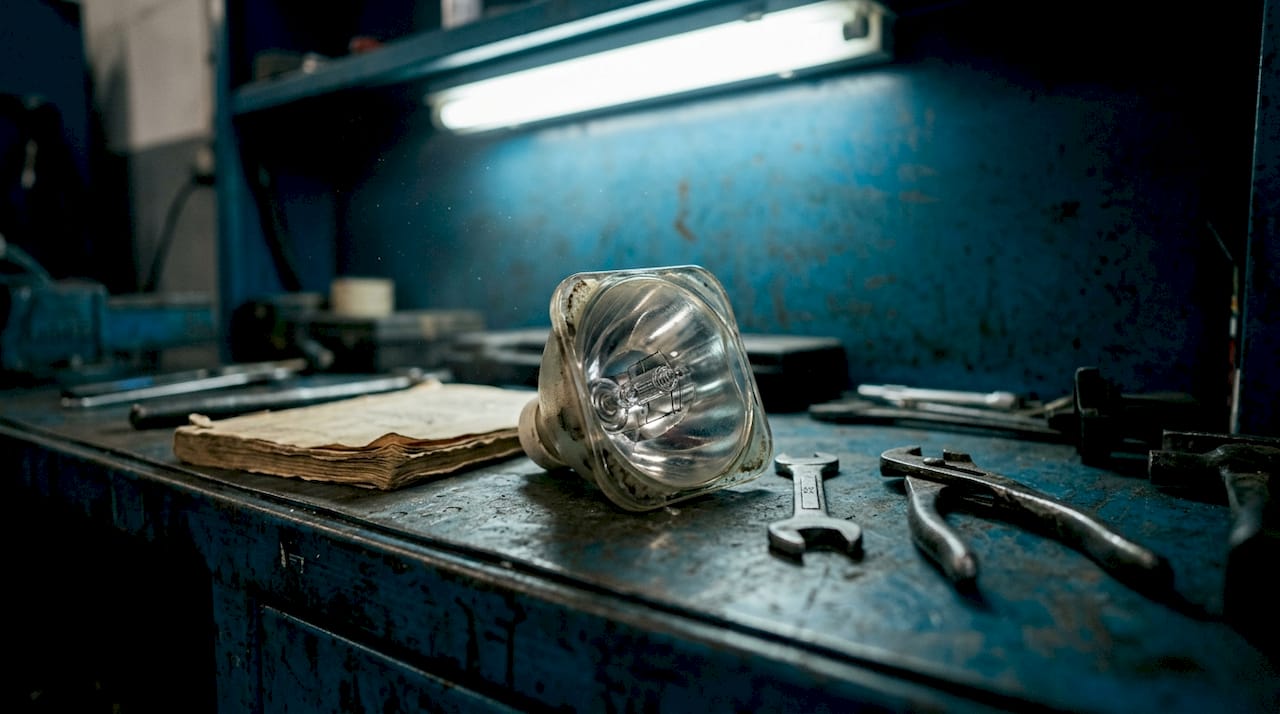
Light source type matters most. Traditional high-pressure mercury lamps degrade rapidly because the arc tube blackens with tungsten deposits as hours accumulate. LED and laser sources degrade more slowly because they produce light through solid-state processes with far less thermal stress on the emitter itself. The degradation curve for lamps is exponential, meaning brightness drops sharply in the first few hundred hours and again near end of life. Laser and LED sources follow a more linear curve, losing brightness gradually and predictably.
Thermal stress accelerates aging across all technologies. High internal temperatures accelerate lumen depreciation and cause color shifts in the light source and surrounding optics. Keeping junction temperatures low is the single most effective engineering lever for extending light source life. This is why projectors with advanced cooling systems consistently outlast those with basic fan setups, even when using the same light source.
Here is what drives degradation beyond the light source itself:
- Dust and clogged filters. Clogged air filters are the leading cause of preventable premature failure. Restricted airflow raises internal temperatures, which accelerates aging of the lamp, LCD panels, and color filters simultaneously.
- LCD panel and polarizer aging. The optical system components, including LCD panels, polarizers, and color filters, degrade from thermal stress faster than the LED or laser light source itself. Color shifts and uneven brightness appear after 7,000–8,000 hours even when the light source still outputs well.
- Operating mode. Eco mode intentionally reduces light output by 20–30% to lower heat and extend lamp life. This is a deliberate trade-off, not a malfunction.
- Ambient light and screen quality. A poor projector screen amplifies perceived brightness loss. Gain loss from a worn or dirty screen compounds the effect of lumen depreciation.
- Improper ventilation placement. Mounting a projector in a confined ceiling space without adequate airflow raises ambient temperature around the unit and shortens every component's life.
Pro Tip: Clean your projector's air filter every 300–500 hours of use. In Malaysia's humid, dust-heavy environment, that interval should be shorter, closer to every 200 hours for projectors in classrooms or open offices.
How long do different projector light sources maintain usable brightness?
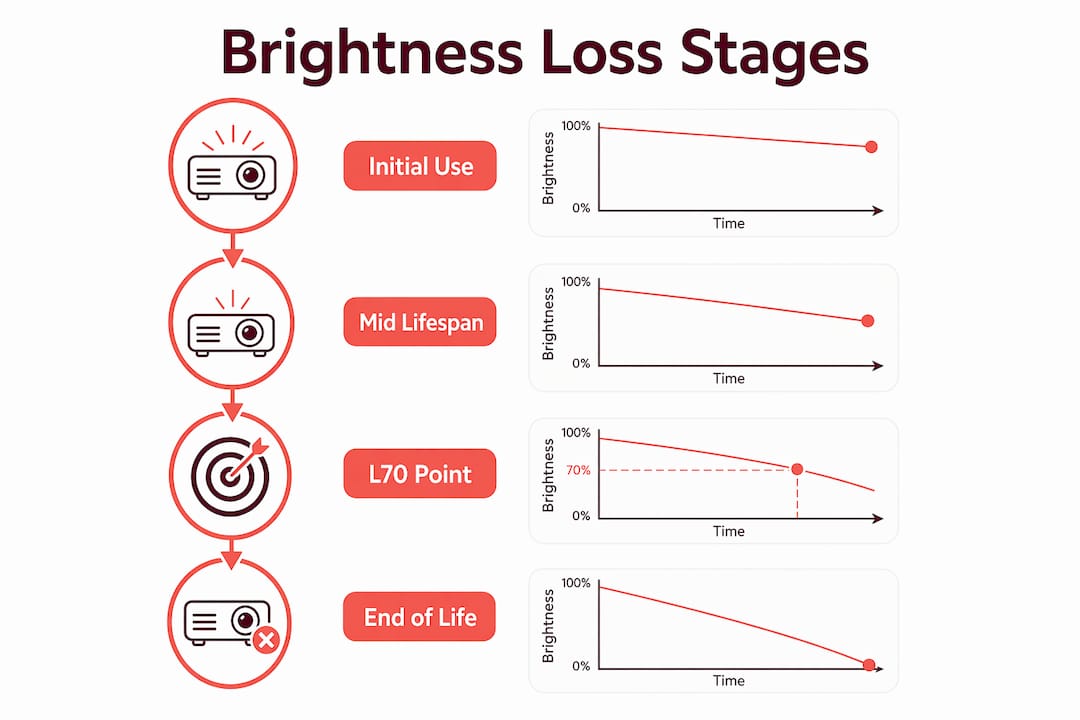
The L70 rating is the industry benchmark for projector lifespan. It marks the point at which a light source retains 70% of its original brightness. Below L70, most users notice visible dimming without direct comparison.
Laser and LED projectors maintain around 70–85% of original brightness after 10,000–20,000 hours of use. Traditional lamps often require replacement well before reaching L70. Lamp projectors show 20–30% brightness loss at half their rated lifespan, while laser projectors show only 15–20% loss at the same relative point.
| Light source | Rated lifespan | Brightness loss at half-life | Degradation curve |
|---|---|---|---|
| Lamp (UHP/mercury) | 2,000–5,000 hours | 20–30% | Exponential |
| LED | 20,000+ hours | ~15–20% | Linear |
| Laser | 20,000–30,000 hours | ~15–20% | Linear |
The practical implication is significant. A classroom projector in Malaysia running 8 hours a day, 5 days a week logs roughly 2,000 hours per year. A lamp projector needs a replacement bulb annually. A laser projector in the same classroom runs 10–15 years before reaching L70. That difference reshapes the total cost of ownership entirely.
The L70 rating also does not tell the full story. Optical components like polarizers and color filters degrade from heat before the light source fails. A projector rated at 20,000 hours may develop color drift or uneven brightness at 8,000 hours due to optical system aging. Buyers should treat the light source lifespan as a ceiling, not a guarantee of consistent image quality throughout.
How does maintenance and environment influence brightness loss?
Consistent maintenance is the most cost-effective tool for slowing projector brightness loss. Most premature degradation is preventable with a structured routine.
Follow this maintenance sequence to protect light output over time:
- Clean the air filter every 200–300 hours. Dust buildup and poor ventilation raise internal temperatures and cause uneven brightness loss. In Malaysia's climate, filters collect dust faster than in temperate environments.
- Wipe the lens with a microfiber cloth monthly. A dirty lens scatters light and reduces perceived brightness without any actual lumen depreciation occurring. This is one of the easiest wins in projector care.
- Recalibrate color settings annually. Annual color recalibration is necessary to counteract color drift and maintain image fidelity in permanent installations. Without it, images become washed out even when the light source is still performing adequately.
- Use eco mode strategically. Eco mode reduces brightness by 20–30% but meaningfully extends lamp life. For presentations in controlled lighting, the trade-off is worthwhile. For home theater use in a dark room, the brightness reduction is barely noticeable.
- Check ventilation clearance every six months. Projectors need at least 30 cm of clear space around vents. Ceiling-mounted units in tight enclosures are the most common victims of heat-related degradation.
A structured cleaning schedule reduces the risk of overheating and extends the usable life of every optical component inside the unit.
Pro Tip: If your projector image looks dim, clean the lens and filter before assuming lamp failure. Brightness can often be restored through cleaning and mode adjustments alone, saving you the cost of an unnecessary replacement.
When should you replace the bulb or upgrade your projector?
Knowing when to replace a lamp versus upgrading the entire unit is a financial decision as much as a technical one.
Watch for these signs that action is needed:
- Visible dimming without a dirty lens or filter. If cleaning does not restore brightness, the light source is degrading.
- Color shift toward yellow or green. This signals lamp aging or optical component degradation, not a settings issue.
- Uneven brightness across the image. Hot spots or dark corners indicate polarizer or LCD panel aging.
- The lamp hour counter exceeds the rated lifespan. Most projectors display this in the settings menu.
The cost decision comes down to total cost of ownership, or TCO. Laser projectors cost more upfront but deliver lower 5-year TCO when usage exceeds 1,500 hours annually, because lamp replacement costs accumulate quickly. A projector lamp in Malaysia typically costs RM 300–800 per replacement, and high-use environments replace them every 12–18 months. Over five years, that adds up to a significant portion of the original projector cost.
For professionals evaluating a projector for large venues or corporate training environments, the math strongly favors laser technology. For casual home users logging under 500 hours per year, a quality lamp projector with good maintenance remains cost-effective. The cost of ownership guide for Malaysia breaks this calculation down by usage scenario.
Measuring brightness objectively requires a lux meter placed at the screen surface. A reading below 50 lux in a darkened room signals meaningful degradation for home theater use. Business and classroom environments need higher thresholds, typically 100 lux or more, to maintain readability under ambient light.
Key Takeaways
Projector light output degradation is best managed by combining the right light source technology with consistent maintenance and timely recalibration.
| Point | Details |
|---|---|
| L70 is the key benchmark | Laser and LED sources reach L70 at 20,000–30,000 hours; lamps fail well before this point. |
| Optical components degrade first | LCD panels and polarizers show color drift and uneven brightness before the light source fails. |
| Dust is the top preventable cause | Clean filters every 200–300 hours to prevent overheating and accelerated brightness loss. |
| Annual recalibration preserves color | Color drift from aging optics requires yearly recalibration to maintain image fidelity. |
| TCO favors laser at high usage | Laser projectors cost more upfront but save money over five years when used more than 1,500 hours annually. |
What I've learned about brightness loss after years in the projector market
The most common mistake I see is treating lumen depreciation as a single-variable problem. Buyers focus entirely on the light source rating and ignore the optical system. A projector rated at 20,000 hours can develop serious color problems at 8,000 hours if the polarizers and color filters degrade from heat. The light source spec is real, but it does not guarantee consistent image quality for the full rated life.
The second mistake is neglecting maintenance until something looks wrong. By the time you notice visible dimming, the projector has already been running hot for months. A filter cleaned every 200 hours in a Malaysian classroom costs nothing. A replacement lamp costs hundreds of ringgit and requires downtime.
I also think the industry undersells eco mode. Most users see it as a brightness penalty. The reality is that running a lamp projector in eco mode from day one extends lamp life substantially and reduces heat stress on every surrounding component. The brightness reduction is real, but in a properly darkened room or with a high-gain screen, it is rarely noticeable in practice.
The projector market in Malaysia has shifted decisively toward laser and LED technology, and for good reason. The advantages of laser projectors go beyond lifespan. They deliver more consistent color over time, require less maintenance, and eliminate the anxiety of tracking lamp hours. For any professional or institutional buyer running a projector more than four hours a day, the upgrade pays for itself.
— Projector
Projectordisplay's solutions for managing projector brightness in Malaysia
Projector brightness loss is a real cost for businesses, schools, and home theater users across Malaysia. Projectordisplay stocks a full range of projectors built for sustained performance, from portable wireless projectors to high-output laser models suited for large venues and corporate training rooms.
Whether you need a projektor murah for a classroom, a high-lumen Epson projector Malaysia setup for a conference room, or a replacement projector lamp Malaysia for an existing unit, Projectordisplay carries the right options. The catalog includes models from Viewsonic projector Malaysia, Optoma projector Malaysia, Panasonic projector Malaysia, and more. For buyers comparing technologies, the LED vs laser comparison guide helps narrow the decision by usage hours and budget. Projectordisplay also supports customers through WhatsApp for fast advice and quotes, with shipping across Peninsular Malaysia.
FAQ
What is projector light output degradation?
Projector light output degradation, also called lumen depreciation, is the gradual reduction in brightness and color quality as a projector's light source and optical components age with use.
How many hours does a projector lamp last before noticeable dimming?
Traditional lamp projectors show 20–30% brightness loss at half their rated lifespan, which typically falls between 2,000 and 5,000 hours total.
Does cleaning a projector restore brightness?
Yes, in many cases. Cleaning the lens and air filter removes obstructions that reduce light transmission and cause overheating, which can restore noticeable brightness without replacing the lamp.
Is a laser projector worth the higher price in Malaysia?
For users running a projector more than 1,500 hours annually, laser projectors deliver lower total cost of ownership over five years because they eliminate recurring lamp replacement costs.
What is the L70 rating and why does it matter?
The L70 rating marks the point at which a projector retains 70% of its original brightness. Laser and LED projectors reach L70 at 20,000–30,000 hours, while lamp projectors typically require replacement long before reaching this threshold.