

TL;DR:
- Micro LED projection features arrays of microscopic LEDs that produce images with near-100% light-to-image efficiency. Currently, most products use micro LEDs as a light source paired with DLP or LCoS chips, while true self-emissive displays are still maturing and limited in production. The technology outperforms OLED and traditional projectors in brightness, power efficiency, and device size, with strong applications in AR, portable entertainment, and education, though manufacturing challenges slow mass adoption.
Micro LED projection is defined as a display technology where arrays of microscopic light-emitting diodes act as both the light source and the image-forming element, producing images with near-100% light-to-image conversion efficiency. Unlike traditional projectors from brands like Epson, BenQ, or Optoma that rely on a separate lamp or laser to illuminate a DLP or LCoS chip, micro LED systems generate light and form the image at the pixel level simultaneously. This distinction makes micro LED projection fundamentally different from what most AV professionals encounter in standard LCD projectors or laser projectors today. As of 2026, the technology is shifting toward commercialization with early adopters in enterprise AR and specialized AV applications leading the charge.
What is micro LED projection and how does it work?
Micro LED projection operates on two distinct architectures, and confusing them is the most common mistake AV professionals make when evaluating this technology. The first is the true self-emissive micro LED display, where each pixel contains its own microscopic LED that emits light directly. The second, and currently more common in commercial products, uses micro LEDs purely as an advanced light source paired with a separate DLP or LCoS imaging chip.
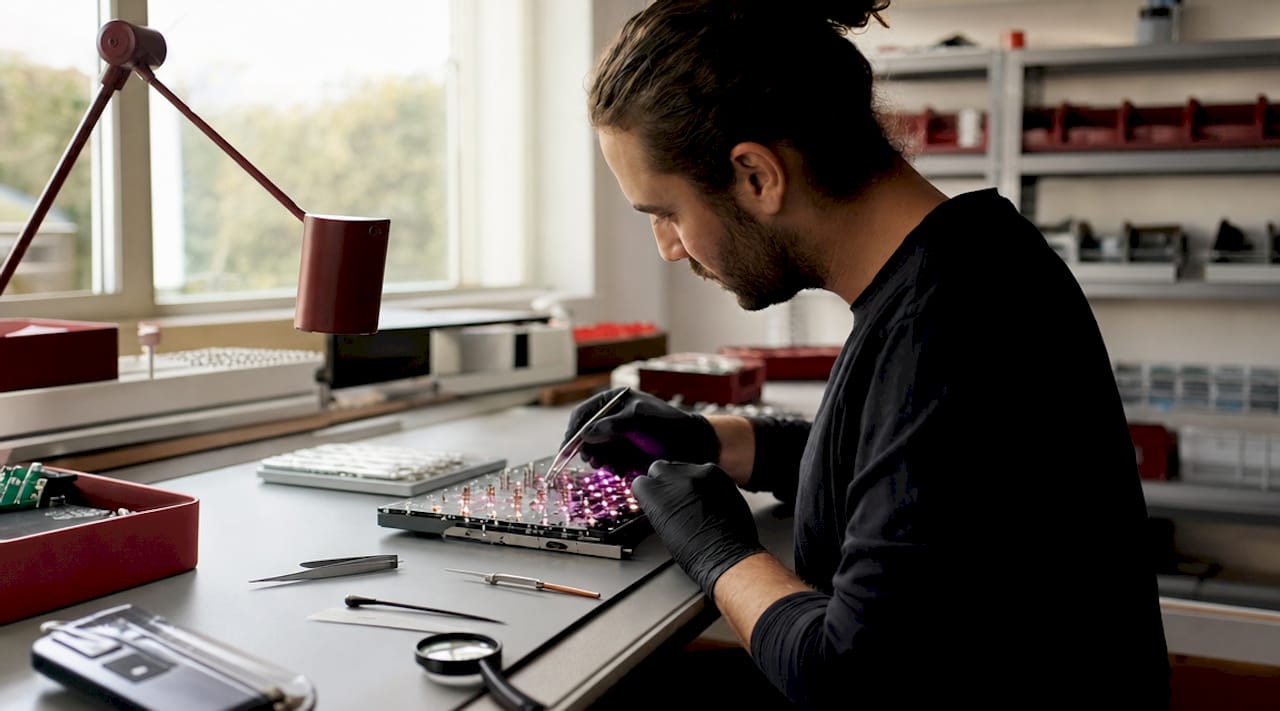
Self-emissive micro LED architecture
In a true self-emissive system, micro LED arrays achieve near-100% light-to-image efficiency because every photon generated contributes directly to the final image. Traditional projectors separate the light source from the display, meaning a significant portion of generated light is absorbed, reflected away, or filtered out before it ever reaches the screen. A 1LCD projector converts only 6 to 10% of its lamp output into useful image light. DLP improves this to roughly 40%. Self-emissive micro LED, by contrast, wastes almost none of it.
Micro LED as an illumination source for DLP and LCoS
Most products currently marketed as micro LED projectors use micro LEDs with DLP or LCoS chips rather than fully integrated self-emissive arrays. In this configuration, micro LEDs replace the traditional lamp or laser as the light engine, delivering higher brightness, faster switching speeds, and better color accuracy than conventional LED or lamp sources. DLP chips use microscopic mirrors to modulate the light; LCoS chips reflect it through liquid crystals. Micro LED enhances both by providing a more controllable, efficient light input.
Pixel-level brightness control and scanning optics
One of the defining capabilities of micro LED projection is per-pixel brightness control. The system activates each LED only when that pixel needs to emit light, functioning like a variable-frequency energy-saving device. For AR near-eye displays, scanning optical systems project micro LED output directly onto the retina or through waveguide optics, requiring pixel pitches below 50 microns. Companies like PlayNitride and Lumus are developing waveguide-based systems where micro LED chips smaller than a fingernail project full images through compact optics.
Pro Tip: When reviewing micro LED projector specs, ask the manufacturer whether the micro LED is the imaging element itself or just the light source. The answer determines the device's true efficiency and image quality ceiling.
How does micro LED compare to OLED and traditional projectors?
Micro LED projection outperforms OLED and traditional projection technologies across three critical dimensions: brightness, power consumption, and device size. Understanding these differences helps AV buyers make informed decisions rather than chasing marketing claims.
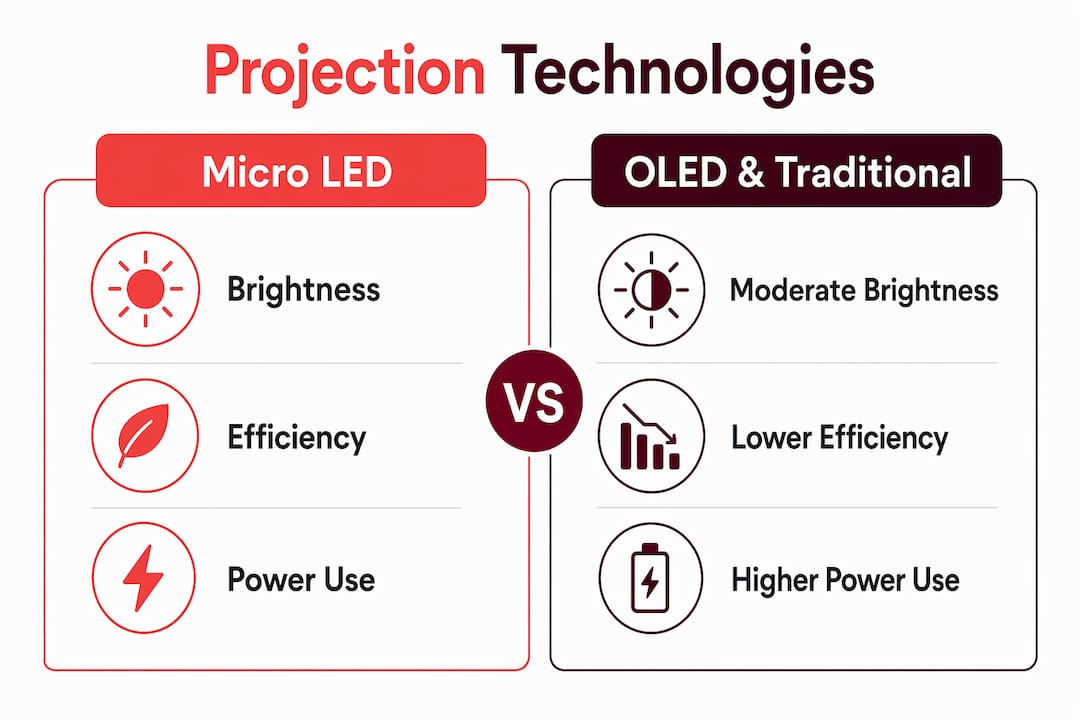
| Feature | Micro LED | OLED | DLP/LCoS Projector |
|---|---|---|---|
| Light-to-image efficiency | Near 100% | Moderate | 6% to 40% |
| Peak brightness | Very high | Limited by burn-in risk | High (lamp/laser dependent) |
| Power consumption | Low (on-demand emission) | Moderate | High (continuous light source) |
| Device compactness | Excellent | Good | Poor to moderate |
| Contrast ratio | Extremely high | Extremely high | Moderate to high |
Micro LED offers superior brightness and lower power consumption compared to OLED and LCoS, which is the decisive factor for wearable AR glasses and portable projectors that run on battery power. OLED panels risk burn-in at sustained high brightness, limiting their peak output in static-image scenarios. Micro LED has no such constraint. For outdoor use or daylight-visible displays, this brightness advantage is not marginal. It is the difference between a usable and an unusable device.
Micro LED also delivers 1 to 2 fold improvements in dynamic energy consumption versus passive projection technologies. This matters enormously for battery-powered devices like AR glasses, where every milliwatt saved extends usable session time. For fixed-installation business projectors, it translates to lower electricity costs and reduced heat generation, which simplifies thermal management.
The compactness advantage is equally significant. Combining light and display functions into a single micro LED system eliminates the separate lamp housing, color wheel, and beam-splitting optics that make traditional projectors bulky. This is why micro LED is the enabling technology for AR glasses from companies like Lumus and why portable projector form factors are shrinking. For the Malaysian projector market, this shift toward compact, high-efficiency devices reflects a broader global trend that buyers should track closely.
What are the current challenges limiting micro LED projection?
Micro LED projection is not yet a mainstream technology, and the reasons are specific, technical, and worth understanding before you commit budget to early-adoption hardware.
The core manufacturing challenge is pixel density at small scales. True micro LED displays face production difficulties maintaining color purity and pixel density below 50 microns, with blue light leakage being a persistent problem in single-chip full-color designs. When red, green, and blue sub-pixels are packed this tightly, blue photons bleed into adjacent pixels, degrading color accuracy in ways that are difficult to correct in post-processing.
Additional challenges include:
- Lambertian emission: Micro LEDs emit light in a wide cone rather than a focused beam. For AR retinal projection, microlens arrays are required to collimate this wide-angle emission into a usable, directed beam. Adding microlens arrays increases optical complexity and cost.
- Pixel repair at scale: Reliable pixel repair is extremely difficult given the microscopic size of individual LEDs. Soft repair methods require redundant LEDs built into the array, raising production complexity and unit cost.
- Color conversion limitations: Quantum dot converters used to shift blue LED output to red and green introduce efficiency losses and add fabrication steps.
- Cost: All of the above combine to make micro LED displays significantly more expensive per unit area than OLED or LCD panels at equivalent resolutions.
Pro Tip: If you are evaluating micro LED projectors for a business or education deployment in 2026, prioritize products using micro LED as a light source with proven DLP or LCoS chips. True self-emissive micro LED at scale is still maturing, and the hybrid approach delivers most of the brightness and efficiency benefits at a fraction of the risk.
These obstacles explain why full-color single-chip micro LED solutions are still in advanced development rather than mass production. The technology is real and advancing rapidly, but buyers should calibrate their expectations to the current state of manufacturing, not the theoretical ceiling.
Applications of micro LED projection in home, education, and business
Micro LED projection is entering practical use across several sectors, though the depth of penetration varies significantly by application type.
-
AR and enterprise wearables: This is where micro LED projection is most mature today. Companies like Lumus and Vuzix are integrating micro LED light engines into smart glasses for industrial inspection, logistics, and field service. High pixel density and brightness are critical for AR applications requiring crisp images visible in varied lighting. A warehouse worker wearing AR glasses needs an image that remains readable under fluorescent lights and near windows. Micro LED delivers this where OLED cannot.
-
Portable home entertainment: Compact micro LED projectors are beginning to challenge traditional portable projectors in the home theater segment. The JmGO M6 Mini represents the category of compact LED projectors that micro LED technology will further shrink and brighten. For home users in Malaysia seeking a best home projector that doubles as a portable device, micro LED-enhanced models offer better battery life and brighter images than lamp-based alternatives.
-
Classroom and education: The best classroom projector for 2026 needs to perform in rooms that are not fully darkened. Micro LED brightness advantages address this directly. Schools and universities evaluating projectors for Malaysian classrooms will find that micro LED light engines produce images that remain vivid even with ambient light present, reducing the need for blackout curtains and simplifying room setup.
-
Business presentations: For the best office projector in a modern conference room, micro LED offers quieter operation (no cooling fan noise from a hot lamp), instant-on capability, and consistent color output over the device's lifetime. Traditional projector lamps degrade in brightness over thousands of hours. Micro LED light sources maintain output far more consistently, reducing total cost of ownership for high-use environments.
| Application | Key benefit | Current readiness |
|---|---|---|
| AR smart glasses | Brightness, compactness | Commercial (limited) |
| Portable home projectors | Battery life, image quality | Emerging |
| Classroom projection | Ambient light performance | Developing |
| Business presentations | Consistency, low noise | Developing |
Key takeaways
Micro LED projection delivers near-100% light-to-image efficiency by combining the light source and display into a single pixel-level system, making it fundamentally more efficient than DLP, LCoS, or OLED alternatives.
| Point | Details |
|---|---|
| Two distinct architectures | Self-emissive micro LED and micro LED as a light source for DLP/LCoS are different technologies with different performance profiles. |
| Efficiency advantage | Micro LED achieves near-100% light-to-image conversion versus 6 to 40% for traditional projectors. |
| Manufacturing barriers | Blue light leakage, pixel repair complexity, and Lambertian emission slow mass production of true self-emissive displays. |
| Best current use case | AR smart glasses and enterprise wearables are the most mature commercial applications in 2026. |
| Buyer guidance | Hybrid micro LED plus DLP or LCoS products deliver most benefits now; true self-emissive is still maturing. |
Why micro LED projection matters more than the hype suggests
From where I sit, having tracked the projector and display industry across Malaysia and the broader AV market, micro LED projection is the most consequential shift in projection technology since laser light sources replaced lamps. But the hype consistently outpaces the reality, and that gap costs buyers money.
The critical insight most coverage misses is the distinction between micro LED as a light source and micro LED as the display itself. Most products hitting the market today, including well-reviewed portable projectors, use micro LEDs only to replace the lamp. That is genuinely useful. Brightness improves, power drops, and the device gets smaller. But it is not the same as a true self-emissive micro LED display, and treating them as equivalent leads to misaligned expectations.
What I find genuinely exciting is the trajectory. PlayNitride's single-chip full-color work and Lumus's waveguide integration show that the engineering problems are solvable. The question is timing and cost. My read is that mainstream self-emissive micro LED projectors for home and business use are still three to five years from price points that make sense for most buyers. For 2026, the smart move is to buy micro LED light source projectors now for the efficiency gains, and plan to upgrade when true self-emissive products reach competitive pricing.
For AV professionals advising clients, the most valuable thing you can do is set accurate expectations. Micro LED projection is not a single product category. It is a spectrum of technologies at different maturity levels, and matching the right architecture to the right application is the actual skill.
— Projector
Explore advanced projection solutions at Projectordisplay
Projectordisplay is Malaysia's specialist projector retailer, stocking a curated range of LED, laser, and smart projectors suited for home entertainment, classrooms, and business environments. Whether you are researching micro LED technology for a future upgrade or need a high-performance projector today, the team at Projectordisplay can match you with the right solution. Browse the top projectors for large venues or explore the full range of projection screens to complete your setup. Fast shipping across Peninsular Malaysia, WhatsApp support, and competitive pricing make Projectordisplay the best projector shop for buyers who want expert guidance alongside their purchase.
FAQ
What is micro LED projection in simple terms?
Micro LED projection uses arrays of microscopic LEDs that generate and form images at the pixel level, achieving near-100% light-to-image efficiency. It differs from standard projectors, which use a separate lamp or laser to illuminate a display chip.
How does micro LED projection differ from OLED?
Micro LED emits light per pixel like OLED but without the burn-in risk and with significantly higher peak brightness. It also consumes less power under variable content conditions because each LED activates only when needed.
Are micro LED projectors available to buy in 2026?
Yes, but most commercial products use micro LEDs as a light source paired with DLP or LCoS chips rather than true self-emissive arrays. True self-emissive micro LED projection is commercially available in limited AR and enterprise applications.
What are the main limitations of micro LED projection today?
The primary limitations are blue light leakage in full-color designs, difficulty repairing defective pixels at microscopic scales, and the optical challenge of collimating wide-angle LED emission for compact projection systems.
Is micro LED projection suitable for classrooms and offices?
Micro LED light source projectors are well-suited for classrooms and offices today, offering better ambient light performance, longer-lasting brightness, and lower power consumption than lamp-based alternatives.
Recommended
- What Is Projector Lumens? A 2025 Guide for Malaysia – Projector Display
- JmGO M6 Mini Portable LED Built in Wireless/WIFI, Bluetooth, Android Mini Pico Projector – Projector Display
- 2025投影仪与LED显示屏比较:马来西亚家庭娱乐与办公选购指南 – Projector Display
- Xiaomi Mi Mini Portable Android Smart Laser Projector [Global English version] Youth Version Full HD Resolution Home Theater [MJJGTYDS02FM] – Projector Display