
TL;DR:
- Motorized lens projectors use electric motors to remotely control focus, zoom, and lens shift, ensuring precise image alignment. They provide superior image quality, installation flexibility, and ease of calibration compared to manual or digital correction systems. This technology is essential for professional AV setups and increasingly accessible in mid-range home theater models.
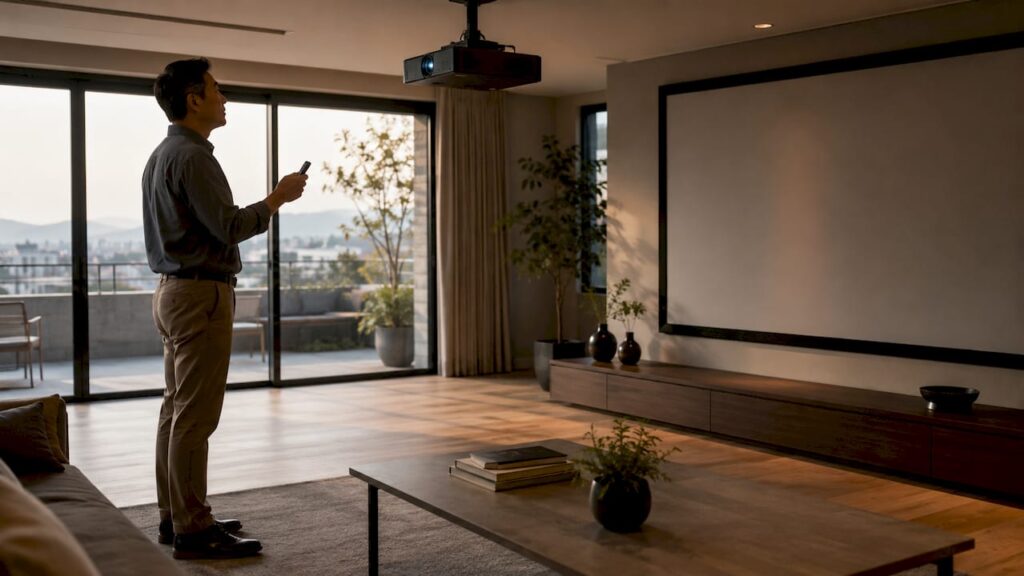
A motorized lens projector is defined as a projector that uses built-in electric motors to control focus, zoom, and lens shift remotely, eliminating the need for manual physical adjustments. This technology is the standard in professional AV installations and is now reaching mid-range home theater models like the XGIMI Titan and JVC DLA-NZ500. Whether you are setting up a home cinema in Malaysia or configuring a classroom display, understanding how motorized lens systems work will directly affect your image quality, installation flexibility, and long-term convenience. The core advantage is simple: optical precision without touching the projector.
What is a motorized lens projector and how does it work?
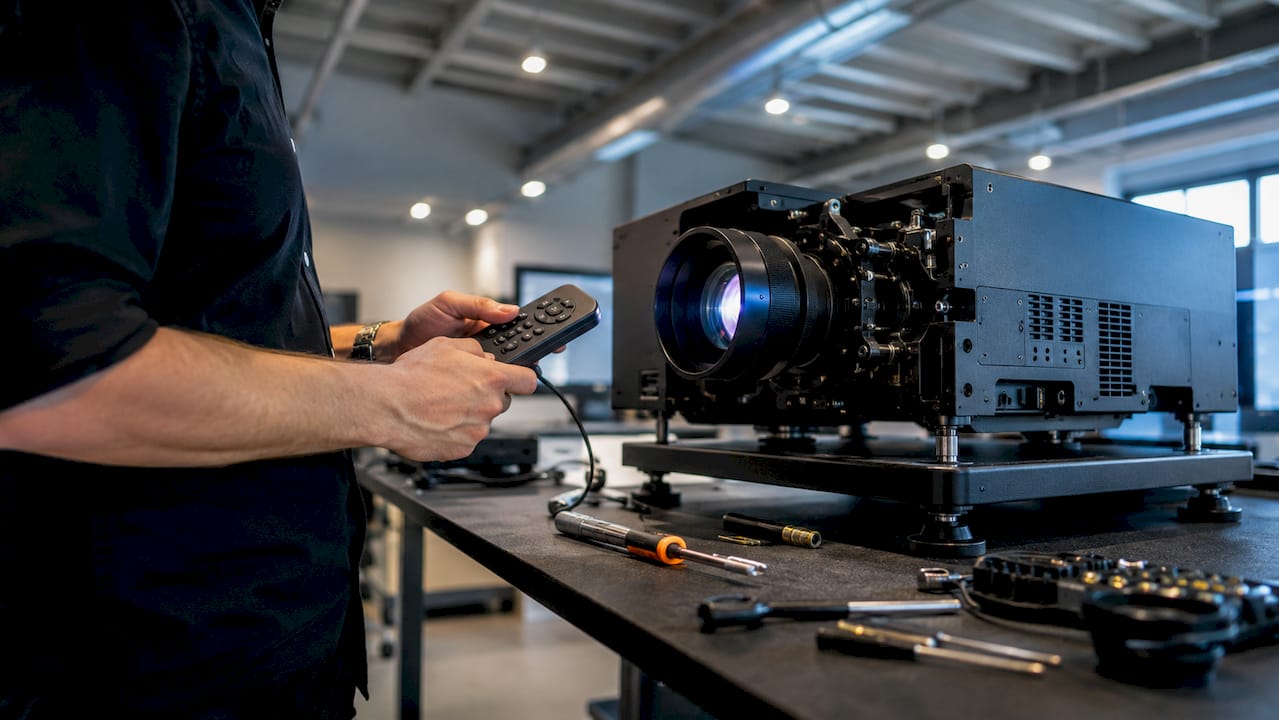
A motorized lens projector uses small electric motors to move physical lens elements inside the projector barrel, adjusting focus, zoom, and lens shift with remote control precision. This is the industry-standard mechanism in professional projection, often called a "motorized lens system" or "powered lens adjustment." Each function operates independently, giving you full control over where and how the image lands on your screen.
The three core motorized functions each solve a different problem:
- Motorized focus sharpens or softens the image without you touching the unit.
- Motorized zoom changes the image size while keeping the projector in a fixed position.
- Motorized lens shift physically moves the lens up, down, left, or right to reposition the image on the screen without moving the projector body.
Vertical lens shift ranges up to ±120% and horizontal shifts up to ±45% in professional models like the XGIMI Titan. That range means you can mount a projector significantly off-center from the screen and still achieve a perfectly aligned image.
Pro Tip: When reading projector specs, look specifically for "motorized lens shift." Many projectors list motorized zoom and focus but omit lens shift entirely. That omission matters more than most buyers realize.
Memory presets are another defining feature. Premium home theater projectors like the JVC DLA-NZ500 include 5 user memory presets, letting you save different lens configurations for different content formats. Switch from a 16:9 movie to a 2.35:1 CinemaScope film with a single button press.
What are the real benefits of motorized projectors?
Optical motorized lens adjustments preserve full native resolution and brightness. Digital keystone correction crops pixels and degrades image quality. That distinction is the most important reason to choose a motorized lens system over a projector that relies on digital processing to fix alignment problems.
Here are the practical benefits that matter most for home and professional users:
- Full image quality at all times. Because the lens physically moves rather than digitally scaling the image, you keep 100% of your projector's native resolution and brightness output.
- Remote alignment from anywhere in the room. You can fine-tune the image from your couch or the back of a classroom without climbing a ladder or repositioning the unit.
- Flexible installation positions. Ceiling mounts, shelf placements, and off-axis positions all become viable because the lens shift compensates for the offset.
- Reduced maintenance in commercial venues. AV professionals rely on motorized lenses for set-and-forget reliability, cutting down on technician visits and physical recalibration after every event.
- Multi-scenario switching with memory presets. Preset functions ranging from 5 to 10 slots let you configure a room for a boardroom presentation in the morning and a widescreen film screening at night.
"Optical lens shifting moves lens elements within the barrel, preserving 100% of native resolution and brightness, unlike digital image scaling which degrades quality." This is why AV integrators and serious home theater enthusiasts treat motorized lens shift as a non-negotiable specification.
The classroom use case is particularly compelling. A teacher in Malaysia using a best classroom projector with motorized lens shift can adjust the image from the front of the room without interrupting the lesson. Brands like Epson projector Malaysia and Optoma projector Malaysia offer models with these capabilities in the education segment.
Motorized lens vs manual: which one should you choose?
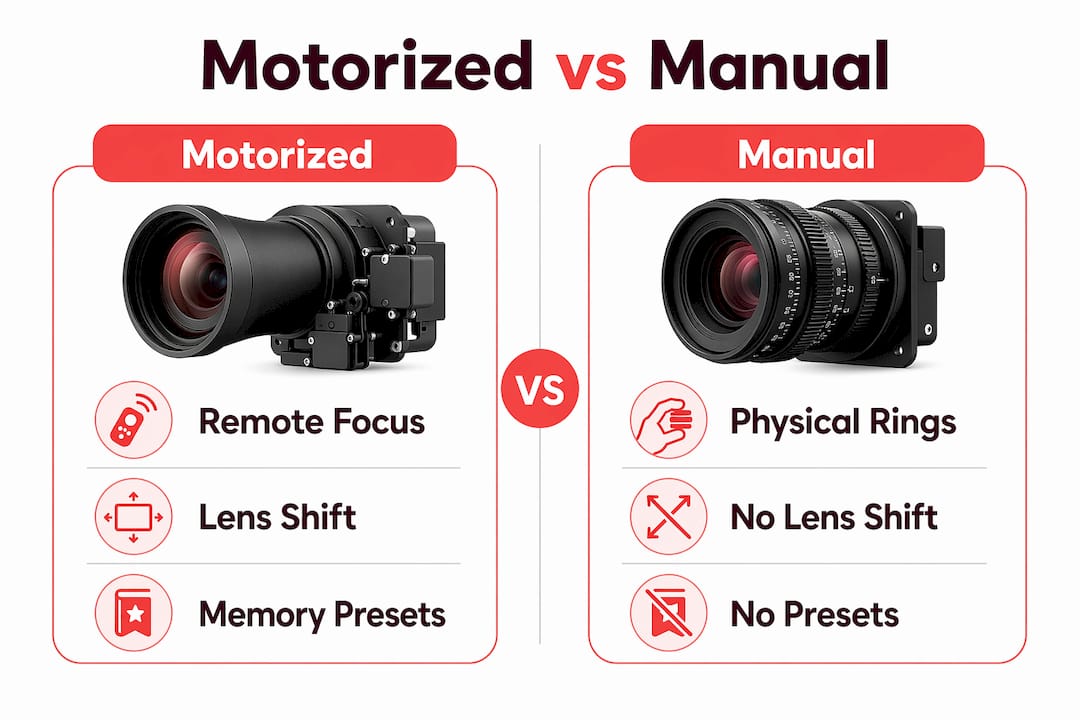
Manual lens adjustment requires you to physically turn rings on the projector body to change focus and zoom. Lens shift, if available at all on manual models, involves turning a separate mechanical dial. This works fine on a desktop setup where the projector is easily accessible. It becomes a real problem when the unit is ceiling-mounted, embedded in a cabinet, or installed in a venue where access is restricted.
| Feature | Motorized lens | Manual lens |
|---|---|---|
| Focus adjustment | Remote control | Physical ring on lens |
| Zoom adjustment | Remote control | Physical ring on lens |
| Lens shift | Remote control (optical) | Manual dial or absent |
| Image quality | Full native resolution | Full native resolution |
| Digital keystone | Not required | Often used as fallback |
| Installation flexibility | High | Low to medium |
| Best for | Home theater, venues, classrooms | Desktop, portable use |
The critical distinction is between motorized zoom and focus versus motorized lens shift. A projector can advertise "motorized lens" while only offering powered zoom and focus, with no motorized shift at all. That projector still forces you to use digital keystone correction for off-axis alignment, which means image degradation.
Digital keystone is described as a "digital solution to a physical problem." It works by cropping and rescaling the image to compensate for a tilted projection angle. The result is a smaller effective resolution and reduced brightness. Optical lens shift avoids this entirely.
Pro Tip: Before purchasing any projector in Malaysia, ask the seller to confirm whether the motorized lens includes shift, not just zoom and focus. Projectordisplay stocks models across brands like BenQ projector Malaysia, Viewsonic projector Malaysia, and JVC projector Malaysia where you can verify this specification directly.
What advanced motorized lens features do professional setups use?
Professional installations push motorized lens technology well beyond basic focus, zoom, and shift. The most advanced systems add lens rotation, which allows the projector to throw an image onto floors, ceilings, or angled walls without repositioning the entire unit. The Fujifilm FP-ZUH6000 is a strong example, offering ±82% vertical and ±35% horizontal lens shift plus full lens rotation for ultra-short-throw installations on unconventional surfaces.
Advanced motorized lens capabilities used in professional AV environments include:
- Edge blending: Multiple projectors overlap their images seamlessly to create one large display across a wide surface. Motorized lenses allow each unit to be fine-tuned independently without physical access.
- Portrait mode projection: Some models support rotating the image 90 degrees for vertical display formats used in digital signage and immersive art installations.
- Stacking: Two or more projectors are aligned on the same screen to double brightness output. Motorized lens shift makes precise alignment between units achievable without manual guesswork.
- 360-degree projection: Motorized lenses facilitate flexible placement including stacking and 360-degree projections typical in commercial simulation and immersive experience setups.
AV integrators working with brands like Barco projector Malaysia, NEC projector Malaysia, and Panasonic projector Malaysia rely on these capabilities for large venue installations. The Optoma ZU920TST PRO, for example, supports edge blending and portrait mode, making it a go-to choice for complex commercial environments.
The projector and AV integration relationship becomes especially important at this level. A motorized lens projector in a professional venue is not just a display device. It is a component in a larger system where remote recalibration, preset switching, and precise optical alignment determine whether the installation succeeds or fails.
Ultra-short-throw projectors with motorized lenses represent another growing category. These units sit just centimeters from the wall and still require precise lens control to fill the screen correctly. Without motorized shift, even minor placement variations cause visible misalignment that digital correction cannot cleanly fix.
Key takeaways
A motorized lens projector preserves full image quality through optical adjustment and delivers installation flexibility that manual or digital correction methods cannot match.
| Point | Details |
|---|---|
| Core definition | Electric motors control focus, zoom, and lens shift remotely without manual intervention. |
| Image quality advantage | Optical lens shift preserves 100% native resolution; digital keystone crops and degrades the image. |
| Motorized lens shift matters most | Zoom and focus motors alone are not enough; lens shift is the critical feature for installation flexibility. |
| Memory presets add versatility | Models like the JVC DLA-NZ500 store 5–10 presets for fast switching between content formats. |
| Professional applications | Edge blending, stacking, and 360-degree projection all depend on precise motorized lens control. |
Why I think most buyers underestimate motorized lens shift
Most people shopping for a projector in Malaysia focus on lumens and resolution. Those numbers matter, but they tell you nothing about whether the image will actually land correctly on your screen once the projector is installed. That is where motorized lens shift changes everything.
I have seen buyers choose a projector with impressive specs, only to discover that their ceiling mount position puts the image six inches off-center. They then activate digital keystone correction, which quietly reduces their 4K image to something closer to 1080p in effective sharpness. The projector was never the problem. The missing lens shift was.
The XGIMI Horizon 20 series bringing motorized lens shift to mid-range home projectors is a genuine shift in what buyers can expect at accessible price points. This feature is no longer exclusive to high-end home cinema or commercial units. If you are buying a best home projector Malaysia in 2026, motorized lens shift should be on your checklist alongside lumens and resolution.
My advice: always verify the spec sheet says "motorized lens shift" explicitly. Do not assume that "motorized lens" covers all three functions. Check the projector smart features breakdown for any model you are considering, and confirm lens shift is included before you commit.
— Projector
Find the right motorized lens projector at Projectordisplay
Projectordisplay is the best projector seller in Malaysia for buyers who want motorized lens projectors backed by real product knowledge. The catalog covers brands including BenQ projector Malaysia, Viewsonic projector Malaysia, Optoma projector Malaysia, JVC projector Malaysia, Hisense projector Malaysia, and more, spanning home theater, classroom, and large venue applications. Whether you need a best home projector Malaysia for a dedicated cinema room or a best classroom projector for a school in Peninsular Malaysia, Projectordisplay offers fast shipping, WhatsApp support, and expert guidance on specs like motorized lens shift. Pair your projector with the right projection screen for a complete setup, or explore projectors for large venues to find models built for professional motorized lens installations.
FAQ
What is a motorized lens projector in simple terms?
A motorized lens projector uses electric motors to adjust focus, zoom, and lens position remotely via a remote control, removing the need to physically touch or reposition the unit. It is the standard technology in professional home theater and commercial AV installations.
Is motorized lens shift the same as digital keystone correction?
No. Motorized lens shift physically moves the lens to reposition the image, preserving full native resolution and brightness. Digital keystone correction is a software process that crops and rescales the image, which reduces sharpness and output quality.
How many memory presets do motorized lens projectors typically offer?
Most motorized lens projectors offer between 5 and 10 memory presets depending on the model. The JVC DLA-NZ500, for example, includes 5 user presets for saving different aspect ratio and lens position configurations.
Do all projectors with motorized zoom also have motorized lens shift?
No. Many projectors include motorized zoom and focus but omit motorized lens shift entirely. Lens shift is the most important of the three functions for installation flexibility, so always confirm it is included before purchasing.
Which projector brands in Malaysia offer motorized lens shift?
Brands available through projector sellers in Malaysia including Optoma projector Malaysia, JVC projector Malaysia, Barco projector Malaysia, NEC projector Malaysia, and Panasonic projector Malaysia offer models with full motorized lens shift across home theater and professional categories.