

What happens when Malaysian classrooms move beyond rote learning and toward real intellectual growth? For educational professionals, embracing a growth mindset means equipping students to see intelligence as something flexible that can expand through effort and new strategies. Effective use of projector technology in interactive lessons can make this belief visible, helping every student experience learning as a process of progress and resilience rather than a race with fixed limits.
Table of Contents
- Defining Growth Mindset in Education
- Types of Mindsets and Common Misconceptions
- Key Traits of Growth-Oriented Learners
- Using Projector Technology to Foster Growth
- Obligations and Challenges for Educators
- Avoiding Common Mistakes with Growth Mindset
Key Takeaways
| Point | Details |
|---|---|
| Understanding Growth Mindset | A growth mindset fosters the belief that intelligence can be developed through effort and learning. Educators should cultivate environments that celebrate this perspective. |
| Role of Educators | Teachers must create psychologically safe spaces and provide constructive feedback to support student growth. Continuous professional development is essential for effectiveness. |
| Avoiding Pitfalls | Effective growth mindset implementation requires avoiding common mistakes, such as promoting effort without strategic learning. A nuanced approach is necessary for genuine impact. |
| Leveraging Technology | Digital projection technologies can enhance learning experiences by making abstract concepts visual and supporting collaborative learning opportunities. |
Defining Growth Mindset in Education
In the dynamic landscape of Malaysian education, understanding growth mindset represents a transformative approach to learning. Growth mindset theory fundamentally challenges traditional perspectives about intelligence, proposing that learning capabilities are not fixed but can be systematically developed through dedicated effort and strategic practice.
At its core, growth mindset embraces the powerful belief that students' intellectual abilities are not predetermined or static. Unlike a fixed mindset, which views intelligence as an immutable trait, a growth mindset recognizes intelligence as a malleable quality that can be expanded through persistence, strategic learning, and embracing challenges. PISA research demonstrates that students who adopt this perspective are more likely to:
- Pursue challenging academic tasks
- Persist through initial setbacks
- View mistakes as learning opportunities
- Develop stronger problem-solving skills
- Maintain higher levels of academic motivation
Educators play a critical role in cultivating growth mindset by creating classroom environments that celebrate effort, encourage strategic thinking, and normalize the learning process as a journey of continuous improvement. This approach shifts students' perspectives from viewing intelligence as a fixed quantity to understanding it as a dynamic skill that can be systematically developed.
Growth mindset is not about praising effort over achievement, but about understanding that effort is the pathway to developing abilities and achieving meaningful learning outcomes.
By implementing growth mindset principles, Malaysian educators can help students build resilience, develop intrinsic motivation, and create a more inclusive learning environment that supports academic and personal development.
Pro tip: Encourage students to use the phrase "I can't do this yet" instead of "I can't do this" to reinforce the belief in their potential for growth and learning.
Types of Mindsets and Common Misconceptions
Understanding the nuanced landscape of mindset psychology requires a deeper exploration of how individuals perceive their intellectual potential. Mindset research reveals that people's beliefs about intelligence exist on a complex continuum rather than in simplistic binary categories.
Primarily, two fundamental mindset types emerge in educational contexts:
Here's a summary of differences between fixed and growth mindsets in education:
| Mindset Type | View of Intelligence | Response to Failure | Effect on Learning Motivation |
|---|---|---|---|
| Fixed Mindset | Set, unchangeable trait | Avoids risk, may give up | Motivation drops after setbacks |
| Growth Mindset | Flexible, developable | Uses failure for improvement | Motivation increases with effort |
- Fixed Mindset: Individuals believe intelligence is static and predetermined
- Growth Mindset: Individuals view intelligence as developable through effort and learning
Contrary to popular assumptions, mindset beliefs demonstrate significant complexity. Students rarely embody a purely fixed or growth mindset, instead displaying varied beliefs across different academic domains and personal experiences. This understanding challenges oversimplified interpretations that categorize individuals into rigid intellectual classifications.
Common misconceptions about mindsets include believing that:
- Growth mindset guarantees academic success
- Effort alone determines intellectual development
- Mindset is a permanent, unchangeable characteristic
- All students respond identically to growth mindset interventions
Mindset is not a binary switch but a dynamic perspective that can evolve through intentional reflection and educational experiences.
Recognizing these nuanced perspectives helps educators design more sophisticated approaches to supporting student learning and intellectual development.
Pro tip: Encourage students to view mindset as a flexible lens for understanding personal growth, rather than a fixed label about their capabilities.
Key Traits of Growth-Oriented Learners
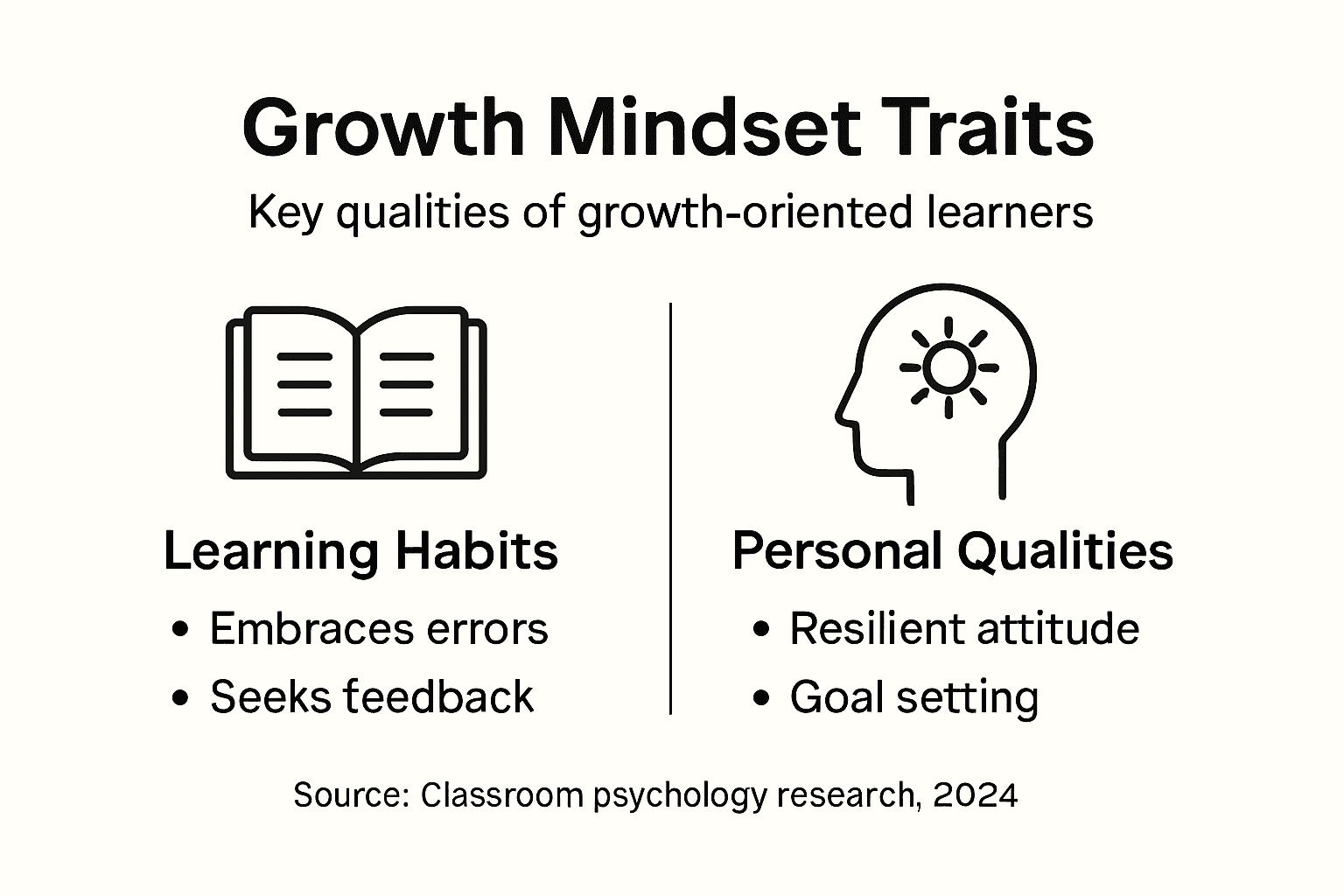
Growth-oriented learners represent a unique category of students who approach academic challenges with remarkable resilience and adaptability. Research on learning behaviors reveals distinctive characteristics that set these students apart in their educational journey.
Key traits of growth-oriented learners include:
- Embracing challenges as opportunities for learning
- Demonstrating persistent effort despite initial failures
- Viewing mistakes as valuable feedback mechanisms
- Actively seeking constructive criticism
- Maintaining high levels of intrinsic motivation
- Adapting strategies when current approaches are ineffective
Academic psychology studies highlight that these learners possess a remarkable ability to transform potential setbacks into strategic learning experiences. They do not interpret academic struggles as personal limitations, but instead as signals to improve their approach, seek additional support, or develop more effective learning strategies.
Growth-oriented learners typically exhibit complex cognitive and emotional characteristics that distinguish them from fixed-mindset peers. They understand that intelligence is not a static trait but a dynamic skill that can be developed through dedicated practice, strategic thinking, and continuous learning.
Growth is not about being perfect, but about making consistent progress and learning from every experience.
Understanding these traits can help educators design more supportive learning environments that nurture students' potential and encourage adaptive learning behaviors.
Pro tip: Encourage students to keep a learning journal that tracks their strategies, challenges, and personal growth insights.
Using Projector Technology to Foster Growth
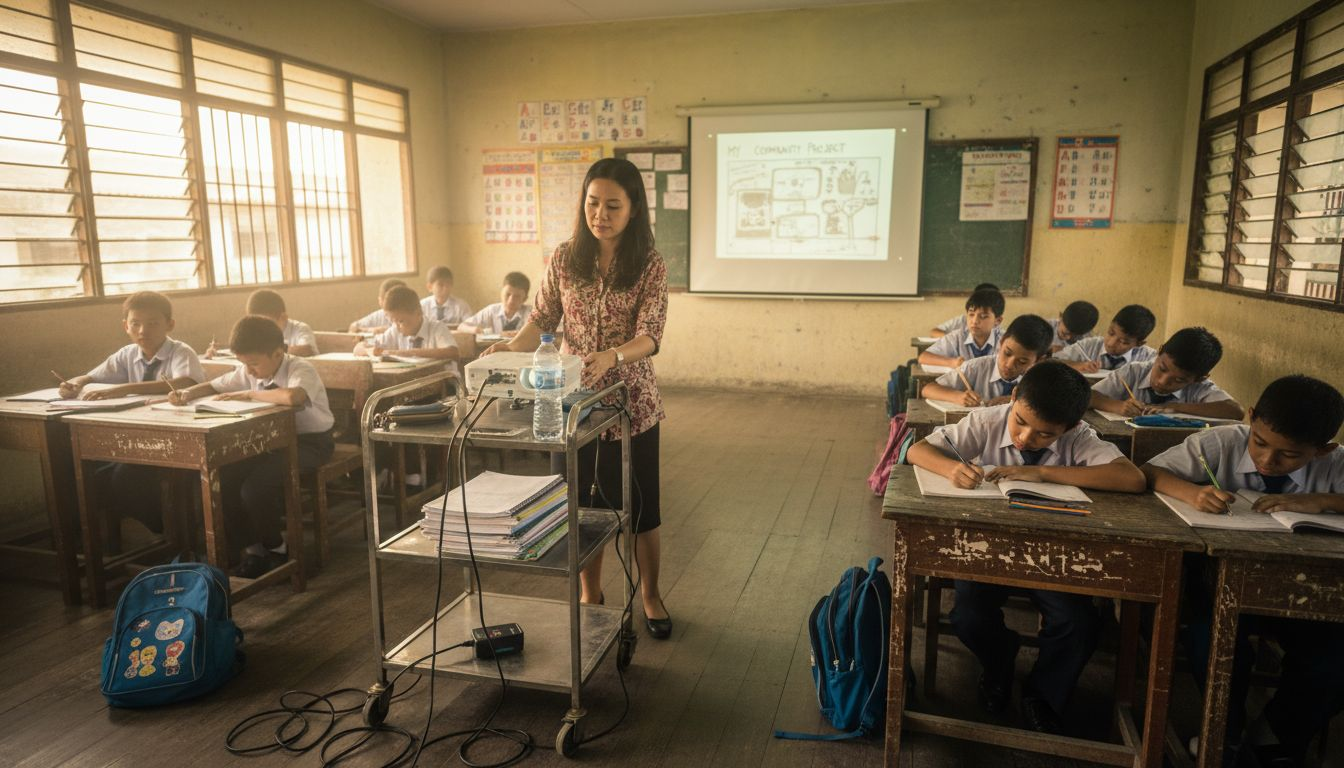
Digital projection technologies are transforming educational landscapes by creating dynamic, interactive learning environments that directly support growth mindset development. Classroom engagement strategies demonstrate how visual technologies can fundamentally reshape student learning experiences.
Projector technology supports growth mindset principles through several key mechanisms:
- Enabling visual representation of complex concepts
- Facilitating collaborative learning experiences
- Providing immediate, large-scale feedback mechanisms
- Supporting multimedia and interactive learning approaches
- Encouraging student experimentation and exploration
Digital learning technologies have become critical tools for creating inquiry-based educational environments. By transforming traditional classroom dynamics, projectors allow students to visualize learning processes, observe incremental improvements, and understand that intelligence is not fixed but continuously developable.
Effective projector integration requires educators to design experiences that explicitly connect visual learning with growth mindset principles. This means creating scenarios where students can see their learning journey, observe progress, and understand that mistakes are integral to the learning process.
Technology does not create growth mindset – thoughtful implementation does.
By strategically utilizing projector technologies, Malaysian educators can create learning spaces that celebrate progress, encourage risk-taking, and demonstrate the malleability of intelligence.
Pro tip: Design projection-based activities that visibly demonstrate learning progression and highlight the process of improvement over final outcomes.
Obligations and Challenges for Educators
Growth mindset transformation requires educators to play a pivotal and complex role in reshaping traditional learning environments. Educators face significant challenges when attempting to shift deeply entrenched academic belief systems and cultivate more adaptive learning cultures.
Key obligations for educators include:
- Creating psychologically safe classroom environments
- Providing constructive, process-focused feedback
- Modeling resilient problem-solving behaviors
- Challenging fixed-mindset narratives
- Supporting student help-seeking behaviors
- Designing learning experiences that celebrate incremental progress
Psychological research on classroom cultures reveals that teachers must navigate complex motivational landscapes. This involves addressing students' initial resistance, managing diverse learning needs, and developing sophisticated communication strategies that signal learning is a dynamic, evolving process.
Successful growth mindset implementation demands continuous professional development, requiring educators to critically examine their own beliefs about intelligence, learning potential, and student capabilities. Challenges emerge from deeply ingrained educational practices that often inadvertently reinforce fixed mindset perspectives.
Key challenges educators face when fostering growth mindset include:
| Challenge | Impact on Students | Strategy for Educators |
|---|---|---|
| Resistance to change | Limits mindset shift | Model adaptive attitudes |
| Balancing feedback types | Potential discouragement | Use process-focused feedback |
| Diverse student needs | Uneven engagement | Tailor interventions |
| Deep-rooted beliefs | Slow culture transformation | Ongoing professional development |
Transforming educational systems begins with transforming educators' internal narratives about learning and potential.
By recognizing and systematically addressing these challenges, Malaysian educators can create more inclusive, adaptive, and empowering learning environments that support students' holistic development.
Pro tip: Regularly reflect on and challenge your own unconscious beliefs about student potential to more effectively support growth mindset principles.
Avoiding Common Mistakes with Growth Mindset
Growth mindset implementation requires nuanced understanding to prevent counterproductive approaches. Common implementation errors can inadvertently undermine the transformative potential of this educational philosophy.
Frequent mistakes educators and institutions make include:
- Praising effort without acknowledging strategic learning
- Misinterpreting growth mindset as endless persistence
- Providing generic, non-specific encouragement
- Failing to distinguish between productive and unproductive struggle
- Overlooking individual learning differences
- Treating growth mindset as a one-time intervention
Most critically, educators must recognize that simply telling students to work harder is not equivalent to cultivating a genuine growth mindset. The approach requires sophisticated understanding of learning processes, individualized support, and consistent modeling of adaptive learning behaviors.
Effective growth mindset strategies demand careful, intentional implementation that goes beyond surface-level motivational techniques. This means creating learning environments that genuinely value process, strategy, and incremental improvement rather than relying on simplistic narratives about effort.
Growth mindset is not a magical solution, but a complex framework requiring deep pedagogical understanding.
By understanding and avoiding these common pitfalls, Malaysian educators can create more authentic, supportive learning ecosystems that truly empower students to develop resilient, adaptive learning approaches.
Pro tip: Regularly conduct self-assessments to identify and challenge your own unconscious fixed-mindset language and behaviors.
Empower Growth Mindsets with Cutting-Edge Projection Technology
Building a growth mindset in Malaysian classrooms requires tools that inspire curiosity and encourage students to embrace challenges visually and interactively. The article highlights how projector technology can transform learning by making concepts more accessible and engaging, helping students see their progress and learn from mistakes. Educators aiming to foster resilience and adaptive learning need reliable, high-quality equipment that supports collaborative and multimedia experiences.
ProjectorDisplay.com offers a diverse range of projectors designed to elevate educational spaces—featuring portable, laser, and smart projectors optimized for clarity and interactive use. With fast shipping across Peninsular Malaysia and expert support, empowering your classroom with powerful projection solutions has never been easier.
Explore our selection to find the perfect technology to help your students visualize growth and develop true learning resilience. Act now to transform your teaching environment and make growth mindset principles come alive in every lesson.
Discover projector options today and start creating a classroom culture where every student believes in their potential.

Frequently Asked Questions
What is a growth mindset in education?
A growth mindset in education is the belief that students' intellectual abilities are not fixed and can be developed through effort and strategic learning. This contrasts with a fixed mindset, which sees intelligence as static.
How can educators cultivate a growth mindset in their classrooms?
Educators can cultivate a growth mindset by creating psychologically safe environments, providing constructive feedback, challenging fixed mindset narratives, and modeling resilience and problem-solving behaviors.
What are some common misconceptions about growth mindset?
Common misconceptions include believing that a growth mindset guarantees academic success, that effort alone leads to improvement, and that mindset is a permanent trait rather than a dynamic perspective that can evolve.
What are key traits of growth-oriented learners?
Key traits of growth-oriented learners include embracing challenges, persisting through failures, viewing mistakes as feedback, seeking constructive criticism, and maintaining intrinsic motivation.
Recommended
- Mindfulness in Education: Boosting Student Engagement – Projector Display
- Student Motivation Strategies That Transform Learning – Projector Display
- The Essential Guide to Teaching Critical Thinking Skills – Projector Display
- Personalized Learning Benefits for Malaysian Classrooms – Projector Display
- 7 Beste Tips voor Leerzaam Speelgoed voor Creatieve Kinderen – Gladi