
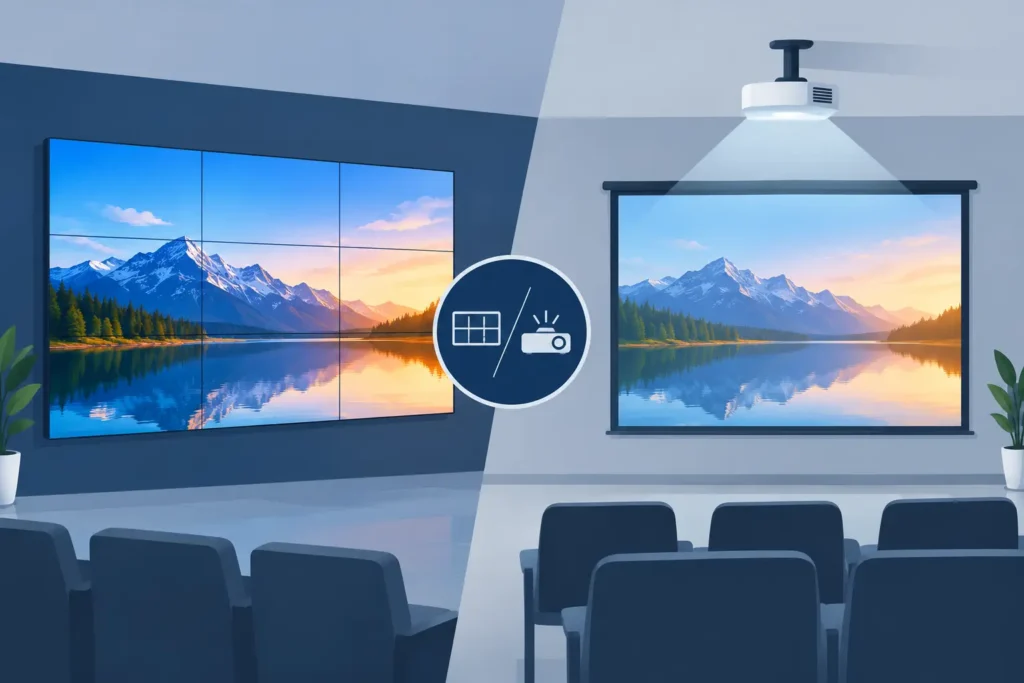
A display that looks brilliant in a bright lobby can be the wrong choice for a movie room. Likewise, a projector that creates a stunning 150-inch image at home may not be practical for an all-day digital-signage installation. The LED wall versus projector decision comes down to the room, viewing distance, ambient light, content, budget, and how permanent the installation needs to be.
For many homes, classrooms, and meeting spaces, a quality projector remains the most cost-effective way to create a truly large image. LED walls bring a different advantage: high brightness, direct-view clarity, and always-on performance in demanding environments. Neither is automatically better. The right display is the one that solves your specific visual challenge without paying for performance you do not need.
LED Wall Versus Projector at a Glance
An LED wall is built from modular direct-view LED panels. Each panel contains its own pixels and produces light directly, so there is no need for a projection lens, screen, or darkened room. This makes LED walls exceptionally bright and highly visible in retail spaces, command centers, lobbies, houses of worship, event venues, and large corporate environments.
A projector creates an image by sending light through a lens onto a screen or wall. Modern laser, 3LCD, and DLP models can produce bright, detailed images from compact hardware. A projector is especially compelling when you need a 100-inch, 120-inch, or 150-inch display but do not want the cost and wall weight of a comparably sized LED wall.
The first question is simple: do people need to see the image clearly under strong room lighting, or can you control the light? If the answer is strong lighting all day, an LED wall often deserves serious consideration. If you can dim lights or manage window light, a projector can deliver exceptional scale and value.
Brightness and Ambient Light
Brightness is where the difference becomes most obvious. LED walls are measured in nits and can remain visible in spaces with daylight, overhead lighting, or bright stage lighting. They are a natural fit for public-facing installations where the display must compete with the environment.
Projectors are measured in ANSI lumens. A higher ANSI lumen rating helps the image remain bright, but projected light still has to reflect off a screen. Light-colored walls, glossy surfaces, and uncontrolled windows can reduce contrast and wash out darker scenes. For conference rooms and classrooms with lights on, a bright laser projector paired with a suitable screen can work very well. For a sunlit reception area displaying graphics from morning to evening, LED is usually the more dependable option.
Brightness alone does not determine image quality. A projector in a controlled room can produce excellent black levels and a more cinematic picture than an LED wall, particularly for films. The contrast you see depends on ambient light, screen material, projector technology, and the content being shown.
Home Theater Is a Different Case
For movies, streaming, and gaming in a dim room, a projector and screen can create an immersive image at a fraction of the cost of a large LED wall. Full HD is still a practical choice for many setups, while 4K laser projectors offer a sharper option for larger screens and close seating distances.
An LED wall can look spectacular in a luxury media room, but it may be excessive unless the room also needs high daytime brightness or commercial-level usage. It can also feel visually intense in a dark room if brightness is not carefully adjusted. Home theater buyers should prioritize controlled lighting, the right screen size, resolution, and audio before assuming LED is the premium answer.
Image Size, Resolution, and Viewing Distance
Projectors are flexible because image size can be adjusted by placement, zoom, or digital settings. A short-throw or ultra-short-throw projector can deliver a large image close to the wall, making it useful where ceiling mounting or long throw distance is not possible. Standard-throw projectors work well in larger rooms, training spaces, and dedicated theaters.
LED walls are also scalable, but pixel pitch becomes critical. Pixel pitch is the distance between LED pixels, usually measured in millimeters. A smaller pixel pitch produces a sharper image for viewers standing closer to the wall. For example, a large LED display in a lobby may look excellent from across the room but reveal individual pixels if viewed from only a few feet away.
This is one of the most common planning mistakes. Do not select an LED wall by size alone. Match the pixel pitch to the nearest typical viewing distance. For meeting rooms where participants sit close to the display, fine-pitch LED is needed, and that raises the investment significantly.
With projectors, resolution is the key specification. XGA may still suit basic presentations, but Full HD is a stronger baseline for modern office, classroom, and entertainment content. 4K is worth considering when displaying detailed spreadsheets, design work, high-resolution video, or content on a very large screen.
Installation, Space, and Maintenance
An LED wall is generally a permanent installation. It requires a structural mounting surface, proper power planning, ventilation, data connections, and professional configuration. Large installations may need access from the front or rear for service. The panels are modular, which means an individual cabinet or module can often be replaced rather than replacing the entire display.
A projector is usually easier to deploy and change. It can sit on a table, mount to a ceiling, use a wall mount, or travel on a trolley between rooms. Portable smart projectors make sense for flexible presentations and casual entertainment, while a fixed laser projector offers a clean long-term installation for a boardroom or classroom.
Maintenance depends on the product. Traditional lamp projectors require lamp replacements over time. Laser projectors typically offer much longer light-source life and reduce maintenance for high-use environments. LED walls avoid projector lamps, but they still need professional servicing, calibration, and occasional module replacement. Their long operating life is valuable, but it does not make them maintenance-free.
Cost: Look Beyond the Display Price
The upfront price gap can be substantial. A projector, screen, mount, HDMI cable, and sound system can often provide a very large viewing area for far less than an LED wall of similar size. That makes projection especially attractive for education, meeting rooms, training centers, and home entertainment.
However, the lowest-cost projector is not always the lowest-cost solution. If a room has heavy daylight, you may need blackout shades, a higher-lumen projector, and a better screen to achieve acceptable results. If staff repeatedly move a portable unit, the organization may also need a trolley, wireless display dongle, and secure storage.
LED walls require a higher initial investment, particularly when fine pixel pitch is needed. In return, they can reduce concerns about room lighting and provide a polished, permanent visual centerpiece. For a customer-facing area that runs content for many hours every day, that value can justify the cost.
When requesting a quote, include the intended screen size, room dimensions, lighting conditions, viewing distance, content type, mounting requirements, and available inputs. Those details lead to a recommendation that is based on use, not just a product specification.
Best Uses for Each Display Type
A projector is usually the better fit for home theaters, classrooms, training rooms, conference rooms, temporary events, and large images on a controlled budget. It is also ideal when portability matters or when a screen larger than 100 inches is desired without a major construction project. Features such as wireless casting, HDMI, AirPlay compatibility, short throw, and built-in smart platforms can make operation easier for everyday users.
An LED wall is usually the better fit for bright lobbies, retail displays, large venues, control rooms, outdoor or semi-outdoor environments, and high-impact corporate installations. It excels when the display must stay visible all day, when content is viewed by many people at once, or when a premium permanent installation is the goal.
For hybrid spaces, there may be a smarter middle ground. A meeting room may need a bright laser projector and quality screen rather than LED. A training center may benefit from an interactive LED smartboard for touch-based teaching, while a larger hall uses projection for audience-scale presentations. The best visual system is often a combination of technologies rather than a single product category.
Make the Decision From the Room Outward
Start with the environment, not the product. Measure the wall, note window positions, estimate the nearest and farthest viewers, and consider whether the display is used mainly for video, presentations, teaching, signage, or collaboration. Then choose the technology that can meet those conditions with the fewest compromises.
ProjectorDisplay.com can help buyers compare projector brightness, throw distance, screen options, mounts, cables, and display alternatives before purchase. A clear quote based on the actual installation is far more useful than choosing solely by screen size or promotional price.
A great display should disappear into the experience: the audience sees the lesson, the presentation, the game, or the film without thinking about the hardware. Choose the technology that makes that happen in your room.