
TL;DR:
- A true outdoor portable projector requires sufficient lumens, reliable power, and smart connectivity to deliver a quality viewing experience. Choosing the right screen, managing ambient light, and pairing the projector with an appropriate power source are essential for outdoor movie nights. Smart features like built-in streaming and auto-correction simplify setup and enhance convenience in outdoor environments.
Grab any portable projector off the shelf, take it outside, and you might be in for a disappointment. A lot of outdoor enthusiasts assume that "portable" automatically means "works great outdoors," but that thinking leads to washed-out images, dead batteries mid-movie, and audio that disappears into the night air. A true portable outdoor projector, which the industry often calls a battery-powered or mobile projector, is a different beast entirely. It needs the right lumen output, reliable power, a quality screen, and smart connectivity to actually deliver. This guide covers everything you need to pick the right one and set it up properly.
Key Takeaways
| Point | Details |
|---|---|
| Brightness threshold matters | Target over 500 lumens for watchable picture quality during outdoor use after dark. |
| Screen quality is a priority | A dedicated portable projector screen delivers a bigger image boost than a slightly brighter projector. |
| Power planning prevents failures | Match your power bank's wattage to your projector's requirements to avoid shutdowns mid-show. |
| Smart features simplify setup | Built-in streaming platforms and wireless connectivity remove the need for extra devices outdoors. |
| Timing and placement count | Viewing after sunset and optimizing projector angle dramatically improve image clarity outdoors. |
What makes a portable outdoor projector worth buying
Not all portable projectors are built for outdoor use. Understanding the key specs separates a frustrating experience from an unforgettable movie night under the stars.
Brightness and resolution
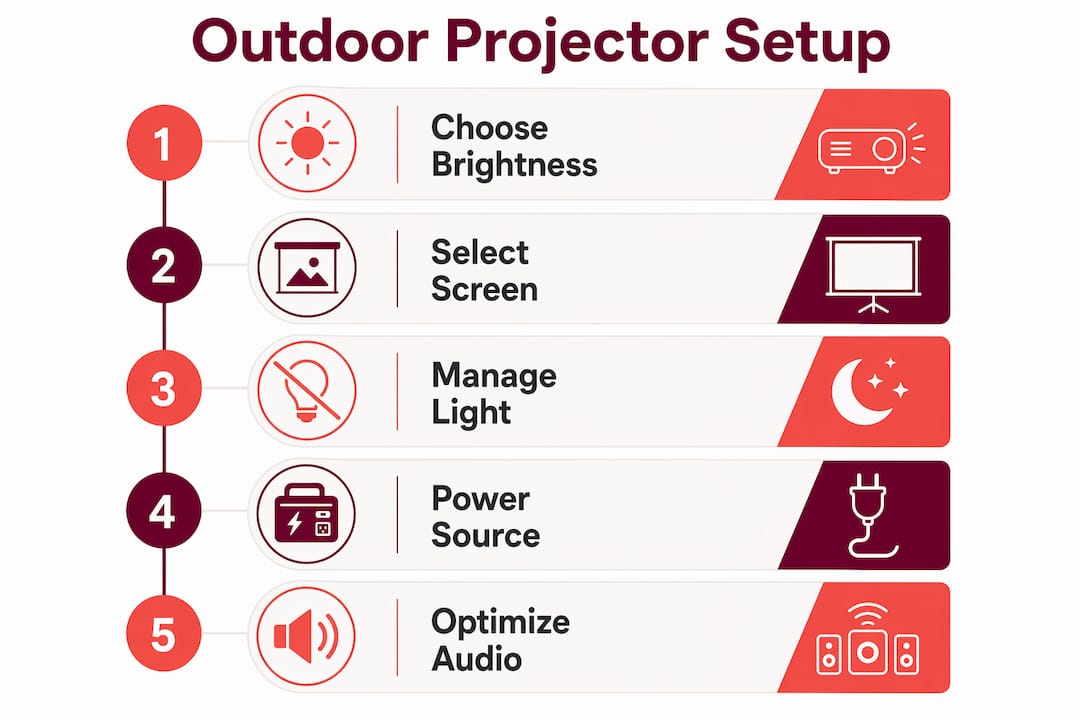
Brightness is measured in lumens, and it is the single most important spec for outdoor use. Over 500 lumens is a solid starting point for dark outdoor environments, but even the brightest outdoor projector struggles when there is ambient light from streetlamps or a setting sun. The fix is timing, not just more lumens. Wait until full darkness and the image quality jumps dramatically.
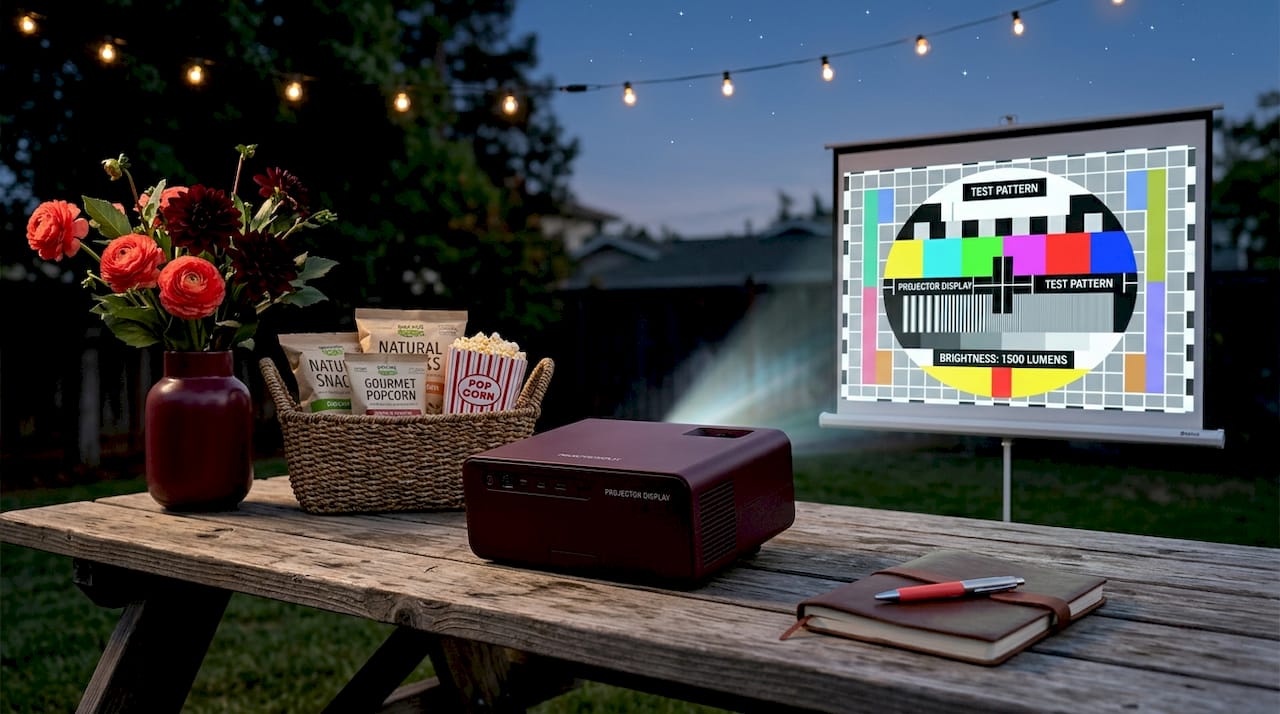
Native resolution matters too. A 1080p native resolution gives you sharp, detailed images on larger screens, which matters when you are projecting onto a 100-inch or bigger surface outdoors. Many budget mini outdoor projectors advertise "supported" resolution rather than native resolution, so always check the spec sheet carefully.
Battery life, audio, and build
Battery runtime varies significantly depending on your brightness setting. At full brightness, some portable models deliver around two hours of runtime. Drop the brightness to extend viewing, and you can push that to four hours or more. That trade-off matters when you are planning a double-feature camping night.
Built-in audio is often underestimated. Outdoors, sound disperses fast. A projector with a weak 3-watt speaker sounds hollow and thin in open air. Look for models with superior outdoor sound modes and dedicated speaker systems designed to project audio outward.
On the durability side, real-world portability means more than a carry handle. Look for IPX3 water resistance ratings or better, along with a rugged build that can handle dust, humidity, and the occasional bump on a camping trip.
- Lumens: 500 minimum for post-sunset use; 1000 or more for areas with light pollution
- Native resolution: 1080p preferred over "supported" 1080p
- Battery life: Check both max brightness and eco-mode runtimes
- Audio: Dedicated outdoor speaker modes add real value
- Build: IPX-rated or rugged housing for outdoor durability
Pro Tip: When comparing specs, find the native lumen rating at the projector's native resolution. Some brands inflate lumen numbers by measuring at reduced resolution settings.
Setting up your outdoor viewing environment
Picking a great projector is only half the job. Your setup determines whether that projector actually looks good.
Why your projection surface changes everything
Projecting onto a white bedsheet or a painted wall is tempting, but it compromises quality in ways that even a very bright projector cannot fix. Sheets introduce texture and wrinkles that distort the image. Walls reflect light unevenly and rarely offer the gain factor that purpose-built screens do. Budgeting for a portable projector screen often yields a greater improvement in image quality than upgrading to a slightly brighter projector. That is a counterintuitive but well-supported finding among reviewers.
A dedicated portable screen gives you a flat, consistent, high-gain surface that reflects light back toward your audience rather than scattering it. The difference is immediately visible, especially on larger screen sizes.
| Surface type | Image quality | Portability | Cost |
|---|---|---|---|
| Bedsheet | Poor (texture, uneven) | High | Very low |
| Painted wall | Fair (depends on surface) | None | None |
| Portable projector screen | Excellent (flat, high-gain) | Medium to high | Moderate |
Managing light and placement
Ambient light is your biggest enemy outdoors. The best outdoor portable projector setup starts after sunset, ideally in a location shielded from direct street lighting. Even mild light pollution from nearby homes can wash out a 600-lumen image.
Placement angle matters more than most people realize. Project at a slight upward angle toward a screen mounted at a comfortable viewing height, and use keystone correction to square up the image. Many 2026 models offer automatic keystone correction, which saves time during setup at a campsite.
Pro Tip: Position your screen with its back facing any residual light source, like a street lamp or a neighbor's porch light. That simple orientation change protects your viewing surface from stray illumination.
Powering your projector away from the grid
Outdoor and camping use means no wall outlet. Getting power right is what separates a smooth outdoor movie night from a frustrating one.
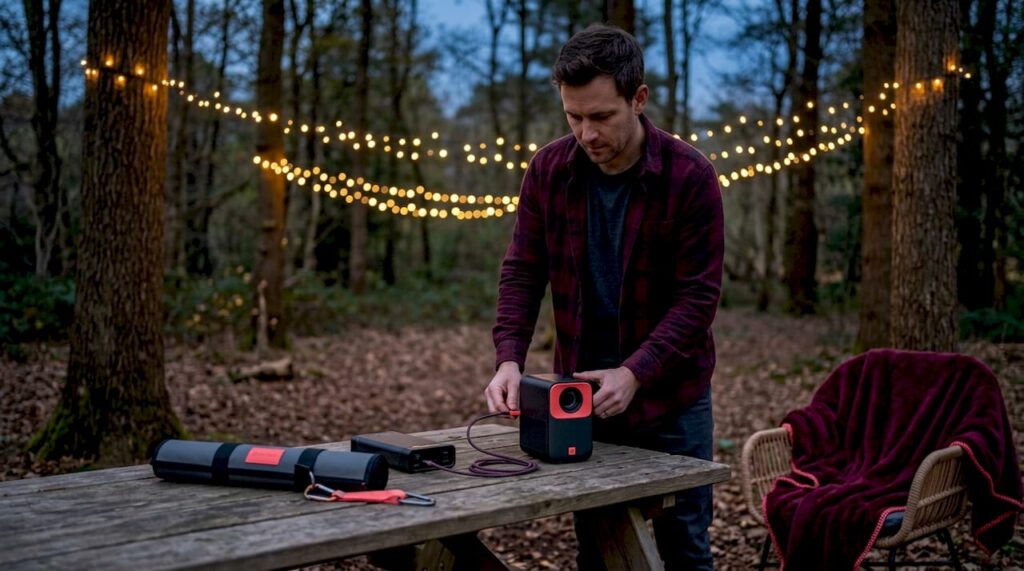
Treat power planning like a budget problem. Your projector has a wattage requirement, and your power bank must meet or exceed it to run without shutting down. Matching power bank wattage and USB-C Power Delivery profiles to your projector's specs prevents those mid-movie failures that ruin the experience.
Here is what to look for in a power setup:
- USB-C Power Delivery (PD) compatibility: Look for projectors that support 65W PD fast charging. The Aurzen EAZZE D1R Air, for example, supports 65W PD power banks for extended outdoor runtime.
- Power bank capacity: A 25,000mAh power bank with 65W output can power most portable projectors through a full feature film with charge to spare.
- Check your projector's wattage: A projector drawing 40 watts needs a power bank delivering at least 45W to stay stable. Under-spec banks cause throttling or shutdown.
- Carry a charged backup: For longer camping sessions or multi-movie nights, a second power bank is cheap insurance.
- Avoid cheap, unbranded banks: Inconsistent wattage delivery from low-quality power banks causes flickering and random shutdowns. Invest in a name-brand option with PD certification.
You can find detailed guidance on pairing power banks with specific projector models in this projector battery life guide, which is a practical resource for anyone shopping for a lightweight outdoor projector in Malaysia.
Smart features that make outdoor use effortless
The best portable projector for outdoor use in 2026 is not just about raw specs. Smart features are now a genuine differentiator, especially for camping and backyard setups where you want to start the movie fast and skip the extra gear.
- Built-in streaming platforms. Models with built-in Roku TV or Google TV let you stream directly without a separate dongle or laptop. The Aurzen EAZZE D1R Air, the first portable projector with Roku TV, pairs native 1080p resolution with a 180-degree gimbal for placement flexibility outdoors. That kind of integration removes a lot of friction.
- Wi-Fi and Bluetooth connectivity. Wi-Fi streaming from your phone or tablet cuts cables entirely. Bluetooth lets you pair external speakers when the built-in audio is not enough for a larger group.
- Automatic keystone and autofocus. Manual adjustments take time and patience at a campsite. Auto keystone correction and autofocus mean you put the projector down, point it at the screen, and the image squares itself up in seconds.
- Optimized outdoor audio modes. Some 2026 wireless outdoor projector models include audio modes that boost mid-range frequencies to compensate for open-air sound loss. That is a small feature that makes a big audible difference.
- Smart remote or phone control. Controlling everything from your phone, including volume and streaming apps, means fewer physical devices to keep track of in the dark.
Portable projectors succeed outdoors by prioritizing go-anywhere design with built-in speakers and streaming apps over just brightness numbers. The spec sheet matters, but so does how quickly you can go from bag to movie.
To learn more about how these smart projector features work in real use, Projectordisplay has a solid breakdown that applies to both home and outdoor setups.
My honest take on outdoor projector choices
I have tested a lot of projectors outdoors, and the pattern I keep seeing is the same. People buy the brightest projector they can afford, skip the screen, use a weak power bank, and then wonder why the experience falls flat.
What I have learned: brightness alone does not save a bad setup. A 1000-lumen projector on a wrinkled sheet still looks worse than a 600-lumen model on a quality portable screen. The screen is where I would spend the extra money first, every time.
On power, I have seen so many outdoor screenings die because someone grabbed a 30W power bank thinking it would work with a 50W projector. It does not. Check the wattage before you leave the house.
The thing that genuinely changed my outdoor setups was going to a projector with built-in streaming. No HDMI adapter, no laptop, no external dongle. You get to the campsite, connect to your phone hotspot, and the movie starts. It sounds minor until you are fumbling with cables in the dark.
My advice for anyone in Malaysia shopping for a projector for camping or backyard movies: do not treat it as just a projector purchase. Think of it as buying a system. Projector plus screen plus power equals a great night. Miss any one of those, and the other two cannot compensate.
— Projector
Get the right setup from Projectordisplay
If you are ready to upgrade your outdoor entertainment, Projectordisplay is Malaysia's go-to source for portable projectors, projection screens, and the accessories that tie it all together. Whether you are searching for the best projector in Malaysia for backyard movie nights or a lightweight projector for camping trips, Projectordisplay carries a curated range of options across every budget. As a trusted projector seller in Malaysia, Projectordisplay makes it easy to find the right combination of projector and screen without guesswork.
Browse outdoor projector picks to compare models by brightness, battery, and smart features. Then pair your choice with a portable projection screen designed for outdoor use. Fast shipping across Peninsular Malaysia, WhatsApp support, and secure online checkout mean you can go from browsing to movie night faster than you think. Looking for top projectors for larger setups? That category is covered too. Projectordisplay also stocks screens, mounts, and accessories for Epson projector Malaysia models, Viewsonic projector Malaysia options, BenQ projector Malaysia lineups, and more.
FAQ
How many lumens do I need for outdoor movie nights?
Target at least 500 lumens for good picture quality after dark. More light pollution in your environment means you should go higher, ideally 800 to 1000 lumens or more.
What is the best screen to use outdoors?
A dedicated portable screen consistently outperforms bedsheets or walls. Purpose-built screens offer better gain, flat surfaces, and consistent reflectivity that improve image quality significantly.
Can I run a portable outdoor projector on a power bank?
Yes, provided you match the power bank's wattage output to your projector's requirements. Look for power banks with USB-C PD at 65W or above for most portable projector models.
Do outdoor projectors have built-in speakers?
Most portable projectors include built-in speakers, but quality varies. Models with dedicated outdoor audio modes deliver noticeably better sound in open-air environments where audio disperses quickly.
Is Wi-Fi important for an outdoor projector?
Built-in Wi-Fi and streaming platforms like Roku TV or Google TV remove the need for external devices, making setup much faster and simpler at campsites or backyard setups where cabling is inconvenient.
Recommended
- Best projectors for outdoor events: top picks & features – Projector Display
- Malaysia Projector Market Trends in 2026: What You Need to Know – Projector Display
- How to Choose Projector: A Complete Guide for 2025 Success – Projector Display
- Projector for Large Venues: Top Picks for 2026 – Projector Display