
TL;DR:
- Poor projector audio diminishes speech clarity, impacting engagement and comprehension in Malaysian environments.
- External solutions like soundbars, powered speakers, and pro AV systems improve audio based on room size.
- Proper connectivity, acoustic treatment, and climate-resistant equipment are essential for optimal performance.
Poor audio is the silent productivity killer in Malaysian boardrooms and classrooms. You can have a 4K projector displaying stunning visuals, but if your audience is straining to hear every third word, the message is lost. Built-in projector speakers are typically underpowered for professional environments, making external audio solutions essential for real speech intelligibility. This article walks you through the key audio challenges facing business professionals and educators in Malaysia, the types of solutions available, how to connect them properly, and how to optimize your setup for local conditions like humidity, echo, and ambient noise.
Table of Contents
- Why projector audio matters in business and education
- Types of projector audio solutions: External speakers, soundbars, and pro AV setups
- Connectivity: How to link audio solutions to your projector
- Choosing and optimizing projector audio in Malaysian spaces
- Our perspective: What most projector audio guides overlook
- Enhance your next presentation with the right projector audio
- Frequently asked questions
Key Takeaways
| Point | Details |
|---|---|
| Audio clarity drives engagement | Superior audio in projectors directly improves understanding and participation during presentations and lessons. |
| Choose the right solution | Soundbars, pro AV systems, and wireless mics each suit different room sizes and usage needs in Malaysia. |
| Optimize for your space | Adapting audio setups to local acoustics and climate prevents common issues like echo, noise, and humidity damage. |
| Modern connections boost quality | Use HDMI ARC/eARC or optical for top audio performance with easy-to-manage systems. |
| Expert tweaks make a difference | Small changes—ecofriendly fan settings, acoustic panels, correct placements—maximize clarity in demanding environments. |
Why projector audio matters in business and education
Most projectors ship with built-in speakers rated between 2W and 10W. That might work in a quiet living room, but it falls apart fast in a 30-seat conference room or a classroom with air conditioning running in the background. The result is muffled speech, frustrated audiences, and presentations that fail to land.
Speech intelligibility is the technical term for how clearly spoken words are understood by a listener. In professional settings, it is not just a comfort issue. It directly shapes learning outcomes and decision-making. When participants cannot follow what is being said, they disengage. In education, that disengagement translates to lower comprehension and retention.
Malaysian environments add specific layers of difficulty:
- High ambient noise from air conditioning units, traffic, and open-plan offices
- Reverberant rooms with hard tile floors and concrete walls common in Malaysian schools and commercial buildings
- Humidity that can affect speaker components and cable connections over time
- Variable room sizes, from compact meeting rooms to large lecture halls
These are not hypothetical problems. Poor audio directly impacts understanding in both conference rooms and classrooms, and off-the-shelf projector speakers rarely address these realities. The fix requires purpose-built external audio solutions matched to your specific space.
"The quality of your audio system determines whether your message reaches the room or just the front row."
Think about the last time you sat through a presentation where the speaker's voice kept cutting out or sounded tinny. You probably spent more energy trying to hear than actually absorbing the content. That is exactly the experience you want to eliminate for your audience.
Types of projector audio solutions: External speakers, soundbars, and pro AV setups
Once you accept that built-in audio is not enough, the next question is what to replace it with. The answer depends on your room size, budget, and how permanent the installation needs to be.
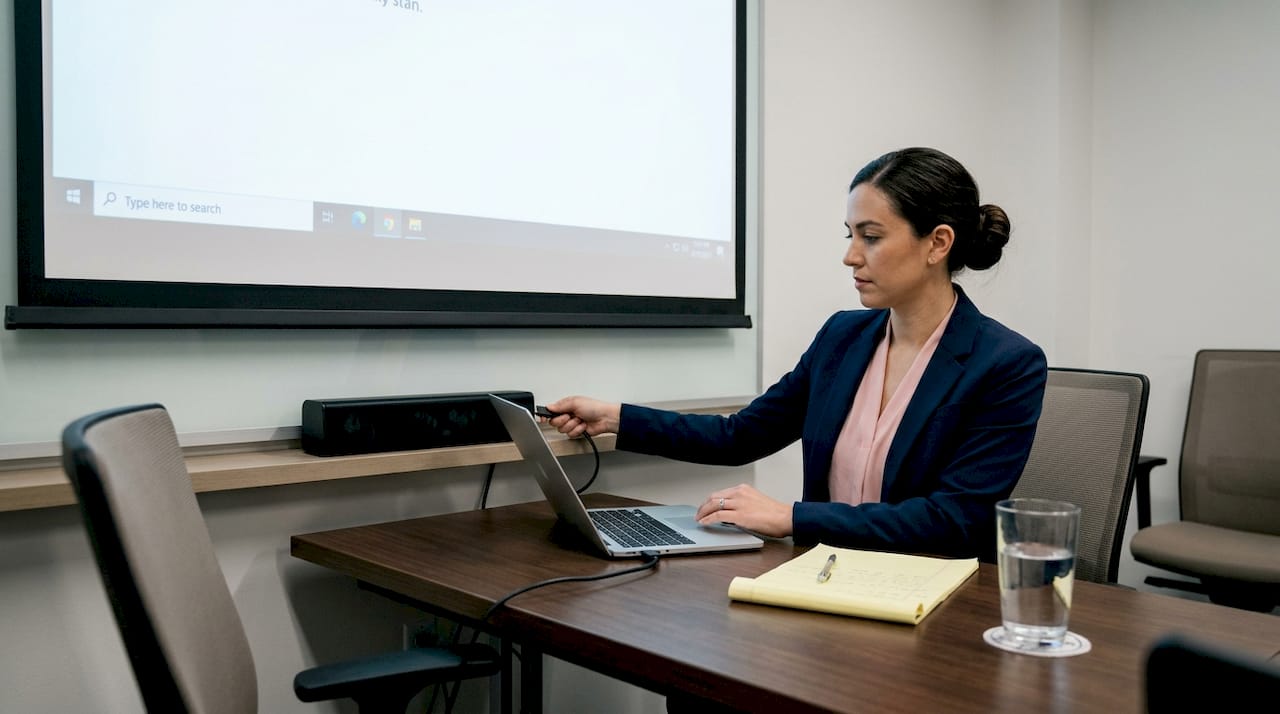
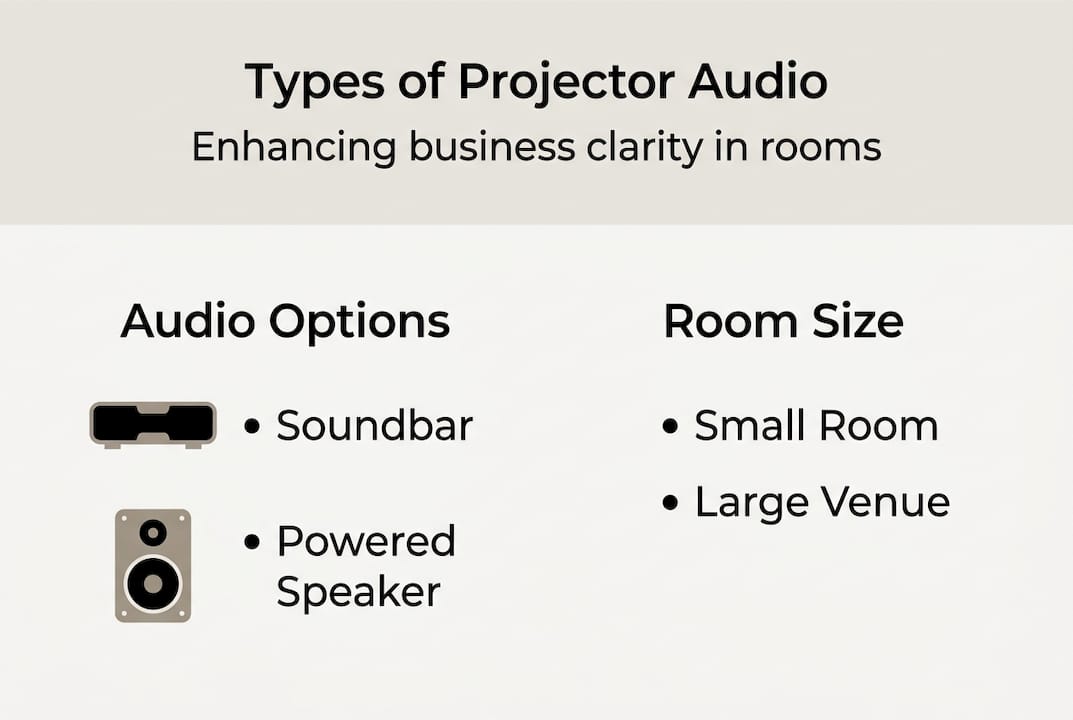
Soundbars are the easiest upgrade for boardrooms and small meeting spaces. They sit neatly below the projection screen, connect via a single cable, and deliver significantly better clarity than any built-in speaker. Brands like Bose offer soundbars that pair well with business projectors and provide clean, natural voice reproduction.
Powered speakers are a step up for mid-sized rooms seating 20 to 50 people. These are standalone units you position at the front corners of the room. They offer more volume headroom and better stereo separation, which helps audiences in wider rooms hear clearly regardless of where they sit.
Pro AV systems are designed for large venues like auditoriums, training centers, and multi-purpose halls. Malaysian AV integrations for business and education commonly use steerable column arrays, DSP amplifiers, ceiling speakers, and wireless microphones working together with projectors. These systems are engineered to control sound direction and minimize echo in challenging acoustic environments.
Wireless microphones deserve special mention. They free presenters and teachers from standing at a fixed point, which transforms how engaging a session can be.
Here is a quick comparison to guide your decision:
| Solution type | Room size | Setup complexity | Best for |
|---|---|---|---|
| Soundbar | Small (under 20 seats) | Low | Boardrooms, small offices |
| Powered speakers | Medium (20 to 50 seats) | Medium | Classrooms, training rooms |
| Pro AV system | Large (50+ seats) | High | Auditoriums, lecture halls |
| Wireless mic system | Any | Low to medium | Mobile educators, presenters |
Pro Tip: For a standard Malaysian classroom, a pair of powered speakers with a wireless lapel microphone gives you the best combination of flexibility and clarity without the cost of a full pro AV installation.
When connecting any of these systems, HDMI with ARC or eARC is the preferred method for high-quality uncompressed audio, while optical and 3.5mm aux remain solid fallback options. You can explore a detailed projector audio guide to match specific products to your room type.
Connectivity: How to link audio solutions to your projector
Even the best external speaker system will underperform if you connect it incorrectly. Choosing the right connection method is a step that most people overlook until they notice audio lag, quality loss, or compatibility issues.
Here is how the main connection types compare:
| Connection type | Audio quality | Latency | Best use case |
|---|---|---|---|
| HDMI (ARC/eARC) | Excellent | Very low | Modern projectors and soundbars |
| Optical (TOSLINK) | Very good | Low | Legacy gear, pro AV setups |
| 3.5mm aux | Good | None | Universal compatibility |
| Bluetooth | Good | Moderate | Wireless convenience |
HDMI, optical, and 3.5mm are the three core connection types for projector audio, with HDMI being the top choice for modern setups. Bluetooth is convenient but introduces a small audio delay that can be distracting during video playback.
Follow this connection checklist for a clean setup:
- Check your projector's output ports before buying any speaker system
- Use HDMI ARC or eARC if your projector and speaker both support it
- Choose optical if you need a reliable digital connection without HDMI compatibility
- Use 3.5mm aux as a universal fallback for older projectors
- Test Bluetooth latency before committing to it for video-heavy presentations
- Keep cable runs short and use shielded cables in humid environments
Pro Tip: If your projector only has a 3.5mm audio output, invest in a digital audio converter to upgrade to optical. This small device costs very little and noticeably improves sound quality.
Understanding how projector audio works at a technical level helps you troubleshoot faster when something sounds off. Also, if fan noise from the projector itself is competing with your audio, reducing projector noise through eco mode and proper mounting is a quick win.
Choosing and optimizing projector audio in Malaysian spaces
Selecting a solution is just the start. Making it work perfectly in your Malaysian space is where you will gain the most benefit. Local conditions require specific adjustments that generic audio guides rarely address.
When evaluating any audio system, prioritize these technical specs:
- Power output: Aim for at least 20W per channel for rooms over 30 seats
- Frequency response: A wider range (80Hz to 20kHz) captures both deep voices and high-frequency consonants clearly
- Signal-to-noise ratio (SNR): Look for 80dB or higher to minimize background hiss
- Connectivity options: Multiple input types give you flexibility as your equipment changes
Effective projector sound systems combine high power output, wide frequency response, low SNR, and flexible connectivity for professional environments. These are not just marketing specs. They translate directly into whether your audience hears a crisp voice or a muddy blur.
For Malaysian spaces specifically:
"Rooms with hard surfaces and minimal soft furnishings create echo that destroys speech clarity. Acoustic panels on rear walls make an immediate difference."
In echoey rooms, acoustic panels reduce reverberation, while eco mode and strategic projector mounting cut fan noise that competes with your audio. Malaysia's tropical climate also means you need to choose humidity-resistant speaker enclosures, especially for permanent installations in schools and training centers where air conditioning is not always running.
Speaker placement matters more than most people realize. Position speakers at ear level when possible, angled toward the center of the audience rather than the walls. For wireless microphones, keep the receiver unit within clear line of sight to avoid signal dropouts. Explore audio solutions for Malaysian climate and noise control for projectors to build a setup that holds up year-round.
Our perspective: What most projector audio guides overlook
Having laid out all the technical essentials, here is what real-world experience in Malaysia has taught us that even the best guides rarely mention.
Most audio guides are written for temperate climates with carpeted offices. They skip the reality of Malaysian schools with concrete floors, open windows, and aging air conditioning units running at full blast. These conditions demand more aggressive acoustic treatment and more robust hardware than a standard soundbar recommendation covers.
The second thing guides miss is the transformative impact of wireless microphones. Wireless mics are essential for educators and mobile presenters, and yet they are almost always treated as an optional add-on. In our experience, a mid-range wireless lapel mic paired with a modest powered speaker outperforms an expensive soundbar with no microphone system in a classroom setting every single time.
The third overlooked issue is overbuying. Many Malaysian businesses install full pro AV systems in 20-seat rooms because they associate higher cost with better results. A well-placed pair of powered speakers and a key projector audio insights review of your room's acoustics will often outperform a poorly configured pro system at a fraction of the price. Match the solution to the space, not to the budget ceiling.
Enhance your next presentation with the right projector audio
If this article has made one thing clear, it is that audio is not an afterthought. It is the foundation of every effective presentation and lesson.
At ProjectorDisplay.com, we help Malaysian businesses and educators find projector audio solutions that are matched to their specific venues and climates. Whether you need a quick soundbar recommendation or a full AV integration plan, our team is ready to help. Browse our projector installation guide for setup tips, or explore our Malaysian audio system guide to find the right fit for your space. Reach out via WhatsApp for personalized advice and fast shipping across Peninsular Malaysia.
Frequently asked questions
What is the best way to connect external speakers to a projector?
HDMI ARC or eARC is typically the best option for modern projectors, delivering high-quality uncompressed audio with a simple single-cable setup. If your projector lacks HDMI ARC, optical audio is the next best choice.
How do I overcome echo or background noise in large rooms?
Install acoustic panels on rear walls, use steerable column array speakers to direct sound toward the audience, and switch to eco mode to reduce projector fan noise that competes with your audio signal.
Can wireless microphones be used with projectors for presentations?
Yes, and they make a significant difference. Wireless mics improve mobility and speech clarity for educators and presenters who need to move around the room rather than stay fixed at a podium.
Which audio specs matter most for Malaysian classrooms?
Prioritize humidity-resistant gear with high power output (20W or more per channel), wide frequency response, and a strong signal-to-noise ratio of at least 80dB to handle Malaysia's demanding climate and noisy environments.
How can I reduce projector fan noise during presentations?
Switch to eco mode and ensure your projector is mounted with adequate ventilation clearance. These two steps significantly reduce fan noise and help your audience focus on the audio content rather than background hum.
Recommended
- How to Improve Team Collaboration Using Projectors Effectively – Projector Display
- 7 Best Portable Projectors for Business Presentations – Projector Display
- Improving Customer Experience: Projector Technology Impact – Projector Display
- 7 Best Mini Projectors for Business Presentations Explained – Projector Display