

Schools around the world are investing billions in technology each year, yet many still struggle to achieve real improvements in classroom learning. The push for digital tools is reshaping education, but funding complexities, equipment costs, and evolving tech landscapes make decision-making tough for school leaders. Understanding the basics of technology funding helps schools avoid costly missteps and build solutions that truly support students and teachers.
Table of Contents
- Defining Technology Funding For Schools
- Types Of School Technology Funding Sources
- Eligibility And Application Processes Explained
- Budgeting, Procurement, And Implementation Challenges
- Compliance, Reporting, And Audit Requirements
- Common Mistakes And How To Avoid Them
Key Takeaways
| Point | Details |
|---|---|
| Holistic Funding Approach | Effective technology funding requires a comprehensive strategy that balances immediate needs with long-term sustainability. |
| Diverse Funding Sources | Schools should leverage multiple funding streams, including government grants, private partnerships, and community support, to enhance their technology initiatives. |
| Strategic Application Processes | Detailed documentation and clarity of educational outcomes are crucial for successful funding applications. |
| Avoid Common Pitfalls | Schools must proactively address common mistakes, such as inadequate planning and overlooking maintenance costs, to maximize the impact of technological investments. |
Defining Technology Funding for Schools
Technology funding for schools represents a strategic investment in educational infrastructure that enables institutions to integrate digital resources, enhance learning experiences, and prepare students for an increasingly technology-driven world. Digital transformation in education isn't just about purchasing hardware; it's a comprehensive approach to reimagining how technology can support pedagogical goals and student outcomes.
According to UNESCO, technology funding encompasses multiple financial models designed to support digital educational initiatives. These models typically involve a combination of public sector investment, private sector partnerships, grants, and institutional budgeting. The core objective is to create sustainable technological ecosystems that can adapt to evolving educational technology landscapes.
Key components of technology funding for schools often include:
- Infrastructure investments (computers, tablets, projectors)
- Network and connectivity upgrades
- Professional development for educators
- Software and digital learning platform subscriptions
- Cybersecurity and technology maintenance
World Bank research emphasizes that effective technology funding goes beyond mere equipment acquisition. It requires a holistic strategy that considers long-term sustainability, equitable access, and alignment with broader educational objectives. Schools must develop comprehensive technology funding plans that balance immediate technological needs with future scalability and educational impact.
Types of School Technology Funding Sources
Technology funding sources for educational institutions represent a complex ecosystem of financial support designed to bridge the digital divide and enhance learning environments. These funding mechanisms are critical for schools seeking to modernize their technological infrastructure and provide students with cutting-edge educational resources.
According to EduTech Global, schools can access multiple funding streams to support their technology initiatives. These sources typically include:
- Government Grants: Federal and state-level technology investment programs
- Private Sector Partnerships: Corporate sponsorship and technology donation programs
- Educational Foundation Grants: Non-profit organizations focused on educational advancement
- Internal School Budget Allocations: Direct institutional investments
- Community Fundraising: Local support initiatives and crowdfunding efforts
European Court of Auditors research highlights that successful technology funding strategies often require a multi-pronged approach. Schools must be proactive in identifying and pursuing diverse funding sources, understanding that no single mechanism will comprehensively address all technological needs. Strategic planning, comprehensive grant applications, and demonstrating clear educational impact are crucial in securing and maintaining technology funding support.
Eligibility and Application Processes Explained
Technology funding applications are complex processes that require strategic planning, meticulous documentation, and a comprehensive understanding of specific institutional requirements. Schools must approach these applications with a detailed, systematic methodology to maximize their chances of securing essential technological resources.
EduTech Global highlights that successful grant applications typically involve several critical components. These include demonstrating clear technological needs, articulating specific educational outcomes, and providing a robust implementation strategy that shows how proposed technology will directly impact student learning and institutional capabilities.
Key eligibility criteria for technology funding often encompass:
- Institutional accreditation status
- Demonstrated technological infrastructure gaps
- Comprehensive digital transformation plans
- Evidence of previous technological implementation success
- Alignment with broader educational technology objectives
According to the European Court of Auditors, the application process requires schools to provide detailed documentation including:
- Comprehensive needs assessment report
- Detailed technology implementation roadmap
- Budget breakdown and financial sustainability plan
- Expected educational and technological outcomes
- Metrics for measuring technology integration success
Schools must approach these applications as strategic opportunities, treating each submission as a comprehensive narrative that demonstrates their commitment to technological innovation and educational excellence.

Budgeting, Procurement, and Implementation Challenges
Technology integration in educational institutions presents a complex landscape of financial and operational challenges that require strategic planning and nuanced decision-making. Schools must navigate multiple interconnected considerations to effectively modernize their technological infrastructure while maintaining fiscal responsibility.
National Center for Education Statistics research reveals that successful technology procurement involves more than simply purchasing equipment. Schools must develop comprehensive strategies that account for:
- Long-term maintenance costs
- Professional development for staff
- Compatibility with existing infrastructure
- Scalability of technological solutions
- Potential return on educational investment
According to Fortune, one of the most significant challenges is managing the rapid technological obsolescence that can render expensive investments outdated within short periods. This necessitates a flexible approach to technology procurement that prioritizes adaptable solutions and future-proofing strategies.
Key implementation challenges often include:
- Limited budget constraints
- Uneven technological access across different school systems
- Rapidly changing technological landscapes
- Training and support requirements
- Integrating new technologies with existing educational methodologies
Successful schools approach these challenges through comprehensive planning, continuous staff training, and a holistic view of technology as an ongoing investment in educational quality rather than a one-time purchase.
Compliance, Reporting, and Audit Requirements
Technology funding compliance represents a critical aspect of educational technology management, requiring schools to navigate complex regulatory landscapes and demonstrate responsible financial stewardship. These requirements ensure that technological investments align with strategic educational objectives and meet rigorous financial accountability standards.
European Court of Auditors research highlights that comprehensive compliance involves multiple layers of documentation and reporting. Schools must develop systematic approaches to tracking and documenting technology investments, including:
- Detailed financial expenditure records
- Evidence of technology implementation
- Performance and impact assessments
- Alignment with original grant proposals
- Transparent budgetary tracking
National Center for Education Statistics emphasizes that effective audit processes require schools to maintain meticulous records demonstrating:
- Proper use of allocated funds
- Direct correlation between technology investments and educational outcomes
- Adherence to original funding proposal objectives
- Comprehensive inventory management
- Regular performance evaluations
Successful compliance strategies involve creating robust documentation systems, implementing regular internal reviews, and maintaining open communication channels with funding bodies. Schools must view these requirements not as bureaucratic obstacles, but as opportunities to demonstrate the tangible educational value of their technological investments.
Common Mistakes and How to Avoid Them
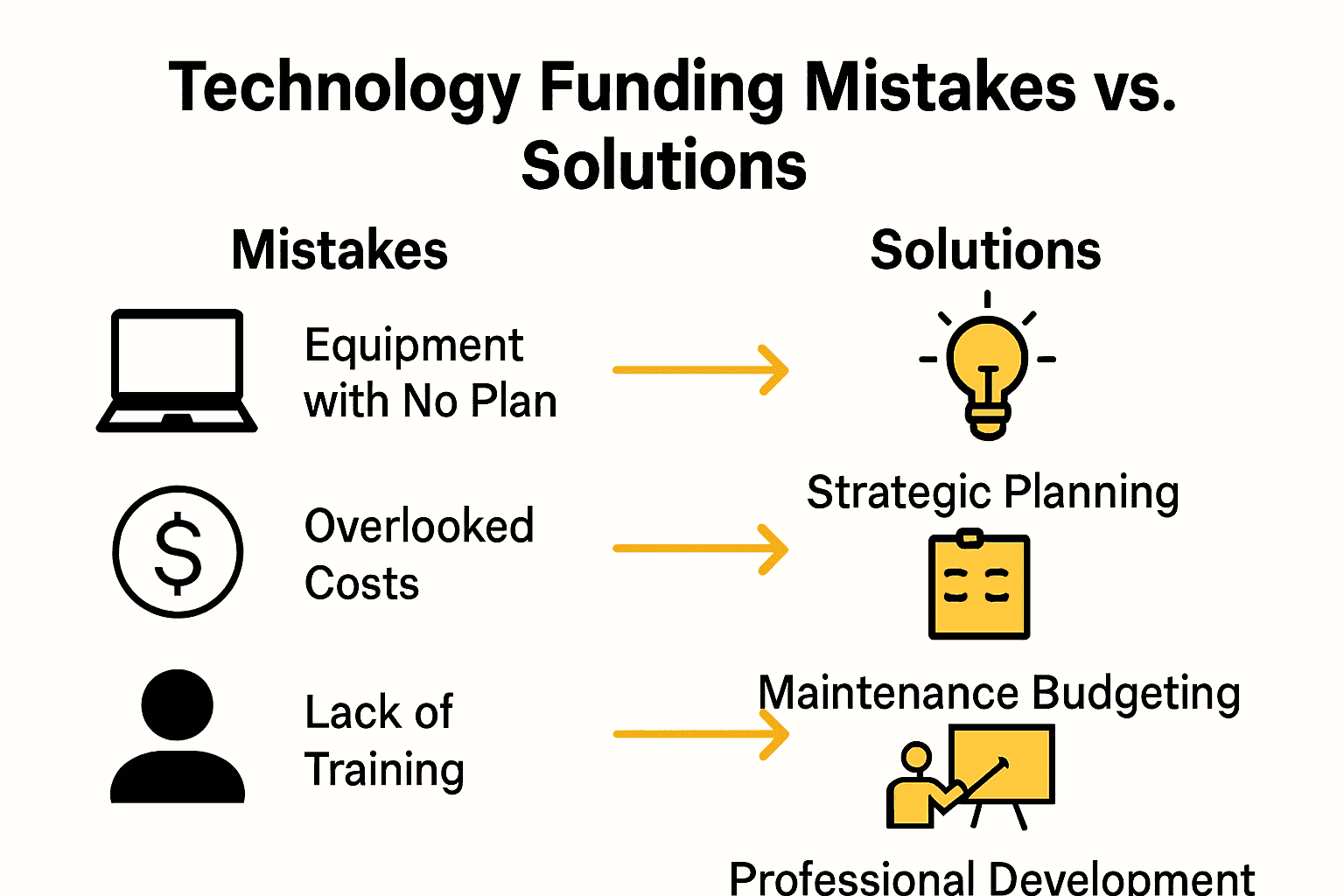
Technology funding strategies can quickly unravel when schools fail to anticipate potential pitfalls in their implementation approach. Recognizing and proactively addressing common mistakes is crucial for ensuring successful technological investments and maximizing educational outcomes.
Fortune highlights several critical errors that educational institutions frequently encounter in technology funding initiatives. These mistakes often stem from short-sighted planning and inadequate comprehensive assessment of technological needs:
- Purchasing technology without clear implementation strategy
- Underestimating ongoing maintenance and training costs
- Failing to involve educators in technology selection processes
- Neglecting long-term scalability and compatibility
- Overlooking cybersecurity and data protection requirements
National Center for Education Statistics recommends addressing these challenges through:
- Comprehensive needs assessment before technology acquisition
- Developing robust professional development programs
- Creating flexible technology integration plans
- Establishing clear performance measurement metrics
- Building sustainable budget allocation strategies
Successful technology funding requires a holistic approach that goes beyond mere equipment procurement. Schools must view technological investments as comprehensive ecosystem transformations, demanding strategic planning, continuous evaluation, and adaptive implementation methodologies.
Empower Your School's Digital Future with Reliable Projection Solutions
Navigating the complexities of technology funding can feel overwhelming, especially when every dollar counts toward creating an effective learning environment. The challenge of managing budgets, planning for long-term sustainability, and ensuring technology integration aligns with educational goals is real. Schools need equipment that is dependable, easy to implement, and scalable to support evolving pedagogical demands. At ProjectorDisplay.com, we understand these pain points and offer a wide range of high-quality projectors and interactive displays designed to empower educators and students alike. Whether you are upgrading your classroom AV systems or investing in interactive technology, our solutions are built to maximize educational outcomes while fitting within your funding parameters.

Discover how our selection of projectors with features like wireless connectivity and full HD resolution can complement your school's technology funding strategy. Act now to take advantage of fast shipping within Peninsular Malaysia and expert customer support ready to help you find the best fit for your institution. Explore more at ProjectorDisplay.com and start transforming your classroom experience today.
Learn more about integrating advanced display solutions by visiting our landing page.
Frequently Asked Questions
What is technology funding for schools?
Technology funding for schools refers to investments aimed at enhancing educational infrastructure through the integration of digital resources and technologies. It encompasses funding for hardware, software, network upgrades, and educator training with the goal of improving student outcomes.
What are the main sources of technology funding for educational institutions?
Main sources of technology funding for schools include government grants, private sector partnerships, educational foundation grants, internal school budget allocations, and community fundraising efforts.
What are the key components to include in a technology funding application?
When applying for technology funding, essential components include a comprehensive needs assessment, a detailed implementation roadmap, a budget breakdown, expected outcomes, and metrics for measuring success in technology integration.
What common mistakes should schools avoid when seeking technology funding?
Common mistakes in seeking technology funding include purchasing technology without a clear implementation strategy, underestimating ongoing costs, neglecting educator involvement, and overlooking cybersecurity requirements. Addressing these issues can lead to more successful technology integration.
Recommended
- Technology for Special Education: Complete Guide – Projector Display
- 21st Century Teaching Skills: Everything You Need to Know – Projector Display
- 7 Key EdTech Trends in 2025 for Malaysian Innovators – Projector Display
- Tech for Small Businesses: Complete Guide for 2025 – Projector Display
- STEM Grant Opportunities for Classroom Lab Supplies – Shop Genomics
- Understanding Virtual School Programs: A Comprehensive Guide – Scheer Genius Assembly Shows