
TL;DR:
- Battery life estimates often assume ideal conditions, which differ significantly from real-world Malaysian environments.
- Using eco mode, lowering brightness, and managing accessories can extend projector runtime, but environmental factors greatly influence actual performance.
Buying a portable projector because you want wireless, cable-free freedom is exciting until the battery dies in the middle of a presentation or at the 90-minute mark of a two-hour movie. Most buyers assume the number printed on the box is what they'll actually get, but battery life is rarely consistent across all brightness settings and use cases. Whether you're hosting a backyard movie night in Petaling Jaya, running a training session in a rural classroom, or pitching to clients in a KL boardroom, this guide gives you the real picture on portable projector battery life and exactly how to stretch it.
Table of Contents
- Understanding portable projector battery life: What really affects it?
- Eco mode vs. max brightness: Tradeoffs for longer sessions
- Choosing the best portable projector for runtime: Model and accessory strategies
- Battery life in special situations: Community events, training, and off-grid use
- Expert strategies for maximizing your portable projector's battery
- Why battery specs don't tell the whole story: Practical lessons for Malaysians
- Get the most out of your portable projector with the right accessories and expert guidance
- Frequently asked questions
Key Takeaways
| Point | Details |
|---|---|
| Actual runtimes vary greatly | True battery life depends on usage, with eco mode delivering longer sessions than max brightness. |
| Accessory options double duration | Battery base stands and external power packs can roughly double how long your projector runs unplugged. |
| Eco mode is your friend | Dimming brightness and using eco mode greatly extends portable projector battery performance. |
| Plan for the session length | Match the projector or accessories to your typical session time—especially important for events and classrooms. |
| Buy for your real-world needs | Specs don't tell the whole story—consider climate, usage style, and power options for best results. |
Understanding portable projector battery life: What really affects it?
To understand how to choose or optimize a portable projector, let's demystify the factors behind battery claims.
Marketing specs for battery life are almost always measured in the most favorable conditions possible. That usually means eco mode, minimum brightness, no Bluetooth speaker output, and a cool ambient temperature. Real-world use in Malaysia, where rooms can be warm and you need higher brightness to compete with ambient light, looks very different.
Key factors that reduce battery runtime:
- Brightness level: The single biggest drain on any projector battery. Pushing from eco mode to maximum brightness can cut runtime by 30% to 50%.
- Room temperature: Heat speeds up battery discharge. A stuffy meeting room or an outdoor event at midday in Malaysia will drain your battery faster than an air-conditioned space.
- Connected accessories: Running Bluetooth audio, Wi-Fi streaming, or USB devices all draw from the same battery.
- Content type: Bright, white-heavy content like slideshows demands more light output than dark movie scenes, so battery drains faster during a presentation than during a thriller movie.
- Speaker volume: Built-in speakers use power. Louder audio means shorter runtime.
Here's a quick look at how battery life varies across popular models:
| Model | Rated battery life | Eco mode | Max brightness mode |
|---|---|---|---|
| Xgimi MoGo 4 Laser | 2.5 hours in Eco | 2.5 hrs | ~1.5 hrs |
| Anker Nebula Mars 3 Air | 2.5 hours rated | ~2.5 hrs | ~1.2 hrs |
| Samsung Freestyle | 3 hours (with battery base) | ~3 hrs | ~2 hrs |
| Pocket projectors | 1 to 1.5 hours typical | ~1.5 hrs | Under 1 hr |
Portable projectors offer real advantages for Malaysian users who need flexibility, but understanding battery behavior before you buy prevents buyer's remorse. The battery runtime typically sits around 2 hours for most mid-range models, with higher brightness dropping that number fast.
Pro Tip: Always check whether the battery life figure in a product listing is measured in eco mode or standard mode. If it says eco mode, expect noticeably shorter runtime at the settings you'll actually use.
Eco mode vs. max brightness: Tradeoffs for longer sessions
Once you know what drains projector batteries, it's crucial to see how usage modes turn theory into practice.
Eco mode reduces the laser or LED light source output to its minimum functional level. This means less heat generated, less power drawn from the battery, and a longer runtime. The tradeoff is a dimmer image. In a dark room like a closed bedroom or a cinema-style home theater, this is usually fine. In a brighter room like a typical Malaysian office or classroom with windows, it may not cut it.
The Anker Nebula Mars 3 Air runtime drops sharply at maximum brightness, which mirrors what happens across the entire portable projector category. The principle is consistent: more lumens means more power consumption.
A comparison between the Xgimi Vibe One and Xgimi MoGo 4 illustrates this clearly. Both have built-in batteries, but as What Hi-Fi notes, the battery life in eco mode comes with the cost of reduced brightness, making them best suited for controlled lighting environments.
How to get more runtime out of your projector in 5 practical steps:
- Switch to eco or power-saving mode first. Access this through your projector's brightness or picture settings. Most modern projectors make this a one-button toggle.
- Lower the volume. Built-in speakers consume a surprising amount of power. Connect an external Bluetooth speaker only when necessary, or lower the built-in volume to 50% or below.
- Disable Wi-Fi when using offline content. Streaming over Wi-Fi keeps the wireless chip active and drawing battery. If your content is already downloaded, switch to offline mode.
- Use a darker screen background for presentations. Dark-mode slides or dashboards reduce the brightness demand from the light source. Google Slides and PowerPoint both support dark themes.
- Keep ventilation clear. Blocked vents mean heat buildup, which triggers the internal fan and increases power draw. Always place your projector on a flat, open surface.
"Eco mode is not a compromise for casual users. In most Malaysian home settings with good blackout curtains, eco mode at 300 to 400 lumens produces a perfectly watchable image while extending your session significantly."
For business projector situations like client pitches or product demos, you'll often need at least standard mode to project clearly in a lit room. Plan for shorter runtime and have a power source on standby.
Pro Tip: If you're projecting in a dim boardroom or classroom, test eco mode first. You may be pleasantly surprised that it's bright enough, and you'll buy yourself an extra 30 to 60 minutes of runtime.
Choosing the best portable projector for runtime: Model and accessory strategies
With a grasp of eco mode and brightness tradeoffs, you can now focus on choosing the ideal model and setup for your needs.
Not all portable projectors are created equal when it comes to battery capacity. Some pack a large internal cell. Others rely on external accessories to deliver extended runtime. Knowing the difference before you buy is critical.
Models worth shortlisting for battery longevity:
- Xgimi MoGo 4 Laser: Rated at 2.5 hours in Eco mode on its internal battery. Add the optional PowerBase stand and total battery time doubles to 5 hours, making it genuinely capable of back-to-back movie nights or full-day training sessions.
- Xgimi MoGo 3 Pro: Designed for up to 2.5 hours with an external PowerBase stand connected via USB Type-C. This model is a strong pick for users who want a lightweight daily driver with an expandable battery ecosystem.
- Samsung Freestyle: Pairs with a dedicated battery base that extends runtime considerably, making it one of the more practical long-session options in a premium form factor.
Where pocket projectors fall short:
Ultra-compact pocket projectors are tempting because of their size and price. But pocket projectors typically run only 1 to 1.5 hours on a single charge. For a quick 20-minute demo or a short clip during a workshop break, that's fine. For a full movie or a 90-minute lecture, it's not enough unless you have a power outlet nearby.
Accessory strategies for extending runtime:
- PowerBase stands: Designed specifically for projectors, they clip onto the bottom or connect via USB-C and add a second full battery. They're heavier, but for users who need 4 to 5 hours, they're worth the trade.
- High-capacity USB-C power banks: A 20,000 mAh or larger power bank can power many portable projectors while they run. Check that your projector supports USB-C power input and confirm the bank's output wattage matches the projector's requirement.
- Portable power stations: For off-grid events, a compact power station in the 200 to 500Wh range powers projectors and other devices for hours without needing a wall outlet.
For teachers and educators, our projector comparison for teachers covers models that balance battery life with classroom-appropriate brightness and reliability.
Battery life in special situations: Community events, training, and off-grid use
For many users in Malaysia, portable projectors also have to perform in academic or off-grid environments. Here's what to consider.
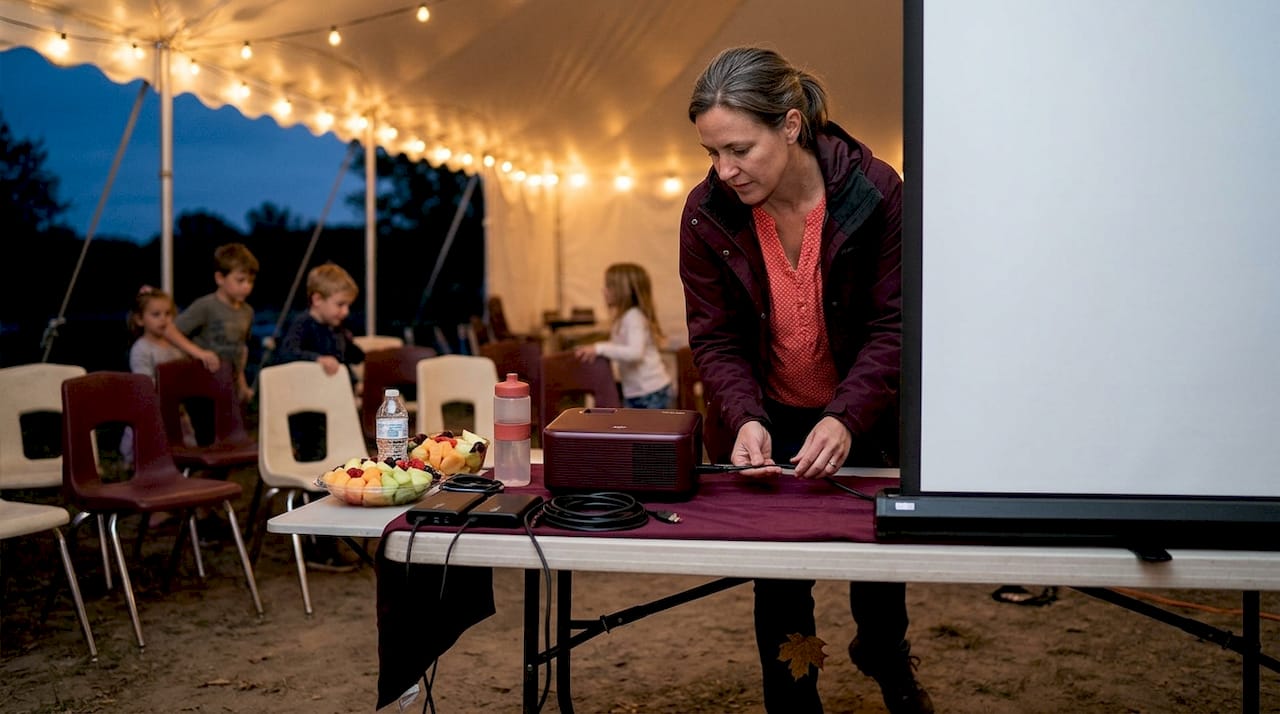
Malaysia has a wide geography. Community halls in rural Sabah, outdoor community movie nights in Kelantan, and farmer training sessions in remote Kedah all share one challenge: electricity access is not guaranteed. This is where battery projectors move from a convenience feature to a mission-critical requirement.
Research from Frontiers highlights that battery-powered projectors for off-grid video training represent a meaningful solution for overcoming barriers related to electricity supply and internet connectivity in rural and remote settings. This applies directly to NGO fieldwork, agricultural extension programs, and mobile teaching units across Malaysia.
Practical tips for reliable off-grid projection:
- Pre-charge fully before every session. Sounds obvious, but many users forget this step when rushing to a venue. Charge to 100% the night before, not on the morning of.
- Bring a backup power source. A small off-grid battery capacity system or a portable power station ensures you have a fallback if the main battery runs low.
- Limit auto-brightness and auto-focus cycling. Both features activate motors and sensors continuously, which drains the battery faster than expected during long sessions.
- Use a wired connection instead of Wi-Fi where possible. A direct HDMI or USB-C connection from a laptop or phone reduces wireless drain significantly.
- Schedule buffer time. If your content runs 90 minutes, make sure your battery can support at least 2 hours. Always add 25% buffer time to your battery calculation.
"The projector that works fine in a KL office may not survive a two-hour farmer training session in a village with no electricity. Battery capacity and backup power planning are not optional for field deployments."
Community event organizers should also factor in audience size and ambient light. Bigger crowds usually mean louder speaker volume and brighter settings, both of which push battery consumption up.
Expert strategies for maximizing your portable projector's battery
No matter where or how you use your projector, these proven strategies will help you avoid running out of battery at the worst time.
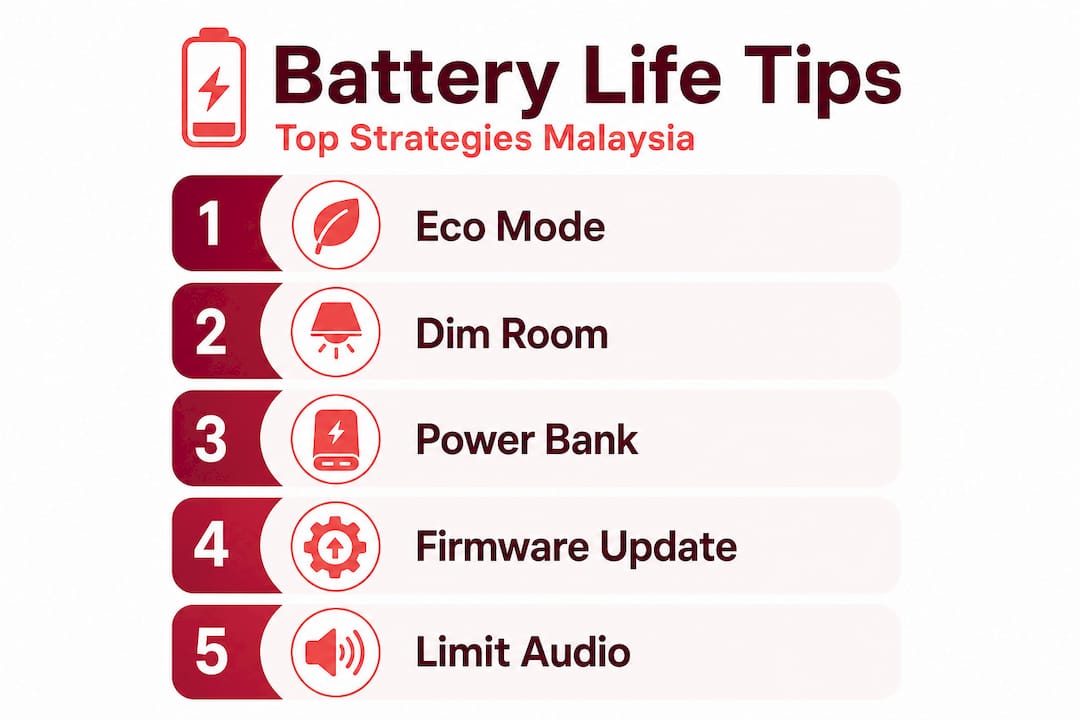
Battery drain is not just about hardware. How you manage the projector matters just as much as the model you buy. Battery-powered portable projectors have limited runtime compared to plugged-in units, and brightness remains the primary lever you can control.
Ten strategies to stretch your projector battery:
- Update firmware regularly. Manufacturers push efficiency improvements through firmware updates. An outdated device may be running less efficiently than the current version allows.
- Reduce screen resolution if the projector supports scaling. Outputting at 720p instead of 1080p on a small screen reduces processing load.
- Turn off unused ports. HDMI passthrough, USB charging ports, and audio output jacks can all draw power even when idle.
- Use content with darker color profiles. Neutral or muted tones require less light output than bright white or saturated content.
- Avoid pausing for long periods. Many projectors keep the light source at full power during pauses. Use the AV mute button or standby mode instead.
- Store at 50 to 60% charge when not in use. Lithium batteries degrade faster when stored fully charged or fully depleted. This matters more for long-term battery health.
- Let the projector cool before storing. Storing a hot projector accelerates cell degradation. Give it five minutes to cool after use.
- Avoid deep discharges. Running the battery to zero regularly damages the cells. Recharge before it hits 15%.
- Keep the lens and vents clean. A clean projector runs cooler and more efficiently, reducing the thermal load on the battery.
- Invest in an external battery when sessions exceed two hours. For business presentations or events that run long, a quality power bank or PowerBase is not an accessory. It's a necessity.
Pro Tip: Set a calendar reminder every three months to check firmware updates for your projector. This one habit can extend both battery runtime and overall device longevity without spending a cent.
Why battery specs don't tell the whole story: Practical lessons for Malaysians
Here's an honest take that most online guides skip entirely: battery ratings are marketing tools, not operational guarantees. When a brand says "2.5 hours," they mean 2.5 hours under the ideal conditions their testing team used. Your conditions almost certainly differ.
In Malaysia, the challenge is layered. You're often dealing with warm rooms, mixed ambient light, and situations where you can't control the environment. A corporate trainer traveling between KL, Penang, and Johor Bahru faces different rooms every session. A lecturer at a rural college has no guarantee of a wall outlet. A family hosting a backyard film screening wants to watch the whole movie without watching the battery indicator more than the screen.
On-paper battery ratings at higher brightness are consistently optimistic. This isn't unique to one brand. It's an industry-wide pattern that affects every buyer who doesn't read the fine print.
What truly matters is your typical session length and your ability to control ambient light. A 2.5-hour rating in eco mode is genuinely useful if your sessions run 90 minutes in a dark room. It's completely inadequate if you're presenting for two hours in a bright seminar hall.
The savvy move is to treat battery life as a baseline, not a ceiling. Plan your accessories, your charging habits, and your room setup around a realistic number, not the box number. Buyers who look at bundle solutions, like a strong projector paired with a PowerBase or a quality power station, consistently get more value than those who chase peak runtime figures. If you're shopping for deals that bundle accessories with projectors, our current sale page is a good place to start.
Get the most out of your portable projector with the right accessories and expert guidance
Making your portable projector perform at its best in Malaysia isn't just about the projector itself. It's about the entire ecosystem around it.
At ProjectorDisplay.com, we stock a full range of must-have projector accessories including battery bases, power banks certified for projector use, and storage solutions that protect your investment between sessions. Whether you need a powerful battery base for your Samsung Freestyle or want to explore which model suits your exact use case, our team is here to help. As the top projector seller in Malaysia, we offer fast shipping across Peninsular Malaysia, WhatsApp support, and product advice tailored to your specific needs. Reach out before your next event or purchase so you're never caught with a dead battery when it matters most.
Frequently asked questions
How can I make my portable projector last for a full movie?
Use eco mode, reduce brightness to the minimum watchable level, and connect a PowerBase or power bank for sessions beyond two hours. As eco mode and external battery stands can double your runtime, this combination is the most reliable approach.
Why does my projector's battery die faster at high brightness?
Higher brightness forces the light source to draw significantly more power from the battery. Max brightness sharply reduces runtime compared to eco mode, sometimes cutting it nearly in half.
Are pocket projectors good for long presentations?
Generally, no. Pocket projectors typically run 1 to 1.5 hours on battery, making them practical only for short demos or when a power outlet is nearby.
Do all portable projectors have built-in batteries?
No. Some models labeled as "portable" require an external PowerBase or power bank for battery operation. For example, some models need a PowerBase stand to operate untethered, so always verify before purchasing.
How important is battery life for outdoor or community events?
It's critical. Battery-powered projectors overcome electricity barriers in off-grid environments, but reliable backup power planning is essential for any session longer than the projector's rated runtime.
Recommended
- Top portable projector advantages for Malaysians: home & biz – Projector Display
- Top travel-friendly projector ideas for on-the-go Malaysians – Projector Display
- Essential guide to using projectors outdoors in Malaysia – Projector Display
- Projector Lamp Lifetime: What Malaysians Need to Know in 2025 – Projector Display