
TL;DR:
- Projectors are experiencing significant growth due to new laser, LED, and interactive technologies.
- Modern projectors solve traditional issues like ambient light sensitivity and maintenance costs.
- Both projectors and flat panels will coexist, each suited for different classroom environments.
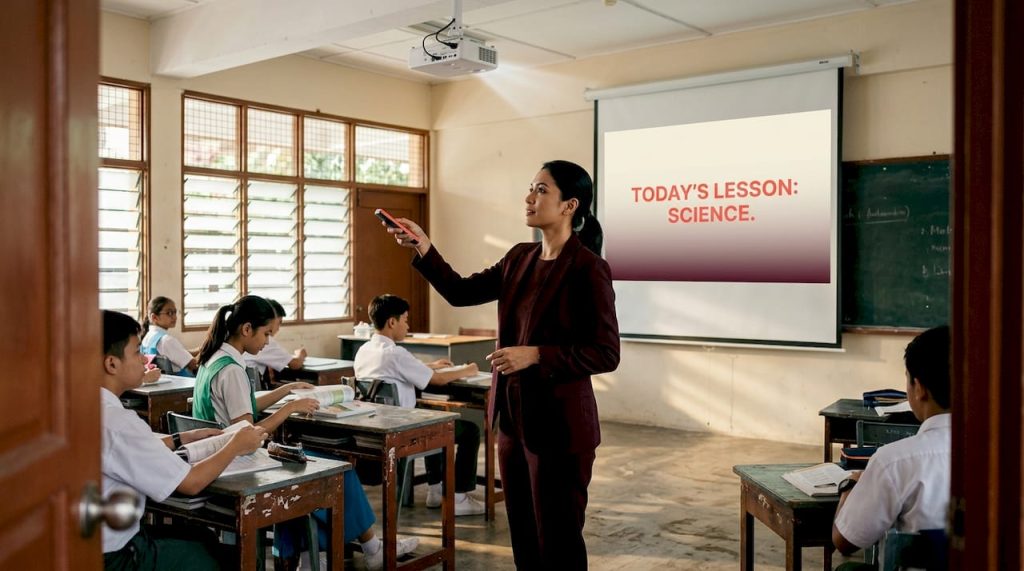
Educators across Malaysia have long thought of projectors as simple display tools, something you plug in, point at a wall, and talk over. That assumption is now dangerously outdated. The education projector market was valued at USD 11.34 billion in 2025 and is expected to reach USD 24.3 billion by 2033, growing at nearly 10% annually. That kind of growth does not happen when a technology is fading. It happens when something is fundamentally changing, and Malaysian educators who understand that shift will be far better positioned to make the most of it.
Table of Contents
- Why projectors still matter in modern classrooms
- Next-gen technologies: How projectors are evolving
- Interactive and hybrid projectors: The next frontier
- Projectors vs. interactive displays: Which fits your classroom?
- Why projectors remain crucial for Malaysian education's future
- Explore the latest projectors and classroom solutions
- Frequently asked questions
Key Takeaways
| Point | Details |
|---|---|
| Market growth is strong | The education projector market is rapidly expanding due to technological innovation and classroom needs. |
| Laser/LED improve reliability | Modern projectors with laser or LED light sources last longer and require less maintenance than traditional models. |
| Interactivity boosts engagement | Hybrid projectors with interactive features and AI enhance student participation and learning outcomes. |
| Projectors remain cost-effective | For large or flexible spaces, projectors continue to provide great value compared to other tech. |
| Choose tech by classroom | Select projectors or flat panels based on room size, budget, and teaching style for optimal results. |
Why projectors still matter in modern classrooms
Before exploring what projectors are becoming, it is worth being clear about why they remain relevant right now. Many schools in Malaysia, particularly those outside major urban centers like Kuala Lumpur or Penang, operate on tight budgets with large classrooms that need to serve 30 to 40 students at once. In those settings, projectors offer something that almost no other technology can match: a genuinely large image at a fraction of the cost of an equivalent flat-panel display.
Consider a 100-inch projected image. A projector capable of producing it costs a fraction of what a 100-inch commercial LED display would. For schools managing multiple classrooms across a limited annual procurement budget, that cost difference is not a minor detail. It is often the deciding factor.
The strengths of projectors in educational settings are real and specific:
- Large image size for auditoriums, lecture halls, and standard classrooms
- Lower upfront cost compared to similarly sized flat-panel alternatives
- Portability for schools that share equipment across rooms
- Flexible throw distance allowing installation in varied room sizes
However, projectors excel in large-image scenarios at lower upfront cost, but they also suffer from ambient light issues, bulb replacements, and calibration needs. These are real problems that every Malaysian teacher who has used an older lamp-based projector will recognize. A classroom with windows on two sides can wash out a dim projector completely. A burned-out bulb mid-lesson creates immediate disruption. Calibration drift means text sometimes appears blurry or offset over time.
"The projector is only as good as the environment it operates in. Schools that ignore ambient light, screen placement, and maintenance schedules are not failing technology. They are failing planning."
Understanding these limitations is the starting point for understanding why the new generation of projectors is such a significant step forward. The good news is that learning with projectors in Malaysia is already well-documented, and the innovations arriving now are directly targeted at solving these exact pain points.
Next-gen technologies: How projectors are evolving
Recognizing both the value and issues with projectors, we can now look at the leap in technology that is driving their renewed relevance. Three specific innovations are reshaping what projectors can do in a Malaysian classroom: short-throw and ultra-short-throw (UST) designs, laser light sources, and LED illumination.
Short-throw and ultra-short-throw projectors address one of the oldest frustrations in classroom use, which is the space between the projector and the screen. A traditional projector needs to sit several meters from the wall to produce a large image. That means cables running across a room, a risk of someone walking through the light beam, and limited flexibility in furniture arrangement. A short-throw projector can produce a 100-inch image from roughly one meter away. An ultra-short-throw model can do the same from just centimeters away, sitting on a shelf directly below the projection surface. For smaller Malaysian classrooms, this is a practical game changer.
Laser and LED light sources address the bulb problem directly. Short-throw and ultra-short-throw projectors have grown popular for space-saving and interaction, and laser and LED light sources now reduce maintenance compared to traditional lamp-based models. A standard lamp-based projector might need a new bulb every 3,000 to 5,000 hours. A laser projector typically operates for 20,000 hours or more before any significant brightness drop. At eight hours of school use per day, that is roughly 6.8 years of continuous daily use, without a single bulb replacement.
Here is a side-by-side look at how these light source types compare:
| Feature | Lamp-based | LED | Laser |
|---|---|---|---|
| Lifespan | 3,000 to 5,000 hours | 20,000 to 30,000 hours | 20,000 to 30,000 hours |
| Maintenance cost | High (bulb replacement) | Very low | Very low |
| Brightness (lumens) | High initially | Moderate | Very high |
| Color accuracy | Good | Very good | Excellent |
| Warm-up time | 30 to 60 seconds | Instant | Near-instant |
| Upfront cost | Lower | Moderate | Higher |
For Malaysian schools doing a long-term cost analysis, the math often favors laser or LED once you factor in the avoided maintenance costs and the reduced risk of mid-class disruptions. Our detailed LED vs laser projector guide walks through that comparison with specific scenarios to help school administrators make the call confidently.
Beyond cost and lifespan, laser projectors offer brighter, more consistent images that hold up better in ambient light. That directly addresses the window-glare problem that frustrates teachers in naturally lit classrooms. If you want a deeper look at why this matters specifically for educational and home use, the laser projector benefits breakdown covers it thoroughly.
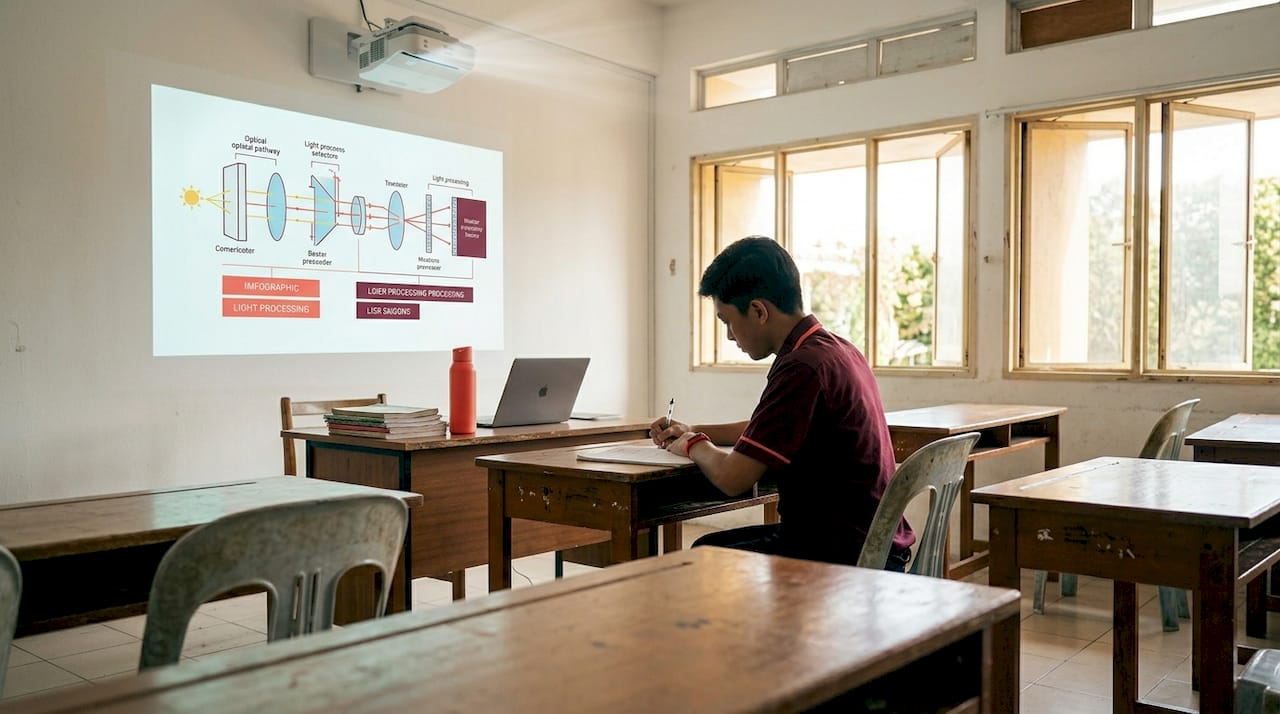
Pro Tip: When evaluating projectors for a Malaysian classroom with natural light, always check the ANSI lumens rating rather than the peak lumens figure. Manufacturers sometimes advertise peak brightness under ideal conditions, but ANSI lumens reflect real-world performance. For a typical classroom, aim for at least 3,500 ANSI lumens to compensate for ambient light.
For schools that want a concise summary of what laser technology brings, reviewing the full list of laser projector advantages will reinforce why the upfront investment is increasingly justified.
Interactive and hybrid projectors: The next frontier
As core projector technology evolves, even greater changes are arriving through interactivity and hybrid features bridging the gap between traditional and digital learning. An interactive projector is not just a display device. It turns any surface into a touchscreen or drawing board, allowing teachers and students to annotate, move objects, and collaborate directly on the projected image.
Here is how the technology typically works in practice:
- The projector casts an image onto a wall or dedicated screen surface.
- An infrared or camera-based sensing layer detects touch, stylus input, or hand gestures.
- The detected input is translated into on-screen actions, just like a touchscreen tablet but at wall scale.
- Multiple students can interact simultaneously, enabling group problem-solving exercises.
- Sessions can be recorded, screenshots saved, and lessons revisited later.
This kind of hands-on engagement has measurable outcomes. Students who physically interact with learning content, rather than passively watching, tend to retain information more effectively. For Malaysian educators trying to shift away from rote-learning approaches, interactive projectors offer a practical bridge.
| Classroom type | Best interactive solution | Reason |
|---|---|---|
| Large lecture hall (60+ students) | Interactive UST laser projector | Wide coverage, no touch needed, gesture works at distance |
| Standard classroom (30 to 40 students) | Short-throw interactive projector | Close installation, stylus/touch enabled |
| Seminar room (under 20 students) | Interactive flat panel | High reliability, direct touch |
| Multipurpose hall | Portable laser projector | Flexible placement, movable between rooms |
The broader digital education trends globally point clearly toward more active, student-driven learning environments. Interactive projection fits naturally into that direction. It is worth noting, however, that the technology still requires thoughtful implementation. Simply installing an interactive projector does not automatically make lessons more engaging. Teachers need training and lesson design support to leverage these tools effectively.
"Technology does not improve teaching. Teachers who understand technology improve teaching. The projector is a tool, not a curriculum."
The market trajectory supports this direction clearly. Hybrid projection with interactive features such as gesture and AI integration is gaining strong ground in developing markets like Malaysia and Southeast Asia. At the same time, flat panels are increasingly dominant for smaller, interactive classroom settings because of their reliability and image consistency. Both technologies have a role, and the choice depends on the specific classroom context.
For schools ready to explore this category, the Epson EB-760Wi is a strong example of an interactive UST laser projector with 4,100 lumens. The ViewSonic LS510WE is another compelling LED short-throw option worth considering for standard classroom setups.
Projectors vs. interactive displays: Which fits your classroom?
With new possibilities available, it is important for educators to assess when each solution fits their environment best. Both projectors and interactive flat panels have genuine strengths, and the honest answer is that neither technology wins in every context.
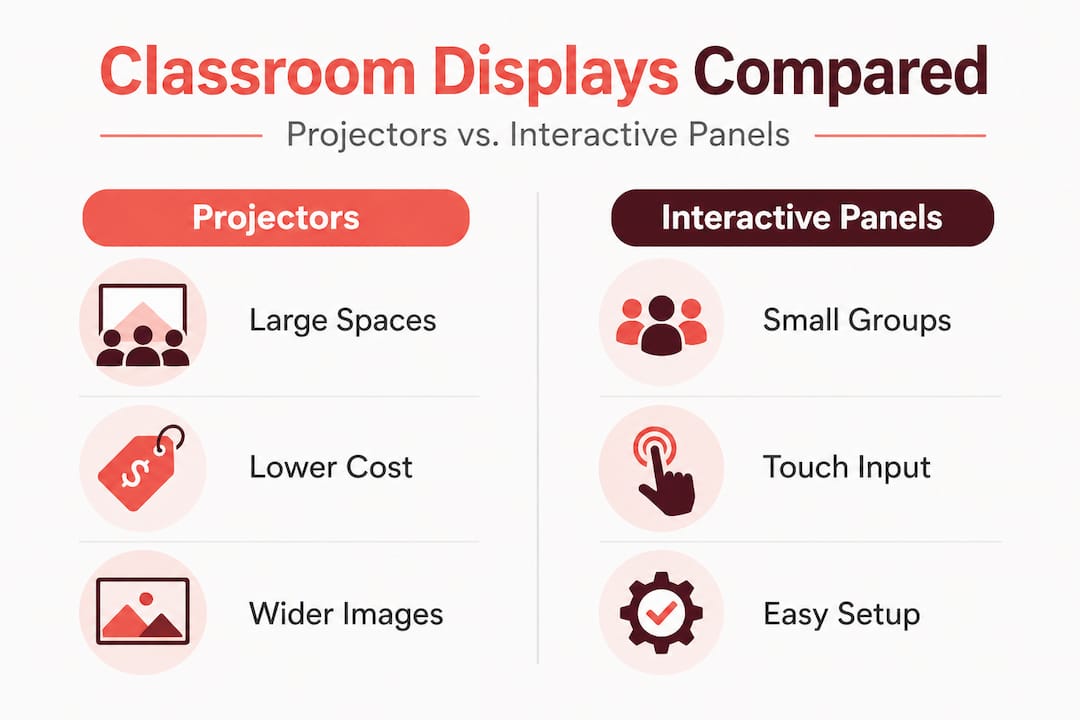
Projectors remain the better choice for large image sizes in auditoriums and lecture halls at a lower upfront cost, while flat panels win on reliability and consistent brightness in smaller rooms. This split is not a temporary situation. It reflects a genuine difference in what each technology does well.
| Factor | Projector | Interactive flat panel |
|---|---|---|
| Image size | Up to 300 inches+ | Typically 65 to 110 inches |
| Upfront cost | Lower for large images | Higher at equivalent sizes |
| Brightness in ambient light | Varies (laser models perform well) | Consistent regardless of lighting |
| Maintenance | Low (laser/LED) to moderate (lamp) | Very low |
| Interactivity | Available in UST/interactive models | Standard across most panels |
| Portability | High (especially portable models) | Low to none |
| Installation flexibility | High | Limited by screen size and mounting |
Choosing between them requires thinking about your actual classroom conditions, not ideal conditions. If your school has:
- Large rooms or auditoriums with distances over 5 meters: projectors win clearly
- Controlled lighting with smaller groups: flat panels offer a more reliable experience
- Multiple rooms sharing one display device: portability makes projectors the practical choice
- A limited budget scaling across many rooms: projectors provide more display area per ringgit spent
Interactive flat panels like the ViewSonic IFP6552 are excellent in seminar and small-group settings. For larger rooms where brightness and throw distance matter more, a short-throw laser projector like the ViewSonic LS921WU at 6,000 ANSI lumens handles the challenge with authority.
The future leans toward hybrid approaches where schools use projectors for large shared spaces and flat panels for smaller learning pods or breakout rooms. Malaysian schools planning infrastructure upgrades now should build that flexibility into their procurement strategy.
Pro Tip: If you manage multiple classrooms and want a unified platform, choose projectors and flat panels from the same brand ecosystem where possible. This simplifies training, software compatibility, and technical support, which matters a lot in schools with limited IT staff.
Why projectors remain crucial for Malaysian education's future
There is a narrative circulating in education technology circles that flat panels are the future and projectors are fading. We think that story is too simple, and frankly, it ignores the reality of how most Malaysian schools actually operate.
Walk into a school in Kelantan, Sabah, or rural Perak. The classrooms are not always climate-controlled, the budgets are not always generous, and the infrastructure is often shared across many grades. In those environments, the flexibility of a projector, its ability to fill a large surface in a wide variety of room shapes, its relatively low cost, and its portability across shared spaces, makes it a more practical solution than any 86-inch panel mounted permanently to a wall.
The flat panel narrative is driven largely by urban, well-resourced schools and conference room logic. It is a valid context, but it is not the whole picture of Malaysian education.
What we consistently observe is that the most effective school technology strategies are not about choosing one technology and committing completely. They are about matching the right tool to the right environment. And in Malaysia's diverse educational landscape, that almost always means projectors play a significant continuing role.
The innovations in laser, LED, UST, and interactive projection are not stopgap measures keeping an old technology alive. They are genuine improvements that expand what projectors can do and where they can do it well. Schools that understand projector learning outcomes and build procurement decisions around real classroom data, rather than technology trends, will serve their students better.
The future of classroom display in Malaysia is not projectors or flat panels. It is projectors and flat panels, each in their appropriate place, supported by educators who know how to use them effectively.
Explore the latest projectors and classroom solutions
Ready to bring the next generation of classroom projection into your school? ProjectorDisplay.com carries the full range of solutions discussed in this article, from interactive UST laser projectors to LED short-throw models and interactive flat panels, all available with fast shipping across Peninsular Malaysia.
Browse educational projectors in Malaysia across every category, and use the detailed product specifications to match each model to your classroom's specific conditions. If you are still working through the laser versus LED decision, the LED vs laser projector options page gives you the side-by-side clarity you need. For schools planning a new installation, the projector installation guidance resource walks through every step from room assessment to final calibration. Our team is also available via WhatsApp for direct support on product selection and school procurement inquiries.
Frequently asked questions
What are the main benefits of laser and LED projectors for classrooms?
Laser and LED light sources significantly reduce maintenance requirements compared to lamp-based models and deliver more consistent brightness over time, making them a smart long-term investment for schools.
How do interactive projectors enhance student engagement?
Interactive UST laser projectors with gesture and AI integration allow students to physically engage with lesson content, shifting the classroom dynamic from passive viewing to active participation.
Are projectors still more cost-effective than flat panels for Malaysian schools?
Projectors excel at large-image delivery in auditoriums and lecture halls at a lower upfront cost than comparably sized flat panels, making them the more budget-friendly choice for large shared spaces.
What is the biggest challenge with projectors in classrooms?
Ambient light sensitivity, bulb replacements, and the need for periodic calibration are the most common issues, all of which are significantly reduced in modern laser and LED projector models.
Will projectors be replaced by other display technologies in the near future?
Flat panels dominate smaller, interactive classrooms for their reliability and consistent image quality, but projectors remain the superior and often only practical option for larger, flexible learning environments.
Recommended
- Best projectors for remote learning in Malaysian classrooms – Projector Display
- Why use projectors in education: boost learning outcomes – Projector Display
- Best Projector for Teachers 2025: Top Choices in Malaysia – Projector Display
- Faktor Penting Beli Projektor Pendidikan Malaysia – Projector Display